





























Complete Motion Constraints Worksheet | Grade 12 Physics
Paste this activity's link or code into your existing LMS (Google Classroom, Canvas, Teams, Schoology, Moodle, etc.).
Students can open and work on the activity right away, with no student login required.
You'll still be able to track student progress and results from your teacher account.
This advanced physics worksheet develops student mastery in constructing, evaluating, and reconciling kinematic curves under operational constraints. High school seniors analyze multi-stage motion profiles, calculate signed integral displacements, and derive piecewise position and velocity functions from synthetic engineering telemetry, preparing them for college-level mechanics and AP Physics exams.
At a Glance
- Grade: 12 · Subject: Physics
- Standard: Advanced Kinematics — Construct and analyze motion graphs satisfying multiple geometric and rate constraints
- Skill Focus: Constructing graphs with multiple motion constraints
- Format: 5 pages · 6 problems · Answer key included · PDF
- Best For: AP Physics and advanced kinematics practice
- Time: 60–90 minutes
What's Inside
The resource includes 5 student pages featuring 6 multi-part tasks, accompanied by a 4-page worked answer key. Students analyze velocity-time coordinate templates, piecewise equations, signed area integrals, and physical limits. Scaffolding includes explicit rate boundaries, synthetic telemetry datasets, and visual comparison plots for competing mathematical models.
Skill Progression
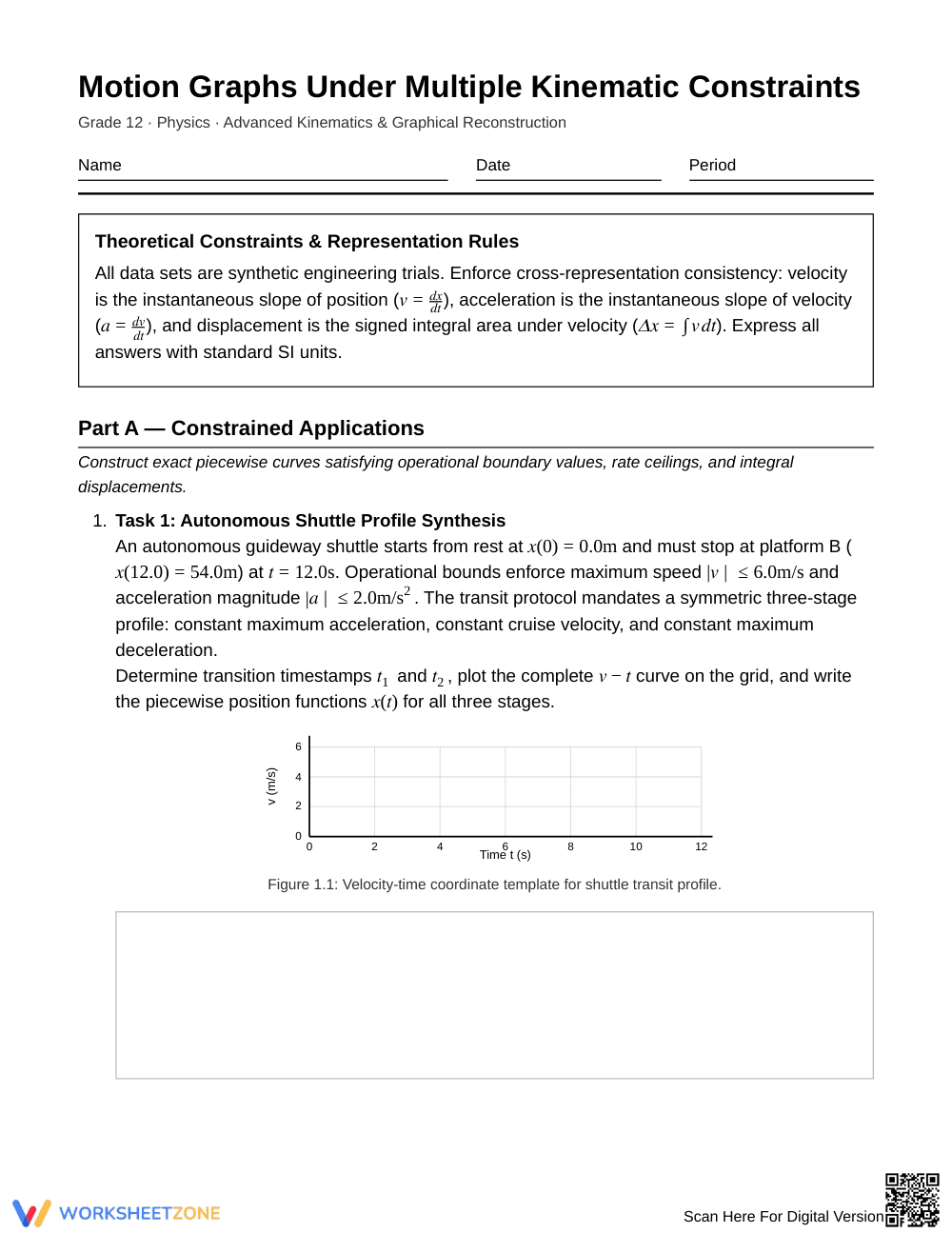
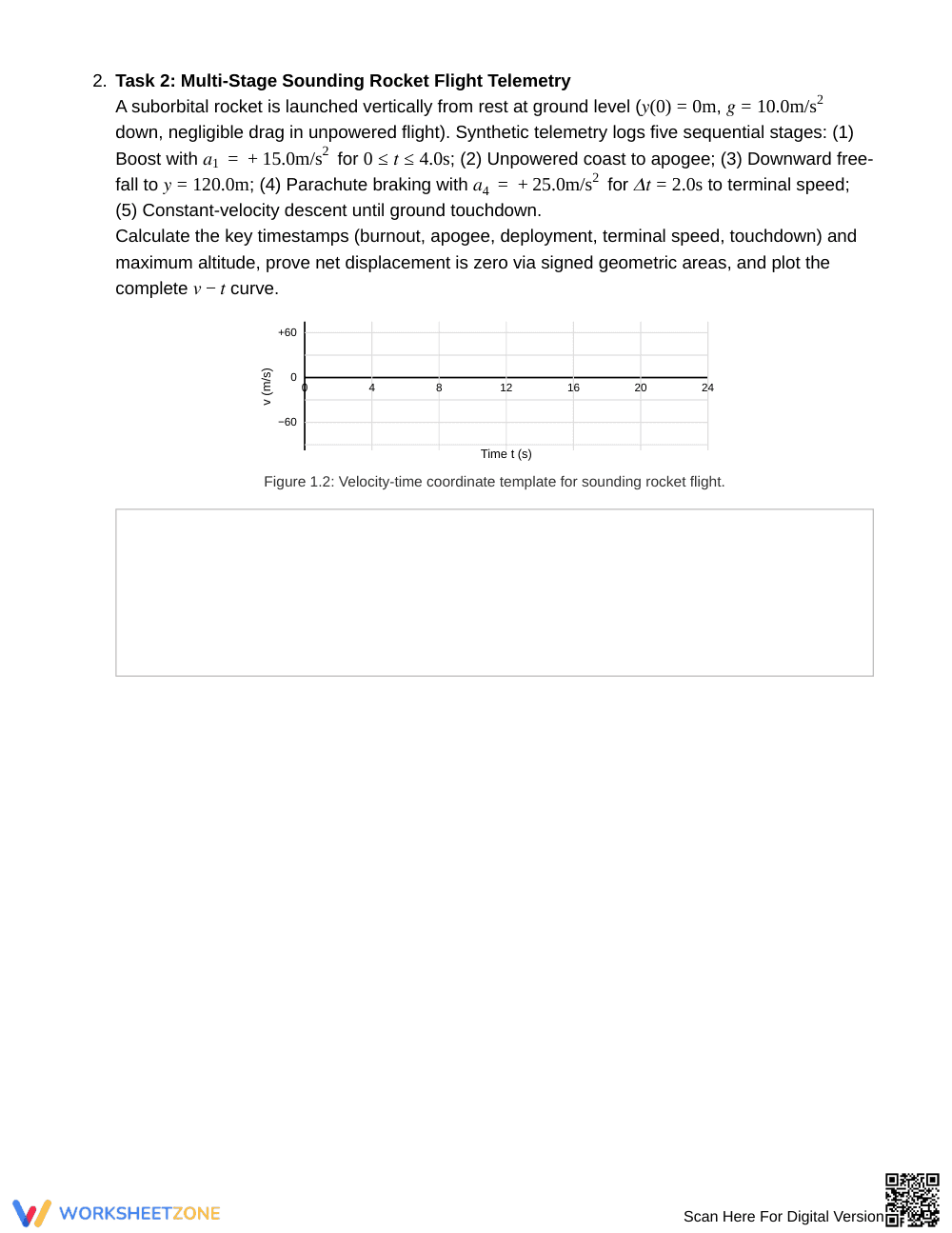
- Guided practice (Tasks 1–2): Reconstructing piecewise velocity-time curves for a shuttle and sounding rocket using boundary timestamps, acceleration limits, and coordinate grids.
- Supported practice (Tasks 3–5): Recovering hidden parameters via simultaneous integrals and evaluating competing braking models against optical telemetry and friction limits.
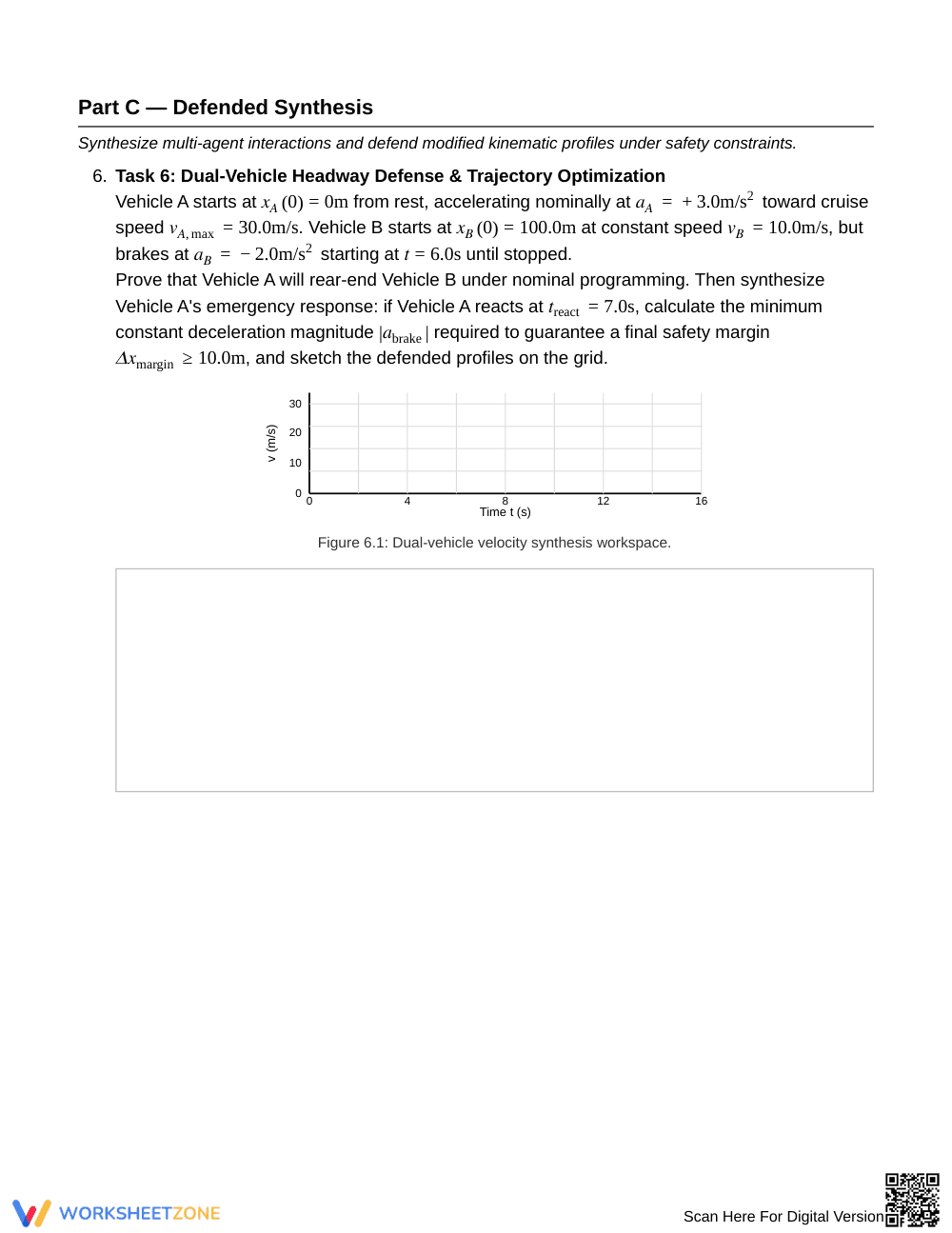
- Independent practice (Task 6): Performing trajectory optimization, calculating reaction-time braking, and plotting dual-vehicle headway curves under safety constraints.
This sequence follows a gradual-release model, moving students from guided piecewise graphing to autonomous kinematic synthesis.
Standards Alignment
This worksheet aligns with advanced high school physics standards for one-dimensional kinematics. Students synthesize relationships between position, velocity, and acceleration by applying integral calculus principles and instantaneous derivatives. Both standard codes can be copied directly into lesson plans, IEP goals, or district curriculum mapping tools.
How to Use It
Assign this worksheet after direct instruction on kinematic graphs and definite integrals. It functions effectively as a collaborative workshop across two class periods or an intensive problem set. During work, check whether students calculate displacement using geometric area rather than misapplying uniform acceleration formulas across piecewise boundaries. Expected completion time is 60 to 90 minutes.
Who It's For
This worksheet is designed for Grade 12 Physics, AP Physics 1, and AP Physics C students requiring rigorous practice connecting calculus with kinematics. For differentiation, provide reference formulas for geometric areas, or pair this activity with an interactive motion-sensor lab to connect synthetic telemetry with physical systems.
According to Fisher & Frey (2014), structured graphical reconstruction tasks that implement gradual-release instructional sequences significantly enhance conceptual mastery in complex secondary STEM disciplines. This Grade 12 physics resource operationalizes those research findings by guiding students through six rigorous kinematic modeling tasks centered on constructing motion graphs under multiple physical constraints. Learners systematically translate operational rate bounds, transition timestamps, and signed geometric integrals into consistent velocity-time and position-time representations. By confronting inverse parameter recovery and competing friction models, students bridge abstract algebraic manipulation with concrete physical boundary analysis. Research on scaffolded problem sets indicates that progressing from guided piecewise curve plotting to autonomous multi-vehicle trajectory optimization reinforces durable spatial reasoning and mathematical fluency. Educators can utilize this comprehensive five-page worksheet to diagnose graphical misconceptions and ensure high school seniors develop advanced analytical competence across kinematics units.


