


























Views
Downloads




Complete Molarity & Dilution Worksheet | Grade 11 Chemistry
Paste this activity's link or code into your existing LMS (Google Classroom, Canvas, Teams, Schoology, Moodle, etc.).
Students can open and work on the activity right away, with no student login required.
You'll still be able to track student progress and results from your teacher account.
Mastering molarity and dilution is essential for high school chemistry, connecting macroscopic laboratory solutions with molecular solute amounts. This worksheet provides structured practice calculating molar concentration, preparing dilutions from stock solutions, and analyzing ionic dissociation. Through clear calculation frameworks, Grade 11 learners develop fluency with solution stoichiometry and chemical problem solving.
At a Glance
- Grade: 11 · Subject: Chemistry
- Standard: Chemistry — Calculate aqueous solution concentration and stock dilution using solute moles and total solution volume
- Skill Focus: Molarity and Solution Dilution Calculations
- Format: 4 pages · 10 multi-part problems · Full answer key included · Printable PDF
- Best For: Quantitative solution chemistry practice, review, and lab preparation
- Time: 45–60 minutes
What's Inside
This 4-page resource includes 10 quantitative problems and a complete 2-page answer key showing step-by-step calculations. A built-in reference box supplies core formulas and molar masses for common solutes. Two guided practice models demonstrate mass-to-molarity and dilution calculations before students complete independent exercises and particulate-level conceptual reasoning.
Skill Progression
- Guided Practice: Two worked models demonstrate mass-to-molarity and stock dilution equations (M1V1 = M2V2).
- Supported Practice (Part A): Three scaffolded problems guide students through calculating moles, converting milliliters to liters, and finding molarity.
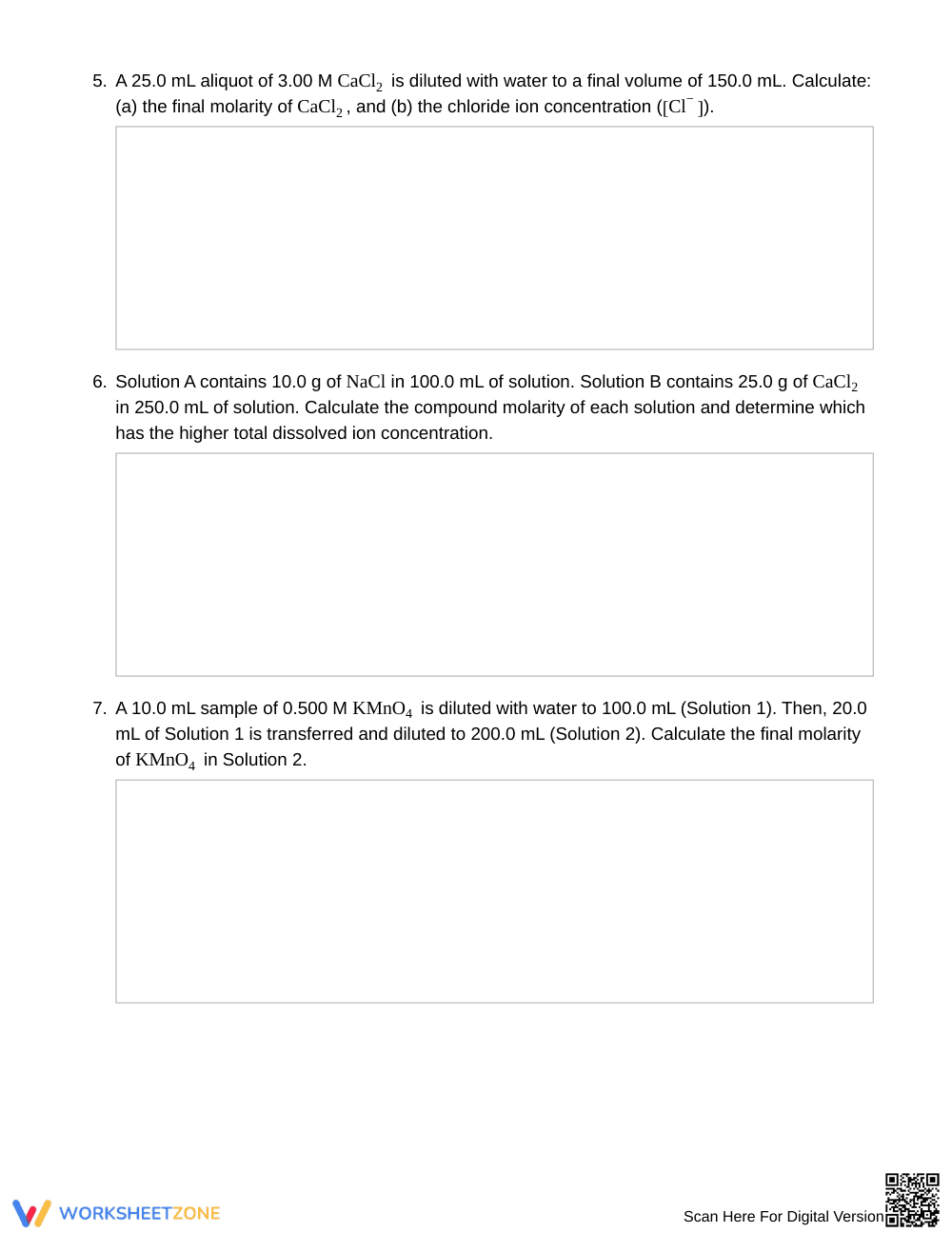
- Independent Practice (Parts B & C): Seven problems require independent calculations of serial dilutions, ion concentrations, and particulate reasoning about solution volume.
This sequence follows the gradual release of responsibility model, moving students from modeled examples to confident independent practice.
Standards Alignment
This worksheet aligns directly with high school chemistry standards for aqueous solution chemistry, focusing on calculating molar concentration, solute quantities, and dilution volumes. Standard concepts and mathematical procedures can be copied directly into lesson plans, IEP goals, or district curriculum mapping tools.
How to Use It
Assign this worksheet after direct instruction on solution concentration. In a 50-minute class period, spend 10 minutes reviewing the worked models, 25 minutes on Parts A and B, and 15 minutes on Part C. Formatively assess students by checking volume conversions in Part A; failing to convert milliliters to liters signals a unit conversion issue rather than a conceptual error.
Who It's For
This resource is designed for Grade 11 chemistry students learning solution stoichiometry. Scaffolded conversion prompts support emerging problem solvers, while Part C challenges advanced students to explain concentration at the particle level. Pair this worksheet with an aqueous solution laboratory or volumetric glassware demonstration.
Quantitative chemistry instruction requires students to bridge algorithmic calculations and particulate conceptual understanding. According to Fisher & Frey (2014), the gradual release of responsibility framework accelerates science competency by scaffolding complex multi-step procedures before requiring unassisted student output. This Grade 11 chemistry worksheet on molarity and dilution operationalizes that research through a structured 10-problem sequence. By anchoring mass-to-mole conversions and volumetric dilution formulas with explicit worked models, students develop procedural accuracy alongside molecular reasoning. High school chemistry learners calculate concentration from solute mass, evaluate comparative ion concentrations in dissolved salts, and diagnose lab preparation errors involving volumetric flasks. Because solution chemistry requires students to manage dimensional analysis alongside conservation of matter principles, integrating formula references with guided and independent problem sets ensures durable mastery. Educators can reliably utilize this resource for targeted skill acquisition and formative diagnostic evaluation.


