


























Views
Downloads



Complete Molarity & Dilution Worksheet | Grade 11 Chemistry
Paste this activity's link or code into your existing LMS (Google Classroom, Canvas, Teams, Schoology, Moodle, etc.).
Students can open and work on the activity right away, with no student login required.
You'll still be able to track student progress and results from your teacher account.
This Grade 11 chemistry worksheet equips students to analyze, calculate, and evaluate valid laboratory preparation pathways for molar solutions and dilutions. Through rigorous quantitative modeling and error propagation, learners contrast conserved final volume methods against naive additive solvent assumptions to master precision chemistry techniques.
At a Glance
- Grade: 11 · Subject: Chemistry
- Standard: Solutions — Calculate solution concentrations and evaluate quantitative laboratory preparation procedures
- Skill Focus: Molarity and Dilution Preparation Pathways
- Format: 7 pages · 10 problems · Answer key included · PDF
- Best For: Quantitative lab prep and AP Chemistry review
- Time: 60–90 minutes
What's Inside
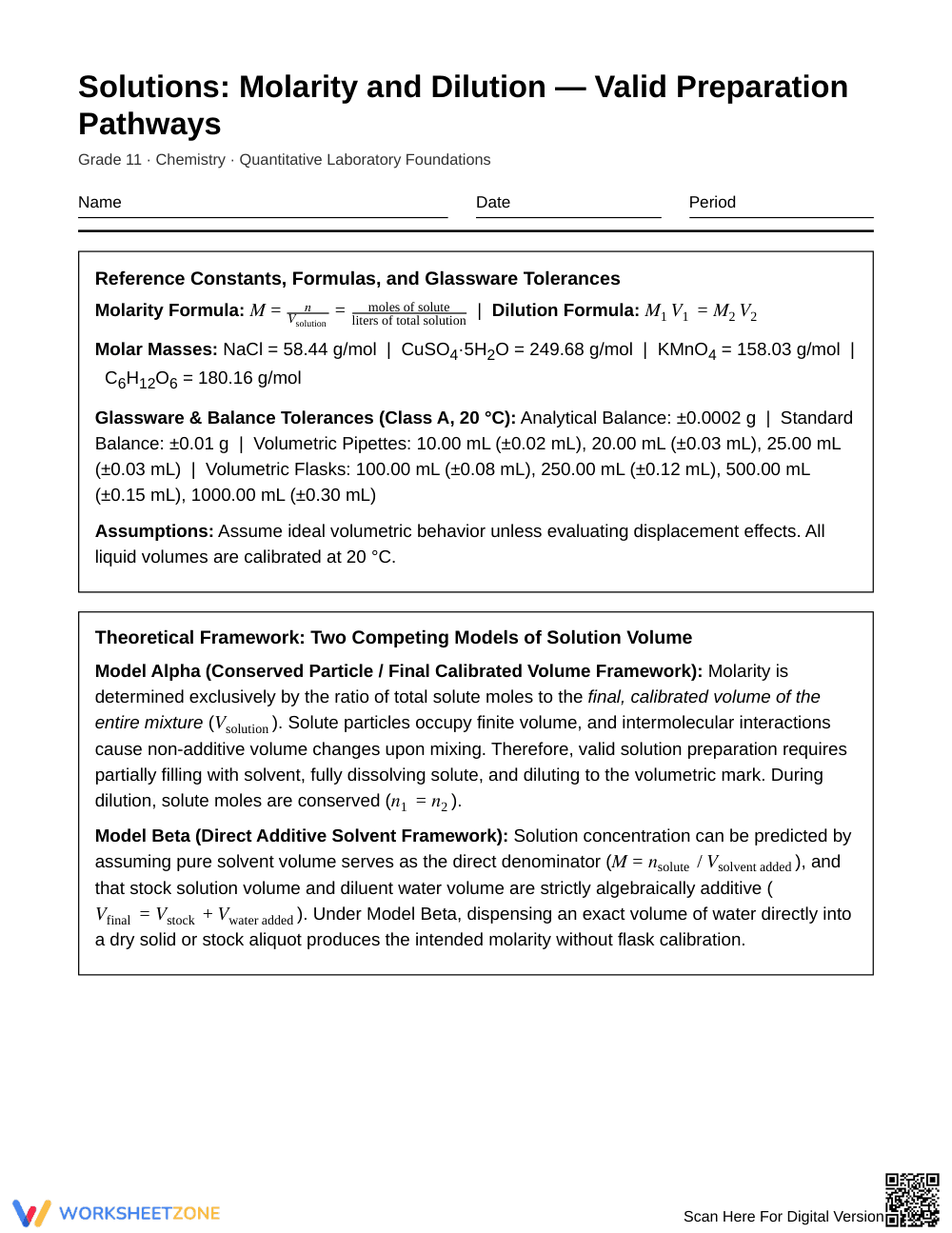
The 7-page resource features reference constants, Class A glassware tolerances, and 10 detailed analytical tasks distributed across three progressive sections. Students evaluate theoretical displacement models, calculate single and serial dilutions, calculate error propagation across balances and pipettes, and analyze synthetic spectrophotometric Beer's Law data. A comprehensive 4-page answer key provides step-by-step mathematical solutions and conceptual justifications.
Skill Progression
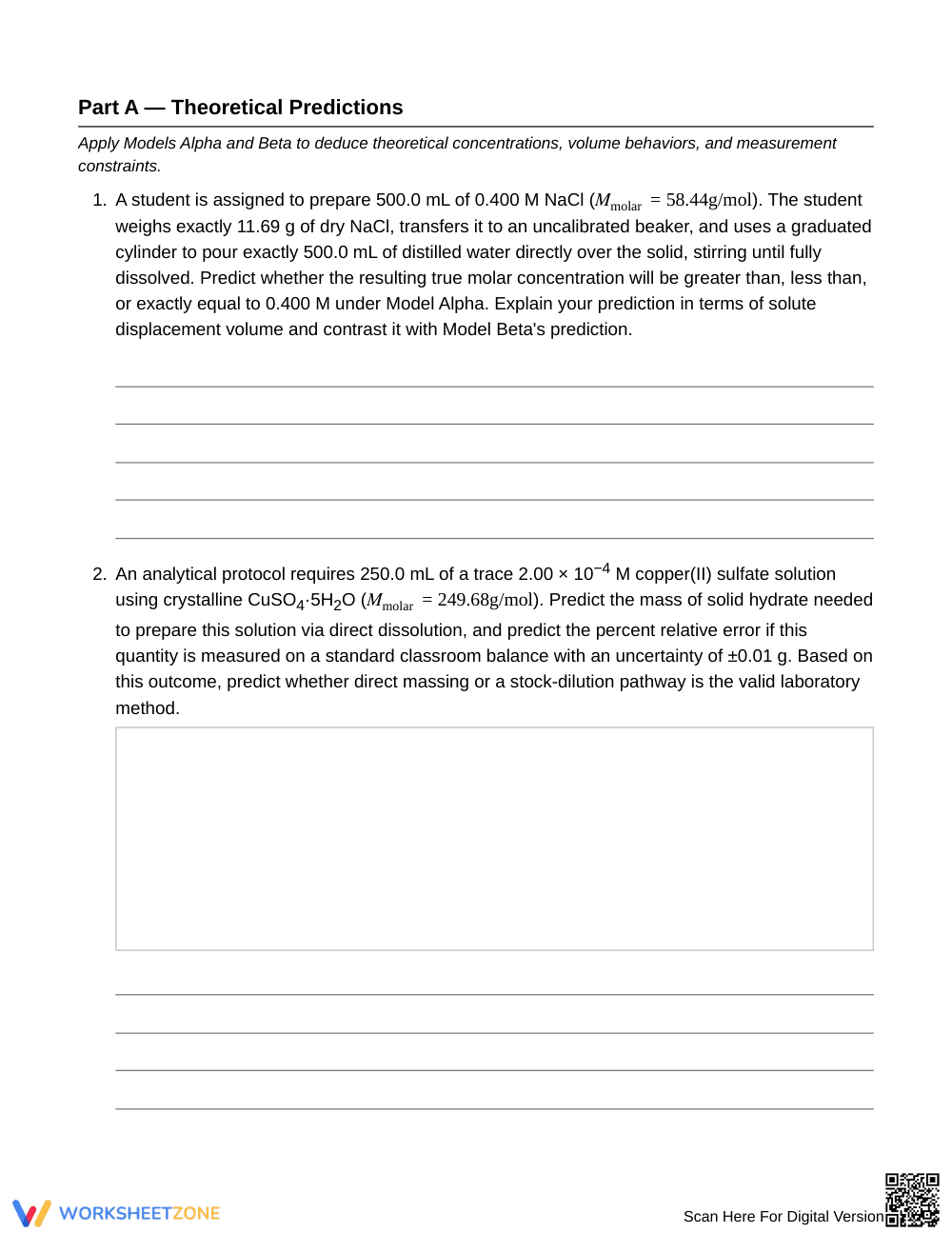
- Guided practice (Problems 1–2): Students apply theoretical volume models to predict concentration errors caused by solute displacement and calculate balance uncertainty during direct hydrate dissolution.
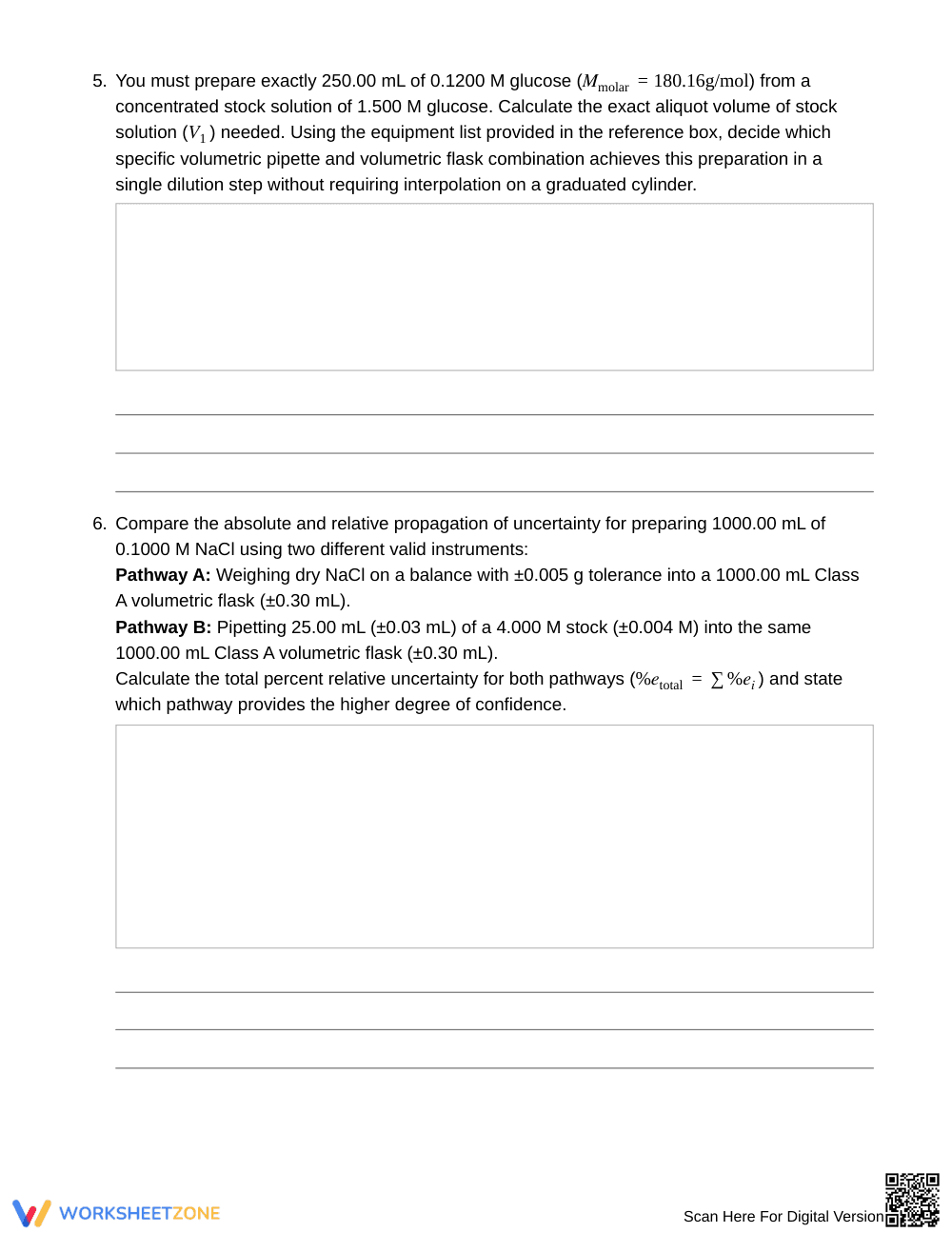
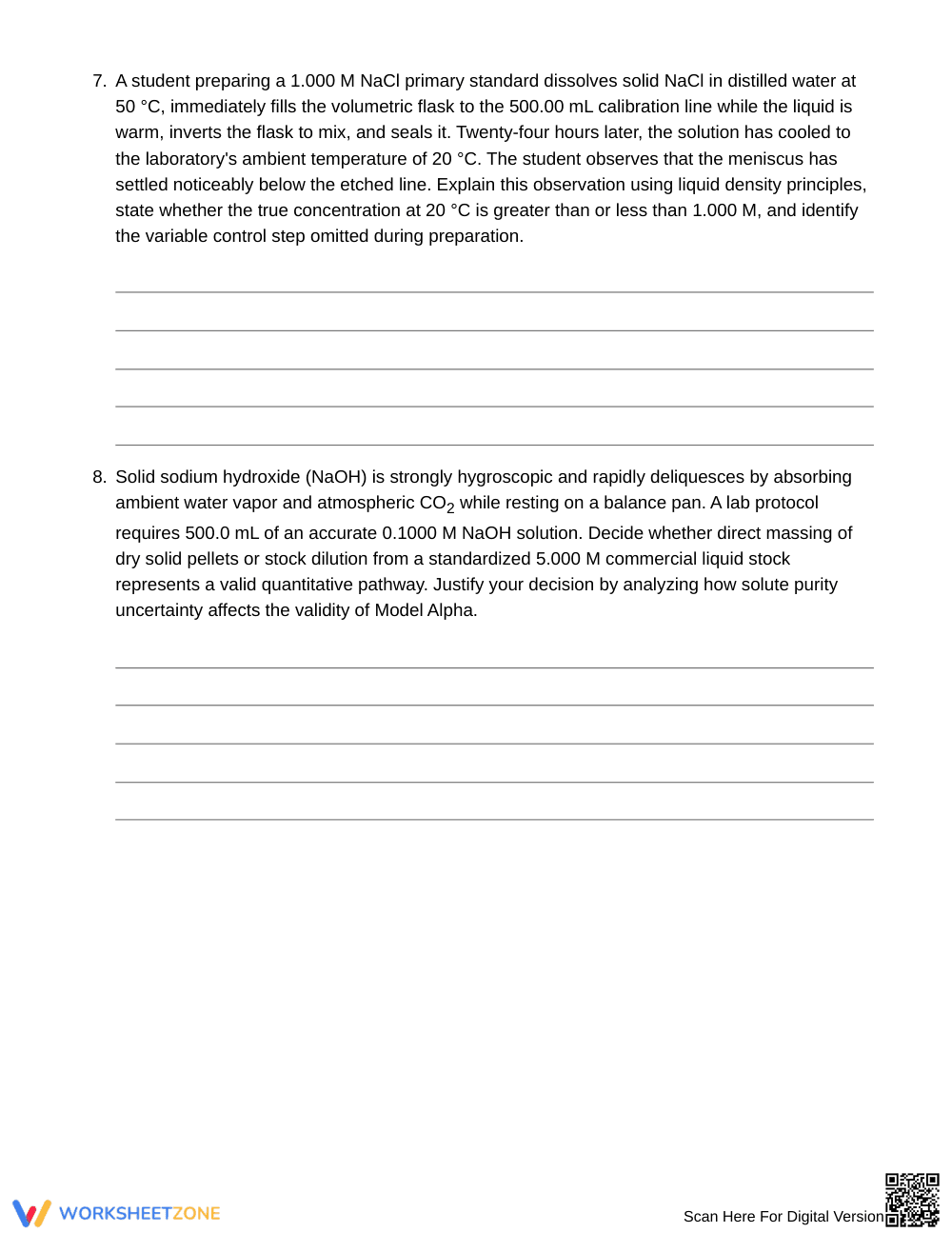
- Supported practice (Problems 3–8): Learners evaluate variable control, solve aliquot equations, determine apparatus selections, and compute cumulative relative uncertainties for competing pathways.
- Independent practice (Problems 9–10): Students analyze UV-Vis spectrophotometric data sets, calculate theoretical Beer's Law absorbances, and resolve which empirical pathway accurately accounts for non-additive solution volumes.
This structure follows an intentional gradual-release framework, moving students from conceptual models to independent quantitative data analysis.
Standards Alignment
This activity aligns with high school physical science standards for solution chemistry, quantitative chemical analysis, and laboratory error propagation. Students mathematically model the conservation of solute particles, determine molarity, and design controlled procedures using calibrated volumetric instruments. Both standard descriptions and laboratory learning targets can be copied directly into lesson plans, IEP goals, or district curriculum mapping tools.
How to Use It
Implement this worksheet after direct instruction on molarity calculations and before students perform wet-lab volumetric flask preparations. During independent work, conduct a quick formative check on Problem 3 to ensure learners correctly sum percentage uncertainties rather than absolute errors. Students typically complete the full 10-task set in 60 to 90 minutes across one extended lab block or two standard class periods.
Who It's For
This resource is designed for Grade 11 chemistry and advanced placement chemistry students developing quantitative lab literacy. Scaffolded reference tables support on-grade learners, while the multi-step propagation problems provide rigorous extension for advanced students. Pair this activity with a demonstration on volumetric glassware calibration or a Beer's Law colorimetry lab.
High school chemistry curricula require students to master stoichiometric calculations and understand the physical realities of solution preparation. This Grade 11 chemistry resource targets molarity, serial dilutions, and laboratory pathway verification across 10 analytical problems. According to Fisher & Frey (2014), structuring instructional tasks with a gradual release of responsibility—transitioning from conceptual modeling of solute displacement to independent spectrophotometric data analysis—significantly deepens scientific reasoning and computational fluency in complex domains. By engaging directly with Class A glassware tolerances, balance precision limits, and non-additive intermolecular volume shifts, students bridge the gap between abstract algebraic formulas and authentic quantitative laboratory execution. The included multi-page teacher answer key details step-by-step mathematical proofs, percent relative uncertainty summations, and Beer's Law evaluations, making this 7-page instructional package an essential, highly rigorous asset for secondary science classrooms.


