


























Views
Downloads




Complete Logarithm Inverses Worksheet | Grade 11 Algebra II
Paste this activity's link or code into your existing LMS (Google Classroom, Canvas, Teams, Schoology, Moodle, etc.).
Students can open and work on the activity right away, with no student login required.
You'll still be able to track student progress and results from your teacher account.
This comprehensive worksheet trains Grade 11 Algebra II students to conceptualize and calculate logarithms as the inverse of exponential functions. Students analyze inverse relationships, evaluate expressions, solve logarithmic equations, and apply exponential modeling to real-world acoustics to build deep conceptual and procedural fluency.
At a Glance
- Grade: 11 · Subject: Algebra II
- Standard:
HSF-BF.B.5— Understand the inverse relationship between exponents and logarithms to solve problems- Skill Focus: Logarithms as Inverse Questions
- Format: 5 pages · 16 problems · Answer key included · PDF
- Best For: Core instruction and targeted skills intervention
- Time: 45–60 minutes
What's Inside
The 5-page resource includes 16 multi-part mathematical tasks organized across three structured sections, supported by a reference box outlining fundamental inverse identities. A comprehensive 3-page answer key provides complete algebraic solutions, graphical symmetry explanations, and step-by-step inverse function derivations.
Skill Progression
- Guided Practice (Part A, 4 problems): Focuses on conceptual foundations, guiding students to distinguish logarithmic questions from radical operations, identify geometric reflections across y = x, and justify domain restrictions.
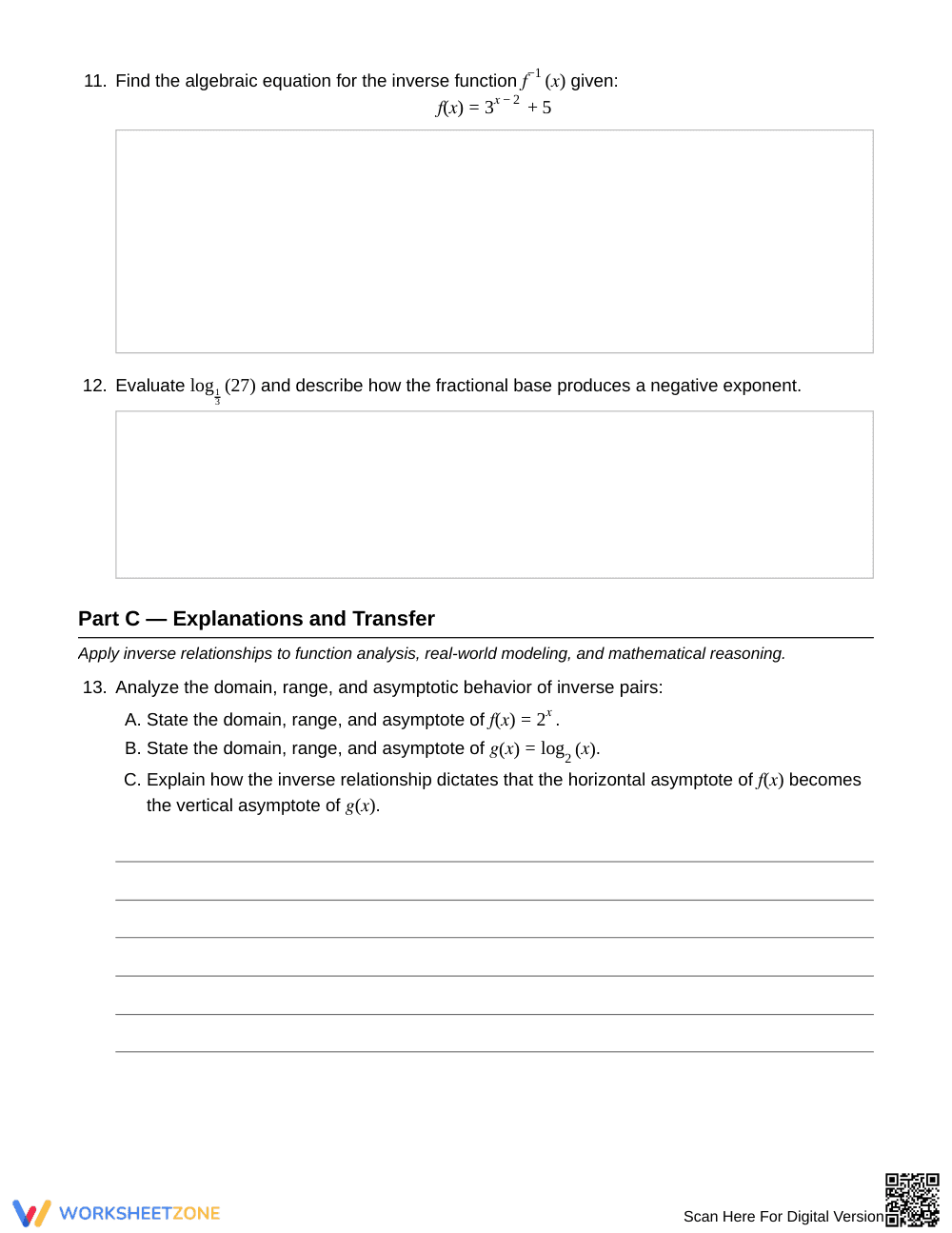
- Supported Practice (Part B, 8 problems): Prompts students to evaluate expressions, isolate unknown bases, and determine inverse functions with structured algebraic steps.
- Independent Practice (Part C, 4 problems): Challenges learners with open-ended asymptotic analysis, acoustic decibel formula inversion, and rigorous error analysis.
This structured progression follows an explicit gradual-release model that transitions learners from foundational sense-making to autonomous problem solving.
Standards Alignment
This resource aligns directly to HSF-BF.B.5: Understand the inverse relationship between exponents and logarithms and use this relationship to solve problems involving logarithms and exponents. It additionally supports HSF-IF.C.7.E by graphing exponential and logarithmic functions showing intercepts and end behavior. Both standard codes can be copied directly into lesson plans, IEP goals, or district curriculum mapping tools.
How to Use It
Deploy this worksheet immediately after direct instruction on exponential functions to introduce logarithmic notation through familiar inverse concepts. Alternatively, utilize it during collaborative station rotations where student pairs debate the Part C error analysis task. Formatively observe whether students correctly identify the horizontal asymptote of an exponential graph as the vertical asymptote of its inverse logarithmic graph. Expect students to complete the 16 tasks within 45 to 60 minutes.
Who It's For
This worksheet serves Grade 11 Algebra II students, Pre-Calculus preparation cohorts, and learners requiring structured conceptual reinforcement in function transformations. Scaffold struggling students with base-conversion graphic organizers while accelerating advanced learners through acoustic modeling extensions. Pair this worksheet with an interactive graphing calculator exploration of reflection lines.
According to research synthesized in Fisher & Frey (2014), structuring mathematical tasks through an intentional gradual-release framework significantly enhances student mastery of abstract algebraic concepts. This Grade 11 worksheet directly operationalizes that pedagogical architecture for standard HSF-BF.B.5, which requires students to understand the inverse relationship between exponents and logarithms to solve complex mathematical problems. By grounding logarithmic notation in the intuitive question of exponential inverses, the 16 structured tasks guide learners through foundational distinctions, algebraic manipulation, and real-world acoustic modeling. Research confirms that deliberate sequencing—moving from guided conceptual definitions to independent error analysis—prevents common algebraic misconceptions, such as erroneously distributing logarithmic operators over addition. Consequently, educators can utilize this resource to foster enduring conceptual understanding and procedural accuracy in advanced secondary mathematics classrooms.


