


























Views
Downloads




Complete Log Parameters Worksheet | Grade 11 Algebra II
Paste this activity's link or code into your existing LMS (Google Classroom, Canvas, Teams, Schoology, Moodle, etc.).
Students can open and work on the activity right away, with no student login required.
You'll still be able to track student progress and results from your teacher account.
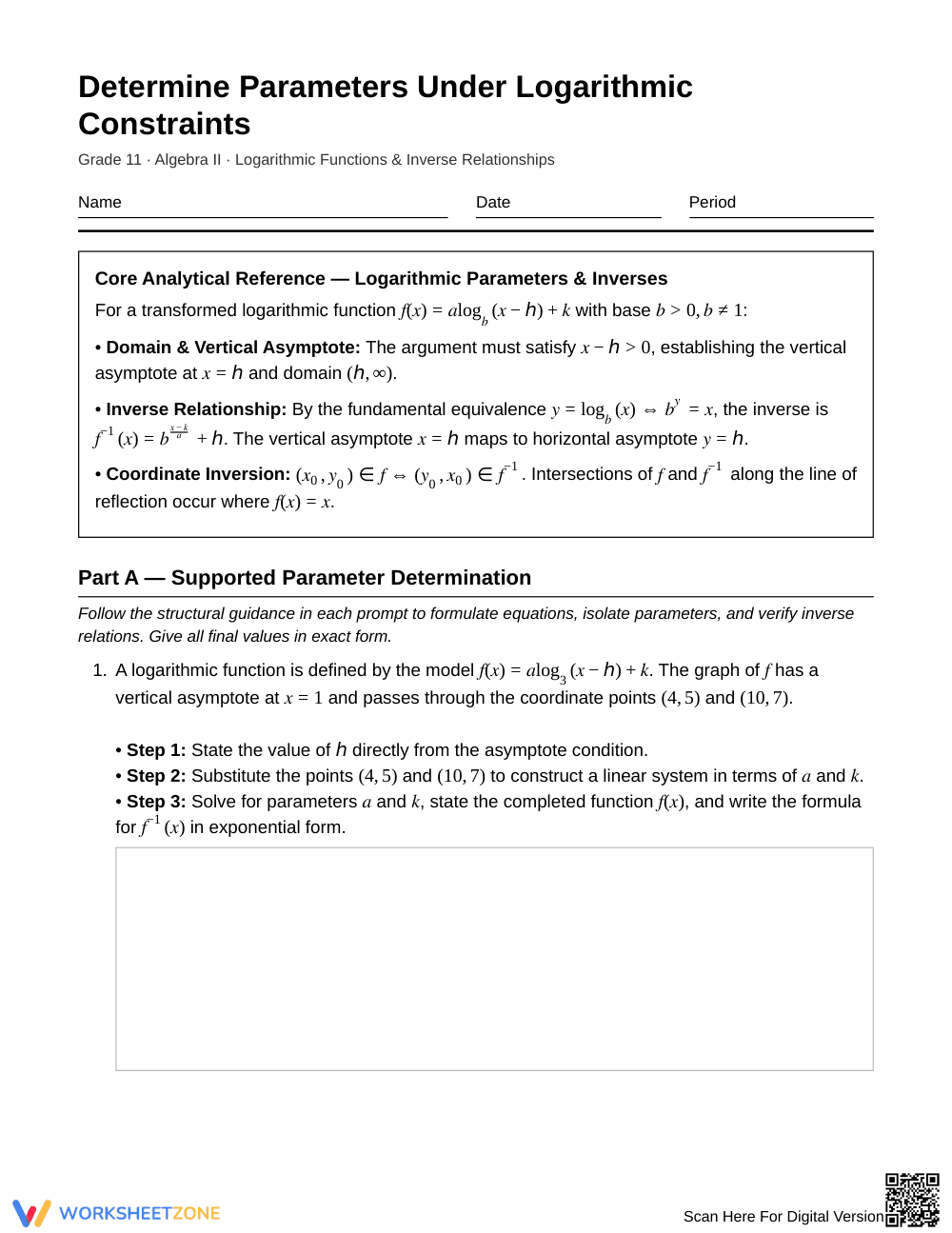
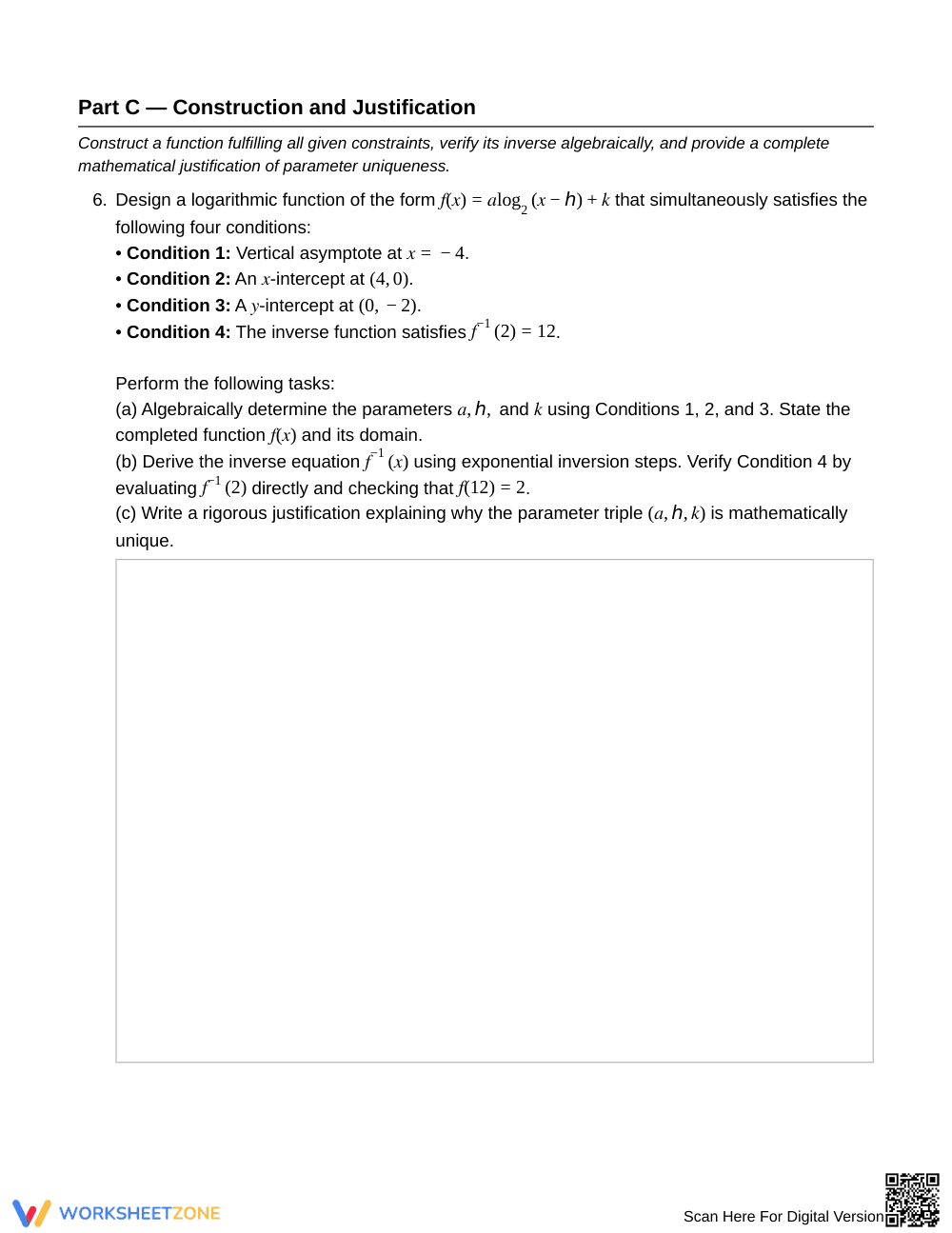
Mastering transformed logarithmic models requires analyzing geometric constraints, domain boundaries, and inverse relationships. This Algebra II worksheet guides Grade 11 learners through finding exact parameters for logarithmic functions and converting them to exponential forms. Students build algebraic fluency by isolating vertical asymptotes, translating coordinate pairs, and proving parameter uniqueness across structured, multi-step prompts.
At a Glance
- Grade: 11 · Subject: Algebra II
- Standard:
HSF-BF.B.5— Understand inverse relationships between exponents and logarithms to solve mathematical problems- Skill Focus: Determine Parameters Under Logarithmic Constraints
- Format: 5 pages · 6 problems · Answer key included · PDF
- Best For: Advanced parameter isolation and inverse practice
- Time: 45–60 minutes
What's Inside
This 5-page instructional resource includes a Core Analytical Reference summarizing asymptote rules and coordinate inversion, 6 multi-part practice problems across 3 difficulty tiers, and a complete 4-page step-by-step answer key. Structural scaffolds include sequential step-by-step prompts in early tasks, coordinate translation guides, and formal justification frameworks for uniqueness proofs.
Skill Progression
- Guided Practice (Part A, Problems 1–2): Students use step-by-step prompts to identify vertical asymptotes from domain boundaries, set up two-variable linear systems, and state inverse equations.
- Supported Practice (Part B, Problems 3–5): Learners independently solve multi-step problems involving base conversions, horizontal asymptotes of inverse functions, and reflection line intersections.
- Independent Mastery (Part C, Problem 6): Students design a multi-constrained function, prove parameter uniqueness algebraically, and verify inverse values.
This structured progression follows the gradual-release model, shifting students from guided parameter identification to rigorous mathematical justification.
Standards Alignment
This worksheet directly aligns with HSF-BF.B.5: Understand the inverse relationship between exponents and logarithms and use this relationship to solve problems involving logarithms and exponents. Students continuously leverage exponential inverses to isolate parameters and evaluate logarithmic functions. Standard codes can be copied directly into lesson plans, IEP goals, or district curriculum mapping tools.
How to Use It
Deploy this resource during the second half of a logarithmic functions unit after direct instruction on transformations and inverse functions. For formative assessment, inspect Part A Step 2 to verify that students correctly convert logarithmic coordinate equations into solvable linear systems before they proceed to unguided problems. The full problem set requires 45 to 60 minutes of active instructional time.
Who It's For
This activity is designed for Grade 11 Algebra II and Pre-Calculus students developing mastery over transcendental functions and inverse modeling. Provide struggling students with the reference sheet's coordinate conversion tables, while advanced learners complete the Part C uniqueness proof. Pair this activity with an interactive graphing calculator exploration of reflected curves.
According to Fisher & Frey (2014), structured instructional frameworks that transition students from scaffolded parameter isolation to independent mathematical proof significantly improve procedural fluency and conceptual retention in advanced secondary mathematics. This 5-page Algebra II worksheet operationalizes standard HSF-BF.B.5 by requiring students to determine exact parameters for logarithmic functions under domain, asymptote, and coordinate constraints. By connecting logarithmic models directly with their exponential inverses, students engage in deep algebraic reasoning rather than rote computation. The progression moves deliberately from scaffolded system-solving prompts in Part A to rigorous uniqueness justifications in Part C, reinforcing how inverse relationships govern function behavior. High school educators using this comprehensive 6-problem resource provide targeted practice that meets rigorous college-and-career readiness standards while generating actionable diagnostic evidence of student mastery across exponential and logarithmic concepts.


