































Complete Location & Coordinates Worksheet | Grade 6 Math

Paste this activity's link or code into your existing LMS (Google Classroom, Canvas, Teams, Schoology, Moodle, etc.).
Students can open and work on the activity right away, with no student login required.
You'll still be able to track student progress and results from your teacher account.
Mastering coordinate planes requires sixth graders to link spatial descriptions with ordered pairs. This 4-page worksheet guides students through reading campus grid coordinates, calculating absolute-value distances, and analyzing reflection rules across both axes. Students build procedural fluency and spatial reasoning across all four quadrants.
At a Glance
- Grade: 6 · Subject: Math
- Standard:
6.NS.C.6— Find and position pairs of integers and rational numbers on a coordinate plane- Skill Focus: Connect Location Descriptions and Coordinates
- Format: 4 pages · 12 problems · Answer key included · PDF
- Best For: Core math instruction and guided skills practice
- Time: 40–50 minutes
What's Inside
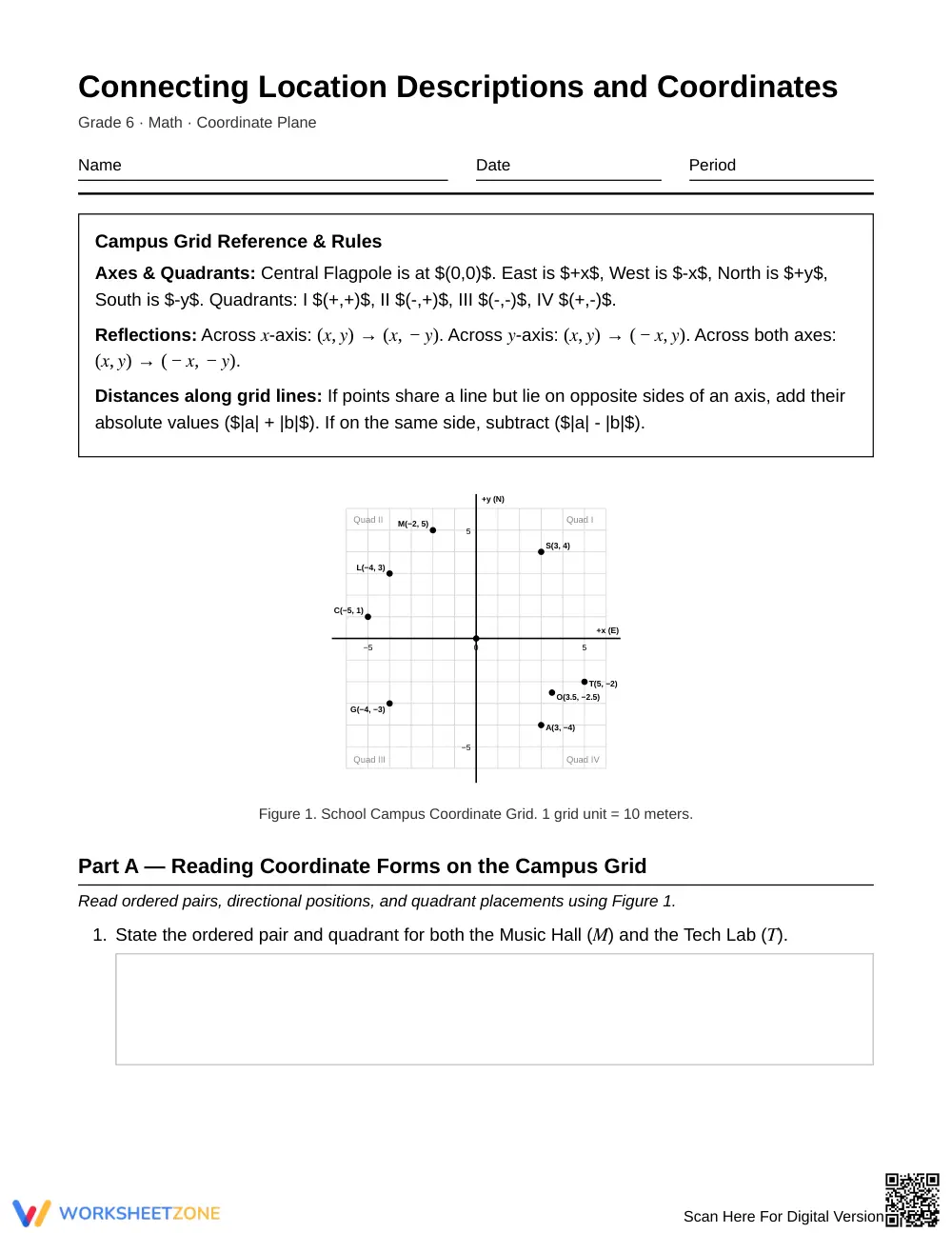
This resource features a school campus coordinate grid with an explicit reference box covering quadrant signs, axis reflections, and absolute-value distance rules. Across 12 structured tasks, students identify landmarks, translate verbal directions into ordered pairs, reflect coordinates, and calculate grid line distances. A full two-page answer key provides complete solutions.
Skill Progression
- Guided practice (Part A, Problems 1–3): Landmark and quadrant identification using map clues, compass directions, and coordinate inequalities with visual grid support.
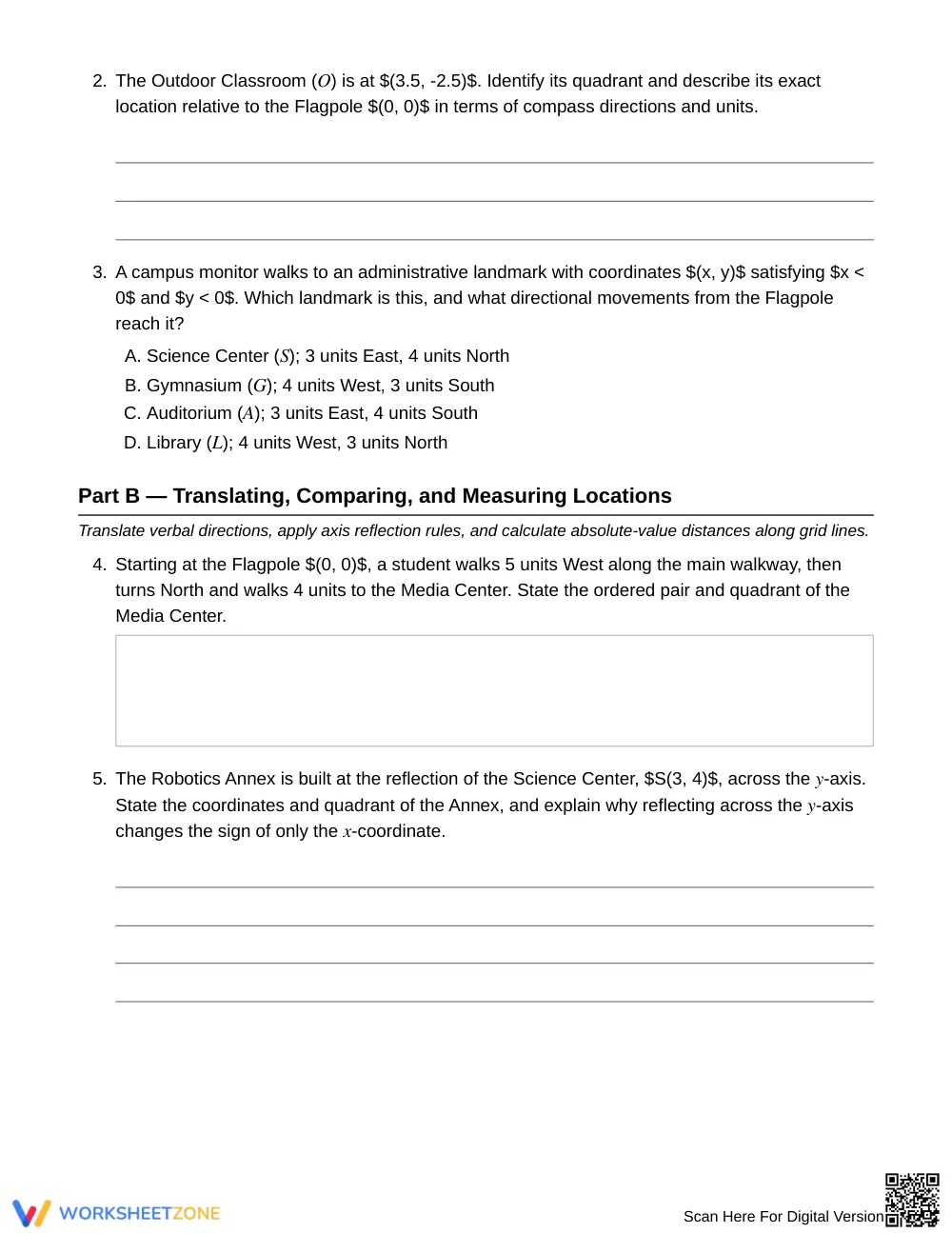
- Supported practice (Part B, Problems 4–9): Intermediate problems translating verbal steps into coordinates, reflecting points across axes, and calculating grid distances using absolute values.
- Independent practice (Part C, Problems 10–12): Non-scaffolded error analysis where students diagnose misconceptions about reflection rules and signs, justifying mathematical corrections.
This progression follows a gradual-release model, moving students from guided map reading to independent analysis and critique.
Standards Alignment
This worksheet aligns directly with `6.NS.C.6` by requiring students to position ordered pairs and recognize axis reflections across all four quadrants. It also supports `6.NS.C.8` as students calculate vertical and horizontal distances between points sharing a coordinate. Both standard codes can be copied directly into lesson plans, IEP goals, or district curriculum mapping tools.
How to Use It
Use this worksheet after direct instruction on four-quadrant grids. Assign Parts A and B for paired practice to reinforce coordinate notation and distance calculations. Use Part C as an individual exit ticket to check if students confuse x-axis and y-axis reflections. Completion takes approximately 40 to 50 minutes.
Who It's For
This resource supports sixth-grade math students, fifth-grade enrichment, and seventh-grade intervention. The campus grid aids visual and English learners, while error-analysis tasks challenge advanced thinkers. Pair this worksheet with an anchor chart showing quadrant signs and reflection rules.
Research synthesized by Fisher & Frey (2014) demonstrates that structured gradual-release frameworks significantly increase student mastery during complex mathematical tasks. Under standard 6.NS.C.6, sixth-grade students must connect location descriptions and coordinates by locating ordered pairs on a four-quadrant coordinate plane, identifying axis reflections, and evaluating spatial relationships. Without structured progression, middle school learners frequently misapply sign conventions and struggle to distinguish reflections across horizontal versus vertical axes. This 12-problem worksheet incorporates visual models, guided coordinate identification, absolute-value distance calculations, and targeted error analysis to scaffold cognitive demand systematically. By moving from concrete campus map coordinates to abstract written critiques of mathematical misconceptions, students build robust conceptual understanding alongside procedural efficiency. Teachers can utilize these targeted tasks and the comprehensive answer key to monitor individual student progress, identify common quadrant misunderstandings early, and ensure every learner achieves measurable proficiency in standard 6.NS.C.6.


