





























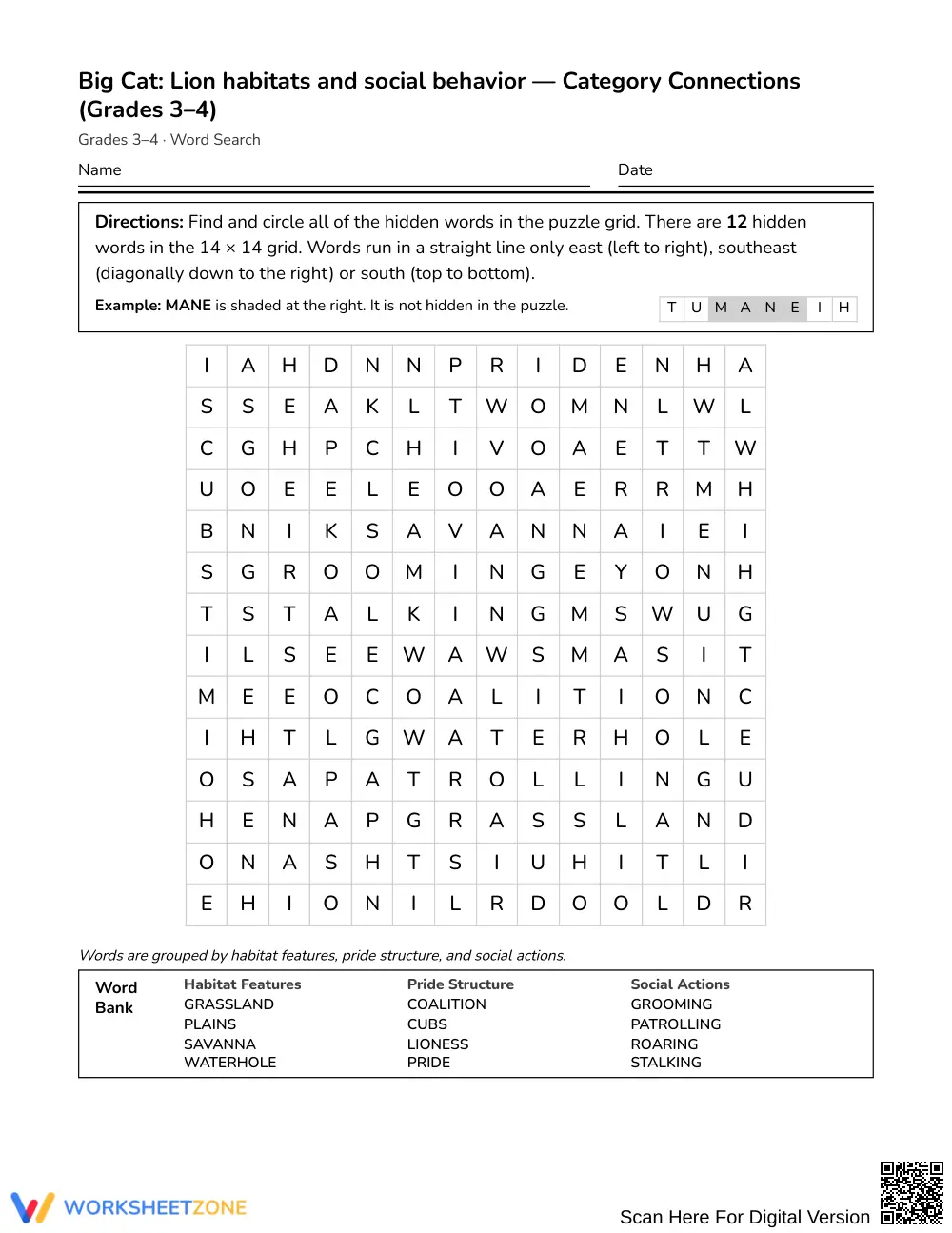


Complete Lion Habitats Word Search | Grades 3–4 Science

Paste this activity's link or code into your existing LMS (Google Classroom, Canvas, Teams, Schoology, Moodle, etc.).
Students can open and work on the activity right away, with no student login required.
You'll still be able to track student progress and results from your teacher account.
This Grades 3–4 science word search reinforces foundational biology vocabulary regarding lion habitats, pride structures, and community behaviors. Students identify 12 subject-specific terms embedded across a structured grid, reinforcing word recognition, domain spelling, and conceptual categorization during your life science unit.
At a Glance
- Grade: Grades 3–4 · Subject: Science
- Standard: Not standards-assessed — vocabulary enrichment
- Skill Focus: Lion habitats and social behavior
- Format: 1 page · 12 words · Answer key included · PDF
- Best For: Science centers or fast finishers
- Time: 15–20 minutes
What's Inside: A clean, one-page printable puzzle featuring a 14 by 14 letter grid and 12 thematic terms. Vocabulary words are grouped into three distinct concept clusters: Habitat Features, Pride Structure, and Social Actions. Each word includes an accompanying contextual clue definition. A comprehensive multi-page answer key showing exact letter paths is included for quick checking.
Zero-Prep Workflow
- Step 1: Print (1 minute): Send the single-page student puzzle directly to your copier or printer. No sorting, laminating, or cutting is required.
- Step 2: Distribute (30 seconds): Hand the puzzle to students as a bellringer, independent desk task, or emergency sub plan. The directions are self-explanatory. Words run strictly East, Southeast, and South, keeping word recognition age-appropriate and frustration-free.
- Step 3: Review (5 minutes): Display the clear solution key or provide it at a self-check station so learners can verify their work independently. Total teacher prep time remains under 2 minutes.
Standards Alignment
This activity provides pure vocabulary enrichment and is not aligned to a specific state or national science standard. It builds contextual literacy for elementary units covering living things, animal adaptations, and savanna ecosystems without the administrative burden of formal assessment tracking.
How to Use It
Deploy this puzzle immediately after direct instruction on big cat ecosystems to anchor new terminology, or assign it during independent rotation stations. For formative assessment, observe whether students identify words by referencing the three category groupings (Habitat Features, Pride Structure, and Social Actions) rather than searching for random letters. Typical completion time spans 15 to 20 minutes.
Who It's For
This resource serves general education elementary learners in Grades 3–4 studying animal behaviors and habitats. The categorized word list offers clear structural scaffolding for developing readers and English language learners. Pair this printable puzzle directly with an informational reading passage on African grasslands or an introductory anchor chart on mammalian social hierarchies.
Targeted vocabulary puzzles provide low-stakes cognitive engagement that strengthens specialized domain literacy. According to Fisher & Frey (2014), intentional exposure to disciplinary words within thematic categories supports long-term schema building and retention across elementary science classrooms. By organizing 12 targeted terms into habitat characteristics, group dynamics, and communicative actions within a 14 by 14 letter matrix, this activity activates prior knowledge and reinforces orthographic mapping. Because the search paths are limited to East, Southeast, and South directions, elementary learners focus their attention on decoding and semantic connections rather than visual disorientation. Serving as a print-and-go supplement, this independent science resource delivers immediate curriculum reinforcement and purposeful practice during literacy stations, introductory ecology lessons, or substitute teacher coverage without requiring advance instructional planning.


