




























Views
Downloads




Complete Linear Models Worksheet | Grade 9 Algebra I

Paste this activity's link or code into your existing LMS (Google Classroom, Canvas, Teams, Schoology, Moodle, etc.).
Students can open and work on the activity right away, with no student login required.
You'll still be able to track student progress and results from your teacher account.
This linear modeling worksheet equips Grade 9 Algebra I students to construct linear equations from two real-world observations. Students calculate rates of change, solve for initial values, and evaluate domain constraints across contextual scenarios to build both procedural fluency and contextual reasoning.
At a Glance
- Grade: 9 · Subject: Algebra I
- Standard:
HSF-LE.A.2— Construct linear functions given two coordinate pairs or input-output values- Skill Focus: Build a Linear Model from Two Observations
- Format: 4 pages · 12 problems · Answer key included · PDF
- Best For: Linear functions practice and skill consolidation
- Time: 45–55 minutes
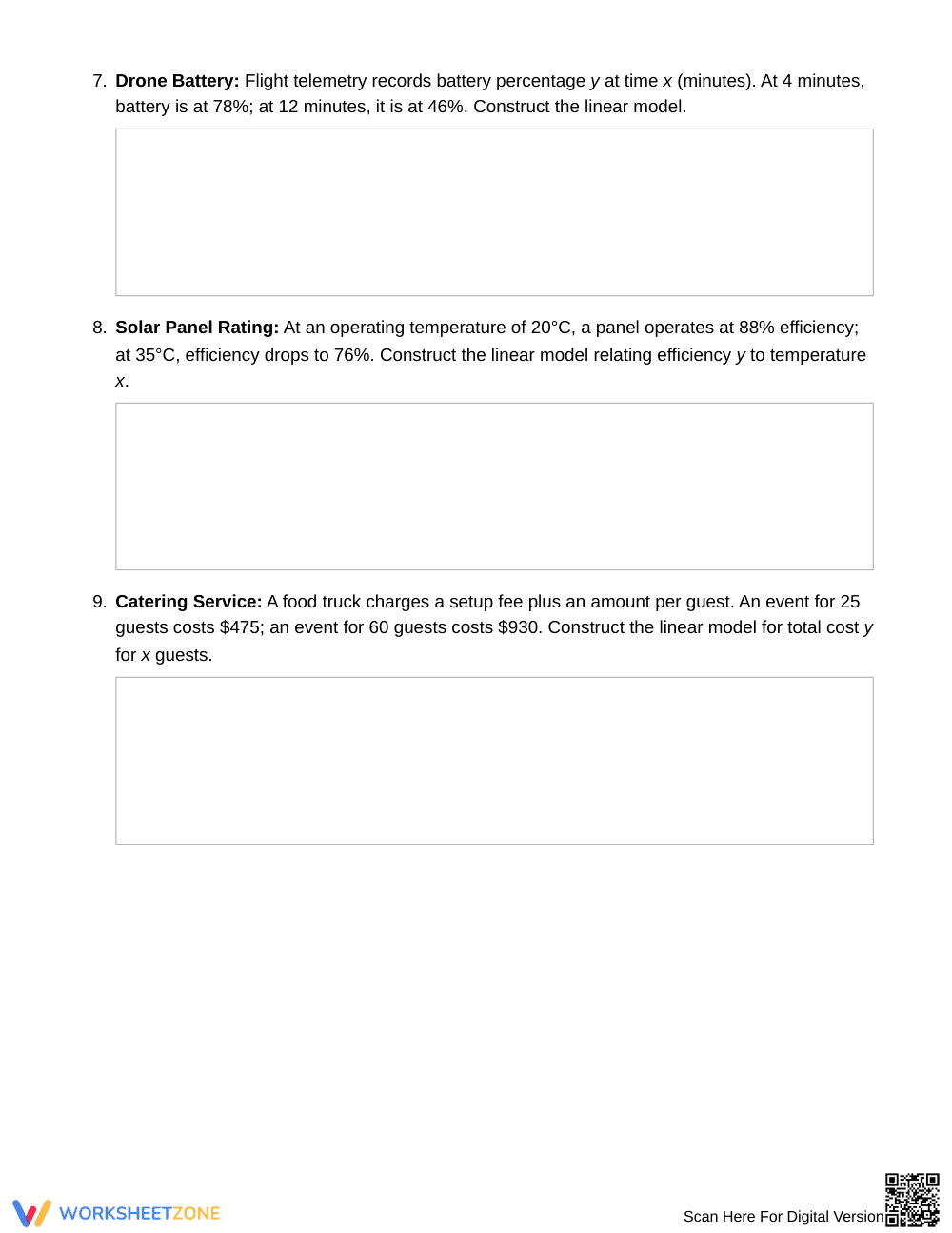
The 4-page worksheet includes 12 contextual tasks organized into four phases. A reference box defines the slope formula and slope-intercept form. Students study two worked exemplars before completing guided missing-step problems and independent modeling items. A 2-page answer key provides complete calculations and constraint justifications.
Skill Progression
- Guided practice (Part B, 4 problems): Students compute slopes and vertical intercepts using structured fill-in prompts.
- Supported practice (Part C, 6 problems): Learners construct linear equations ($y = mx + b$) from unprompted real-world scenarios.
- Independent practice (Part D, 2 problems): Students apply models to evaluate budget limitations and physical domain constraints.
This sequence implements a gradual-release model, advancing learners from guided practice to autonomous problem solving.
Standards Alignment
This worksheet aligns to HSF-LE.A.2: Construct linear functions given two input-output pairs. It also supports HSA-CED.A.2 by creating equations in two variables. Both standard codes can be copied directly into lesson plans, IEP goals, or district curriculum mapping tools.
How to Use It
Use this worksheet after introducing slope-intercept form. Assign Part B during guided instruction to check variable assignments, and Parts C and D for independent practice. Formative tip: verify that students recognize negative rates in draining or cooling scenarios before computing intercepts. Expected completion time is 45 to 55 minutes.
Who It's For
This resource targets Grade 9 Algebra I students learning contextual modeling, plus Grade 8 accelerated learners. Support developing students with coordinate pair templates, while challenging advanced peers with Part D domain analysis. Pair this resource with a direct instruction lesson on slope interpretation.
Mastering HSF-LE.A.2 requires high school algebra students to build linear models from two observations by translating discrete quantitative data into functional relationships. Educational research by Fisher & Frey (2014) highlights that structured gradual-release frameworks significantly increase student competence when shifting from guided procedural prompts to independent contextual analysis. This 12-problem worksheet operationalizes that research by leading Grade 9 Algebra I learners through worked examples, missing-step scaffolding, autonomous function construction, and realistic domain evaluations. Students compute rates of change across diverse physical contexts, isolate vertical intercepts algebraically, and evaluate boundary conditions against real-world constraints. By bridging arithmetic calculations with algebraic modeling, this printable resource solidifies core conceptual understanding while providing teachers with reliable diagnostic evidence of individual student mastery. High school educators can implement this structured activity to support standard-aligned intervention, whole-class instruction, and target skill reinforcement.


