































Complete Limiting Reactant Worksheet | Grades 9-12 Science

Paste this activity's link or code into your existing LMS (Google Classroom, Canvas, Teams, Schoology, Moodle, etc.).
Students can open and work on the activity right away, with no student login required.
You'll still be able to track student progress and results from your teacher account.
This comprehensive chemistry worksheet guides high school students through identifying limiting reactants, calculating theoretical yields, and explaining mass conservation across four rigorous sections. Students analyze particulate diagrams, interpret empirical experimental data, solve multi-step stoichiometry problems, and articulate thermochemical reasoning to build genuine conceptual mastery of chemical reactions.
At a Glance
- Grade: Grades 9–12 · Subject: Science
- Standard: High School Chemistry — Calculate stoichiometric quantities and identify limiting reactants in chemical reactions
- Skill Focus: Limiting reactant and theoretical yield
- Format: 4 pages · 21 problems · Answer key included · PDF
- Best For: Cumulative unit assessment or review
- Time: 45–60 minutes
What's Inside
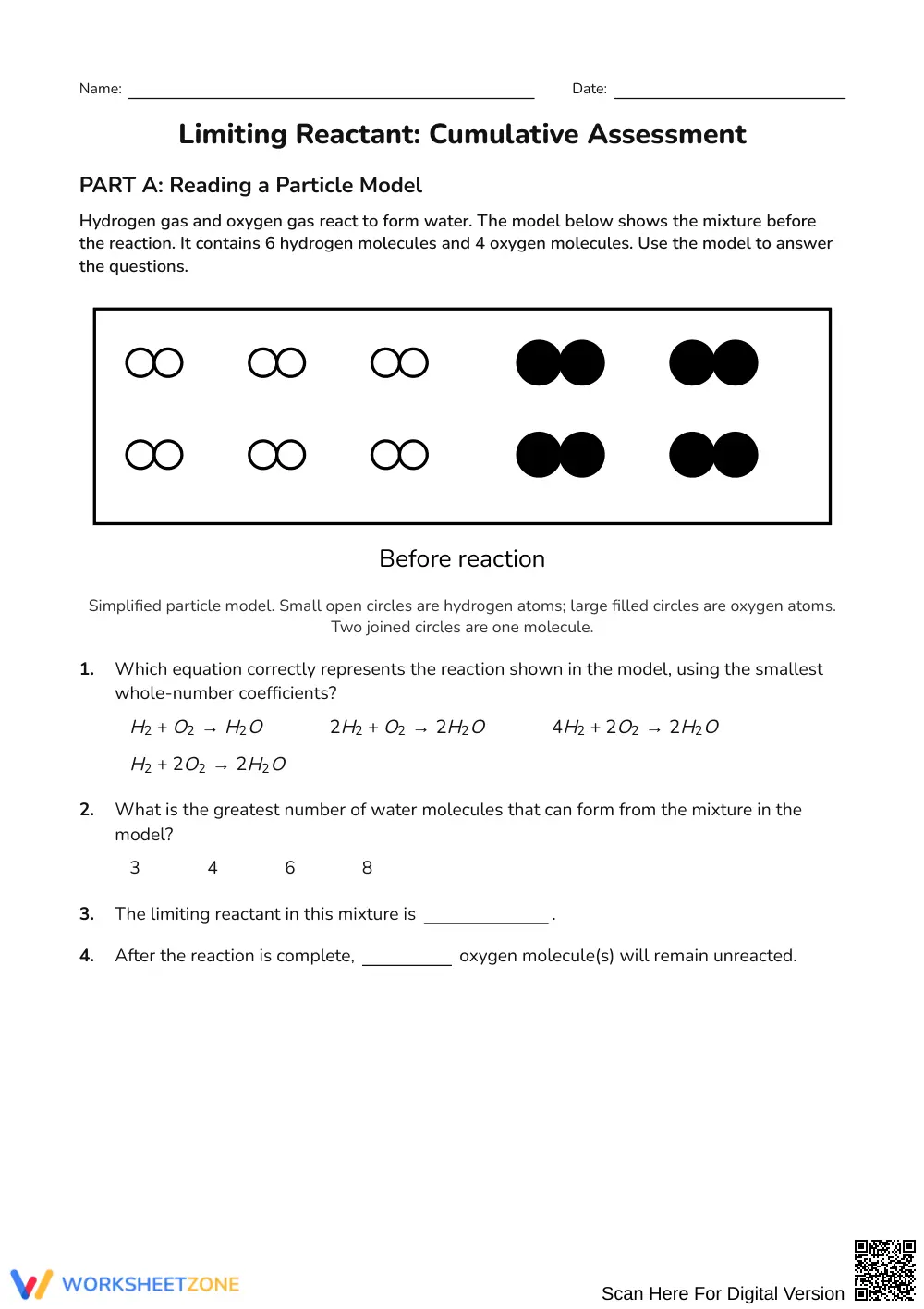
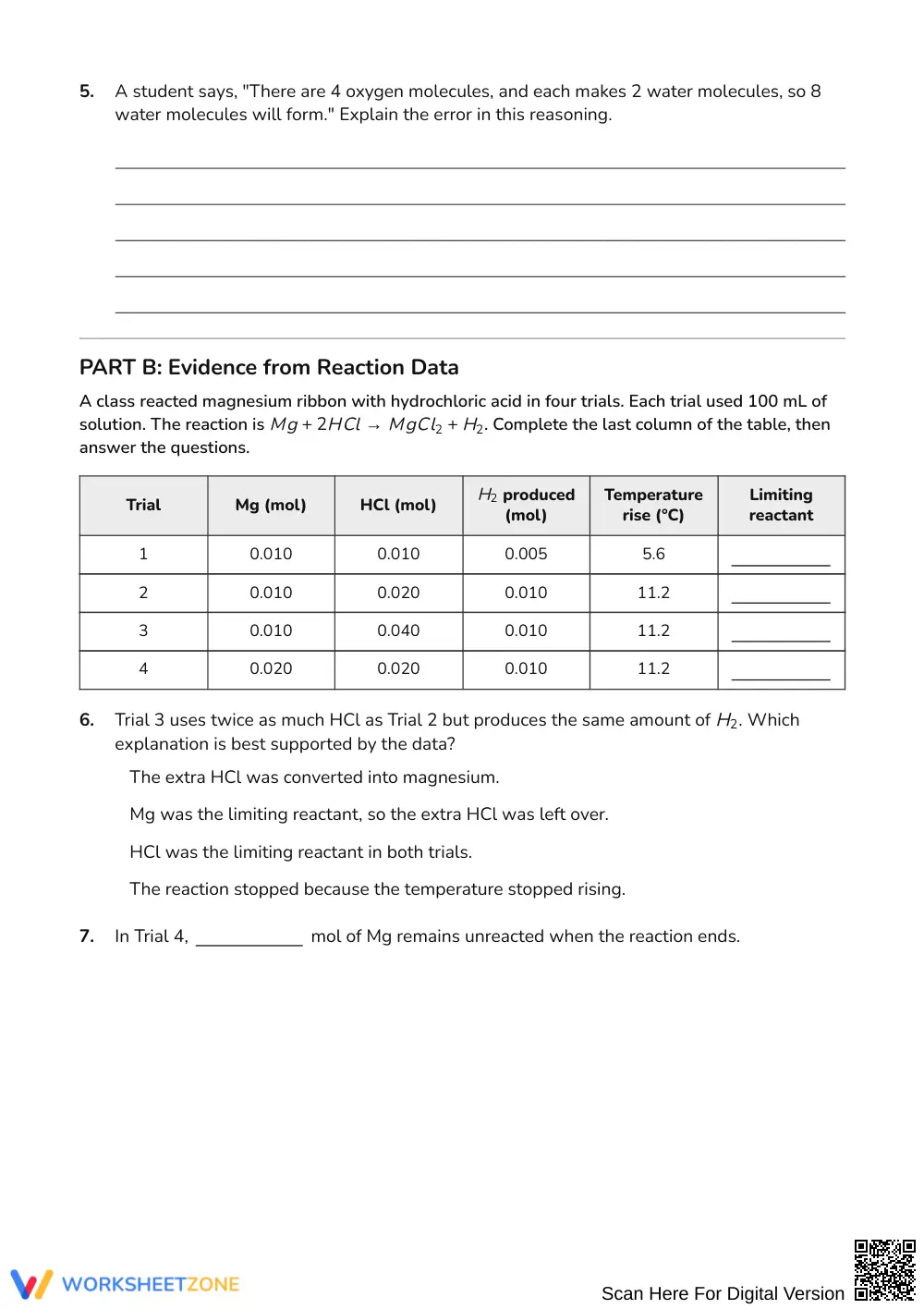
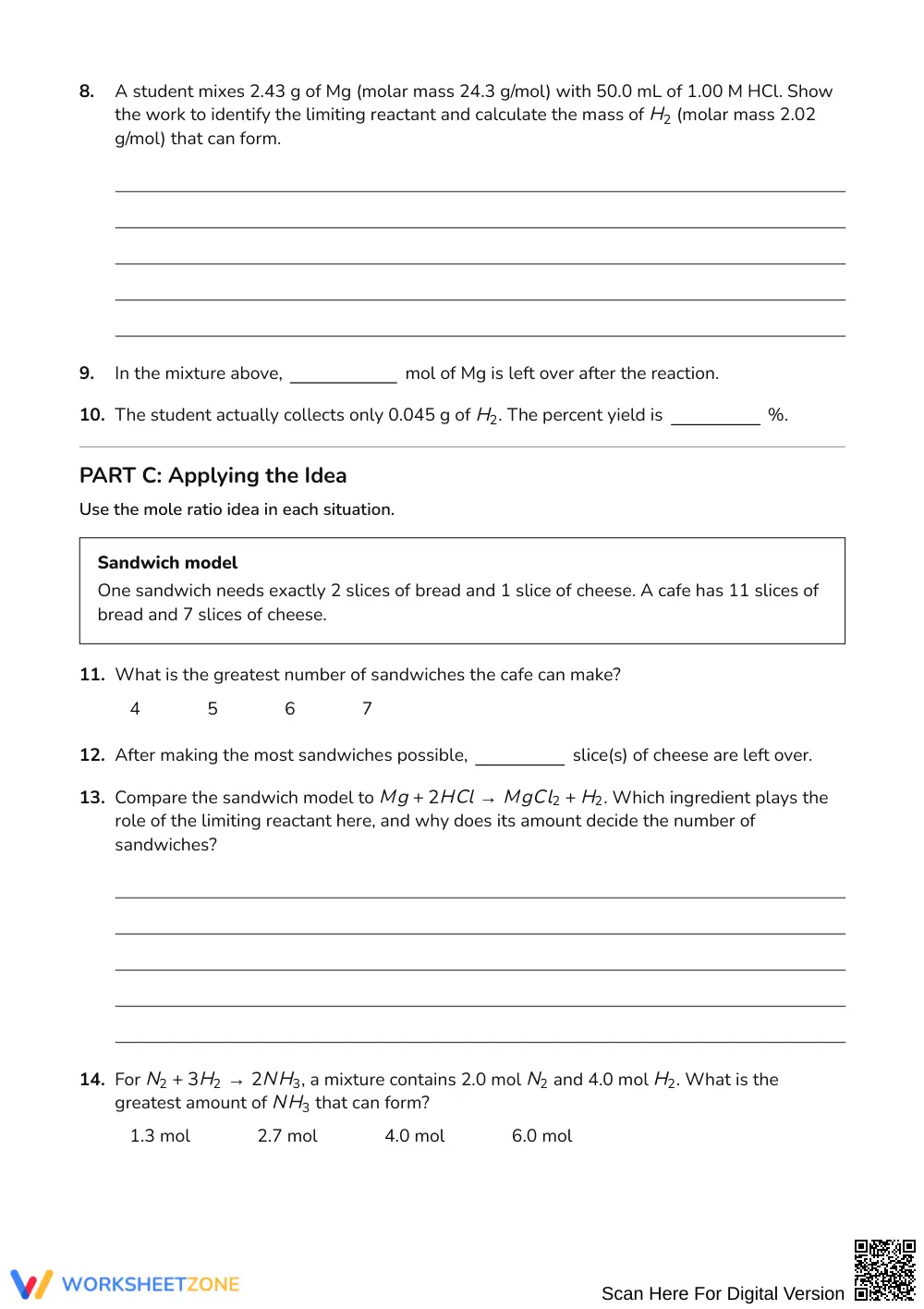
Across 4 structured pages, students complete 21 targeted tasks addressing limiting reactant principles through diverse representations. The assessment includes a submicroscopic particle diagram of water synthesis, an empirical four-trial laboratory data table with temperature changes, an intuitive sandwich conceptual model, and rigorous quantitative stoichiometric mass-to-mole conversions. A complete 4-page answer key provides step-by-step calculations and exemplar explanations.
Skill Progression
- Guided practice (Tasks 1–5): Students examine particle-level representations of hydrogen and oxygen molecules to identify excess reactants and identify conceptual errors in reactant ratios with structural visual support.
- Supported practice (Tasks 6–14): Students analyze authentic laboratory data from magnesium-acid trials and solve structured mole-to-gram stoichiometric equations with given molar masses.
- Independent practice (Tasks 15–21): Students independently transfer limiting reactant logic to conceptual analogy problems and craft Claim-Evidence-Reasoning arguments connecting thermal energy changes to reaction limits.
This sequence follows a gradual-release framework that shifts students from visual modeling to autonomous quantitative and conceptual synthesis.
Standards Alignment
This assessment aligns directly with high school physical science standards for chemical reactions. Students construct explanations based on evidence, utilize mathematical representations of chemical equations, and quantify matter conservation. Supporting chemistry standards address exothermic enthalpy and energy conservation during bond reorganization. Both standard descriptions can be copied directly into lesson plans, IEP goals, or district curriculum mapping tools.
How to Use It
Administer this 4-page assessment after direct instruction on stoichiometry to evaluate summative student mastery, or divide the sections across two class periods for targeted mid-unit review. During completion, monitor students on Part B calculations to check whether they divide masses by molar mass before applying mole ratios. Expect students to take 45 to 60 minutes for full completion.
Who It's For
This resource serves general high school chemistry, honors chemistry, and introductory physical science students needing rigorous stoichiometric practice. Pair this printable worksheet with a physical molecular modeling lab or an aqueous precipitation demonstration to reinforce microscopic-to-macroscopic connections.
According to Fisher & Frey (2014), structured problem progressions that transition from visual representations to quantitative problem-solving foster robust conceptual understanding in secondary science. This 21-task worksheet systematically evaluates whether learners can identify limiting reagents across microscopic particle diagrams, authentic laboratory data tables, and stoichiometric calculations. By pairing conceptual analogies with rigorous mole-ratio computations, the tasks isolate common student misconceptions surrounding excess reagents and theoretical yields. Students who engage with integrated mathematical and qualitative assessments demonstrate higher retention of conservation principles. This self-contained assessment resource delivers clear diagnostic insight into student readiness for advanced chemical equilibrium and thermochemistry units.


