































Complete Limiting Reactant Worksheet | Grades 9-12 Science

Paste this activity's link or code into your existing LMS (Google Classroom, Canvas, Teams, Schoology, Moodle, etc.).
Students can open and work on the activity right away, with no student login required.
You'll still be able to track student progress and results from your teacher account.
This Grades 9–12 science worksheet guides students through limiting reactant principles using experimental data, particle models, and thermochemical metrics. Learners analyze how reactant amounts dictate product yields, identify excess reagents, and connect macroscopic observations to atomic behavior. Structured questions build quantitative mastery and data analysis skills.
At a Glance
- Grade: Grades 9–12 · Subject: Science
- Standard: High School Physical Science — Predict reaction products and limits using data and models
- Skill Focus: Limiting reactants, particle diagrams, and stoichiometric data
- Format: 4 pages · 16 problems · Answer key included · PDF
- Best For: Chemistry guided practice or review
- Time: 45–60 minutes
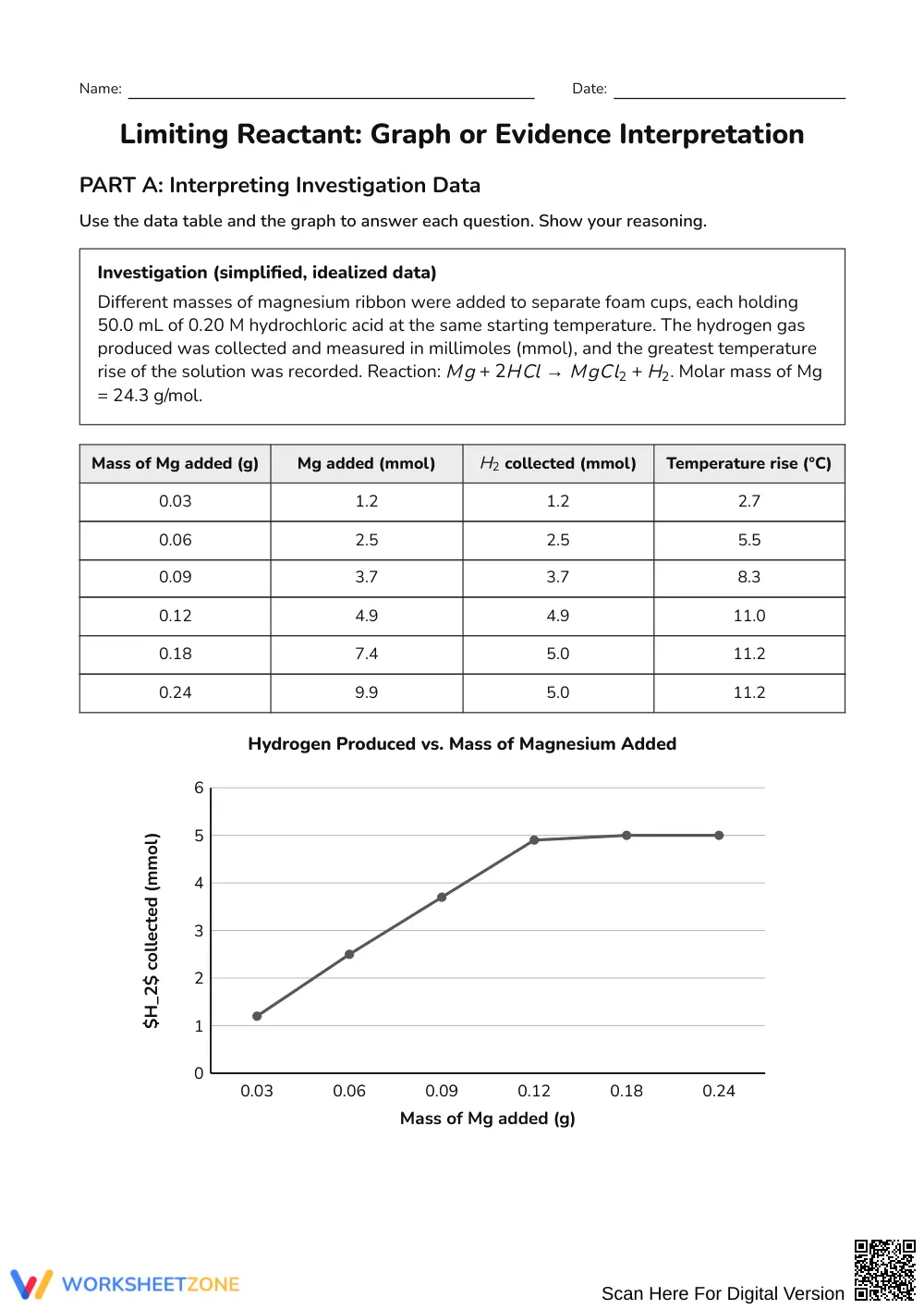
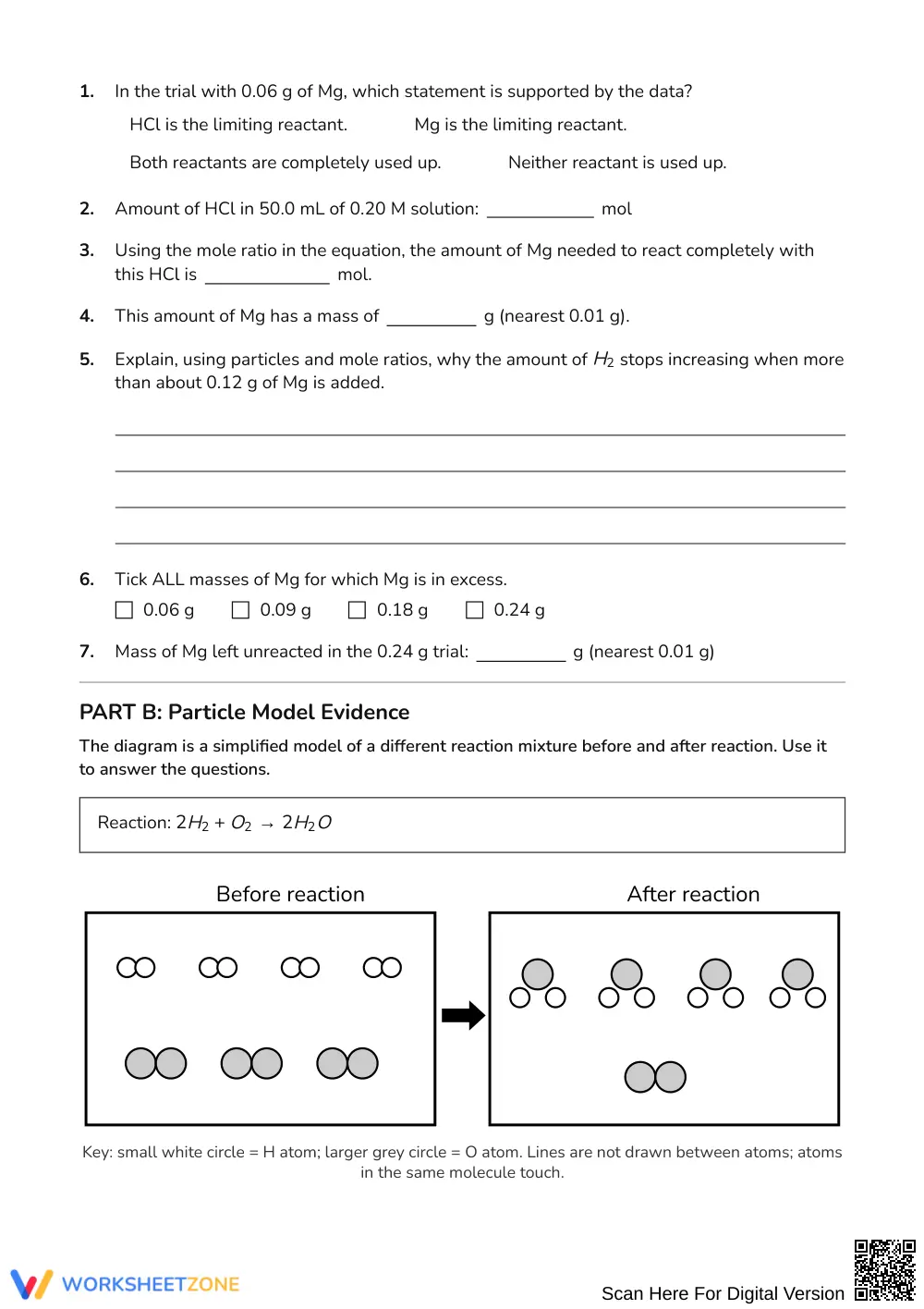
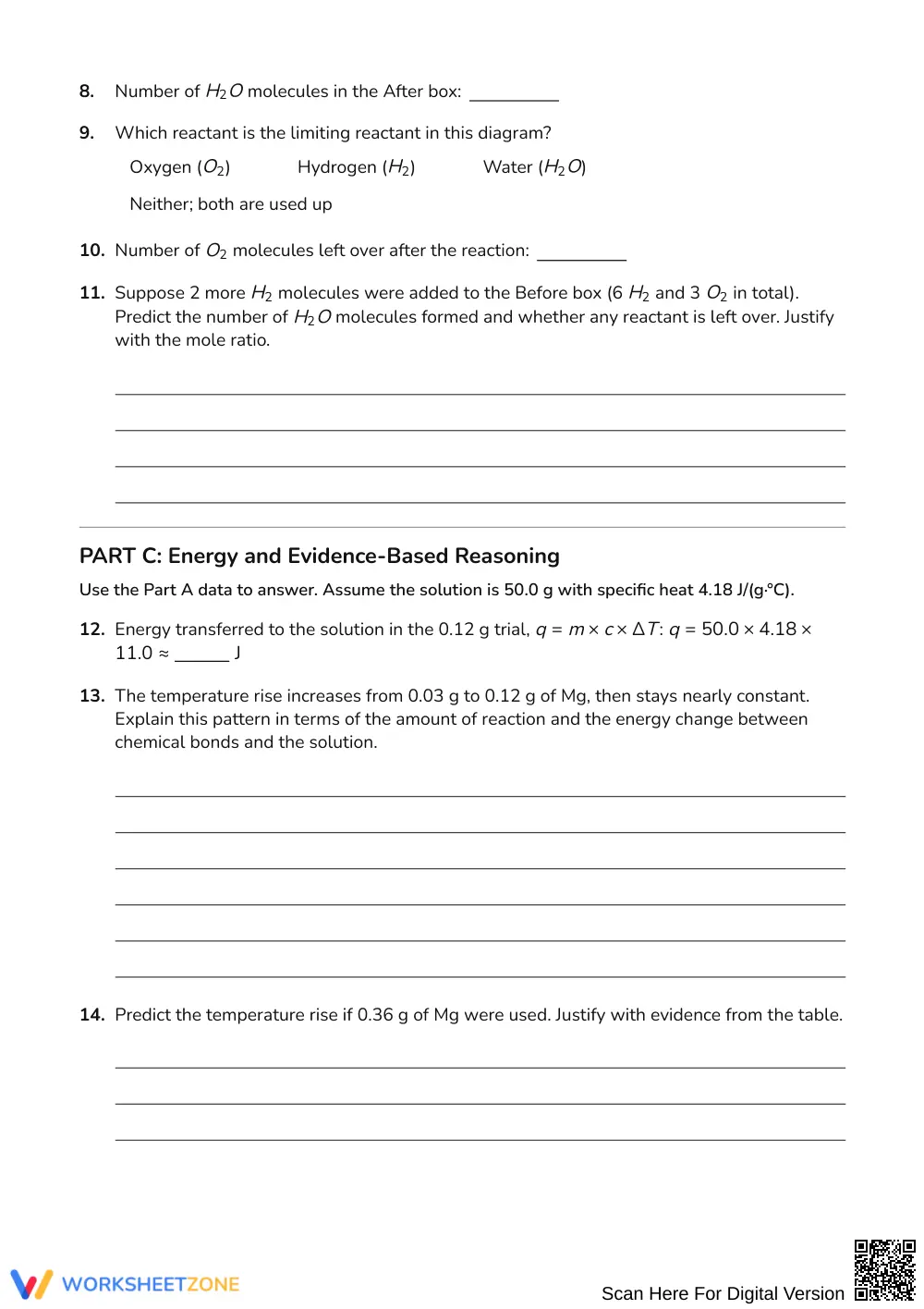
The 4-page worksheet contains 16 evidence-based problems organized across three structured sections. Students examine an empirical magnesium-acid reaction data table, a yield graph, atomic particle diagrams of water synthesis, and thermal energy measurements. A 4-page answer key provides complete calculations, mole ratios, and claim-evidence-reasoning explanations.
Skill Progression
- Guided practice (Part A, 7 tasks): Students evaluate lab data and an empirical graph to determine where product yield plateaus and calculate unreacted magnesium.
- Supported practice (Part B, 4 tasks): Learners inspect particle diagrams, identify the limiting reagent, quantify excess molecules, and predict outcomes for altered reactant ratios.
- Independent practice (Part C, 5 tasks): Students calculate energy transfer, explain thermal plateaus using bond changes, and complete a claim-evidence-reasoning argument.
This sequence follows the gradual-release model (I Do, We Do, You Do) to foster analytical independence.
Standards Alignment
This resource aligns with high school physical science standards for chemical reactions. Students use mathematical representations to show that atoms and mass are conserved during reactions, accounting for limiting reagents. Both standard descriptions can be copied directly into lesson plans, IEP goals, or district curriculum mapping tools.
How to Use It
Use this resource after direct instruction on mole ratios. In small groups, have students complete Part A to uncover why product yields level off. During formative assessment, monitor whether students assume the reactant with lower mass is automatically limiting, redirecting them to molar ratios. Completion takes approximately 45 to 60 minutes.
Who It's For
This worksheet is designed for high school chemistry and physical science students. Support emerging learners by providing molar mass formulas, and challenge advanced students to write balanced thermochemical equations. Pair this activity with an interactive particle simulation or stoichiometry lab.
Limiting reactant mastery requires high school chemistry students to reconcile macroscopic observations with atomic representations and stoichiometric mole ratios. According to research from Fisher & Frey (2014) on structured instructional frameworks, pairing concrete empirical data with visual particle models accelerates conceptual understanding during complex chemical problem-solving. This 4-page science worksheet delivers 16 evidence-based tasks that guide students from experimental data analysis to particulate modeling and thermochemical evaluation. Learners interpret magnesium reaction yields, determine excess reagents, calculate energy transfer using calorimetry formulas, and write scientific arguments supported by data. By connecting submicroscopic particle diagrams directly to quantitative reaction plateaus, students overcome pervasive misconceptions regarding reactant mass versus mole quantities. The scaffolded progression ensures that students build enduring conceptual and mathematical competency in chemistry, making it a reliable instructional tool for standards-based secondary science classrooms.


