































Complete Limiting Reactant Worksheet | Grades 9-12 Science

Paste this activity's link or code into your existing LMS (Google Classroom, Canvas, Teams, Schoology, Moodle, etc.).
Students can open and work on the activity right away, with no student login required.
You'll still be able to track student progress and results from your teacher account.
This limiting reactant worksheet helps high school chemistry students identify limiting reagents, interpret particle diagrams, and calculate reaction yields. Across 34 structured problems, learners connect qualitative models to quantitative stoichiometry, examining how reactant ratios govern product formation and energy release.
At a Glance
- Grade: Grades 9–12 · Subject: Science
- Standard: High School Chemistry — Calculate stoichiometric relationships, determine limiting reactants, and evaluate reaction yields
- Skill Focus: Limiting reactant classification, particle models, and yield calculations
- Format: 4 pages · 34 problems · Answer key included · PDF
- Best For: High school stoichiometry and chemistry practice
- Time: 45–60 minutes
What's Inside
This four-page resource provides 34 tasks covering core definitions, particle diagrams, data analysis, and calculations. Scaffolds include a recipe analogy, balanced chemical equations, and structured tables. A four-page answer key provides complete mathematical steps and explanations for all reasoning prompts.
Skill Progression
- Guided practice (Part A, 9 items): Students match vocabulary terms and apply a sandwich recipe analogy to establish the limiting reactant concept.
- Supported practice (Parts B & C, 18 items): Learners evaluate reaction tables, analyze submicroscopic particle diagrams, and interpret multi-trial experimental data connecting mole ratios to temperature changes.
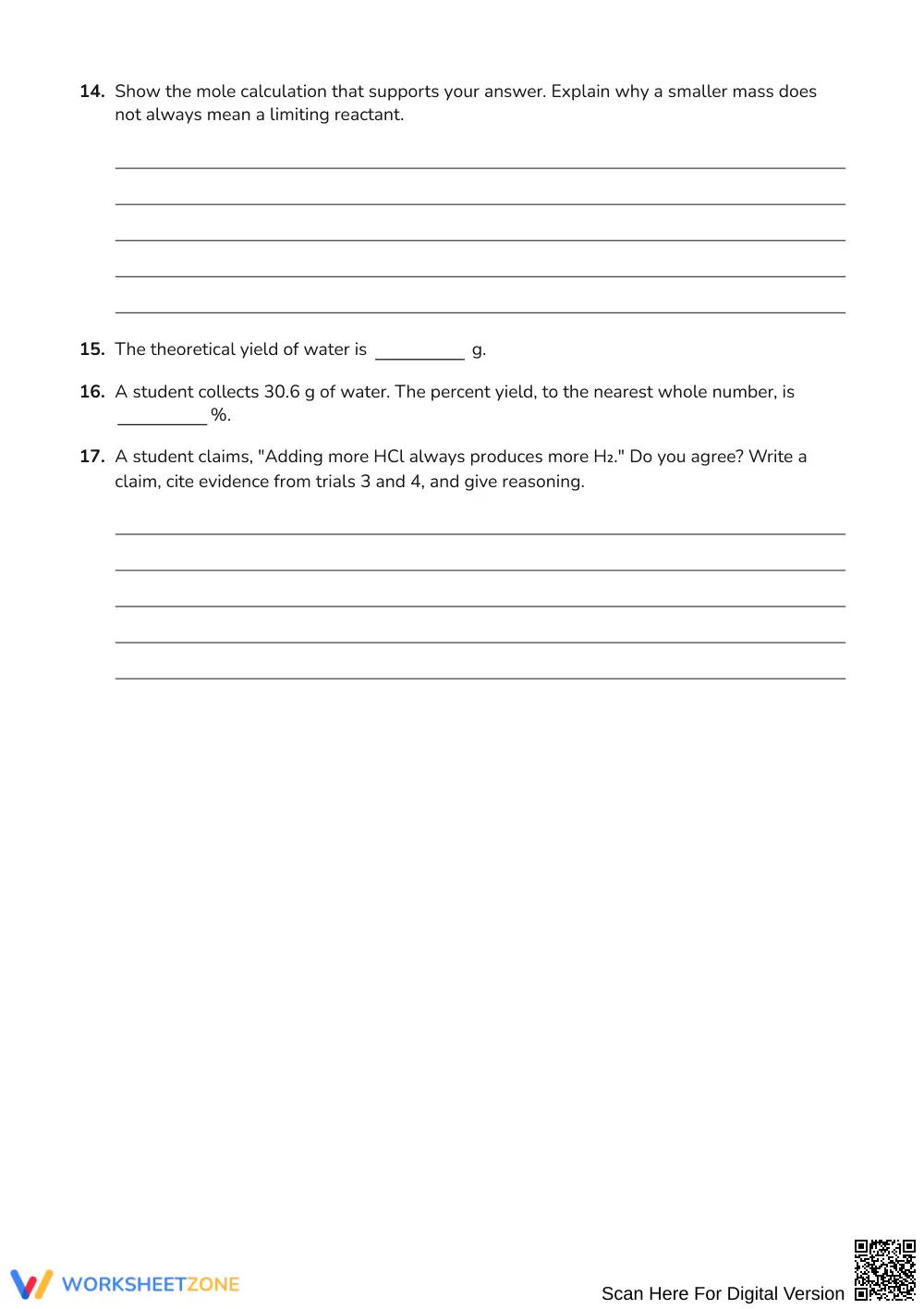
- Independent practice (Part D, 7 items): Students calculate theoretical and percent yields from mass measurements and construct claim-evidence-reasoning explanations.
This gradual release progression transitions students from intuitive models to independent chemical calculations.
Standards Alignment
This worksheet aligns with high school physical science standards for chemical reactions. Students apply mathematical representations to support the claim that mass is conserved during chemical reactions, using stoichiometric ratios to identify limiting reactants. Both standard codes can be copied directly into lesson plans, IEP goals, or district curriculum mapping tools.
How to Use It
Assign this worksheet after direct instruction on mole ratios to consolidate stoichiometry skills. During guided practice, observe whether students convert gram quantities to moles before identifying the limiting reagent. For extended practice, assign Parts C and D as a post-lab review. Expected completion time is 45 to 60 minutes.
Who It's For
This resource is built for high school chemistry students learning stoichiometric relationships. Particle models provide entry points for visual learners, while multi-step yield calculations challenge advanced students. Pair this activity with an introductory particulate simulation or a laboratory reaction demonstration.
According to Fisher & Frey (2014), structured instructional sequences that move from scaffolded conceptual models to independent quantitative problem-solving foster enduring mastery in secondary science classrooms. This Grades 9–12 chemistry resource reinforces limiting reactant classification, mole ratio analysis, and yield calculations across 34 targeted prompts and 4 student pages. By integrating familiar analogies, submicroscopic particle diagrams, and experimental data analysis, the activity ensures high school students actively differentiate between mass and molar proportions. Learners systematically calculate theoretical yields, determine percent yields, and articulate scientific arguments supported by empirical evidence. The structured progression scaffolds complex chemical reasoning while reinforcing conservation of mass principles. Accompanied by a 4-page answer key with complete mathematical solutions, this printable worksheet provides educators with reliable, curriculum-aligned materials designed to accelerate high school chemistry competency and quantitative data interpretation.


