
































Complete Invariant & Mapping Worksheet | Grade 10 Geometry

Paste this activity's link or code into your existing LMS (Google Classroom, Canvas, Teams, Schoology, Moodle, etc.).
Students can open and work on the activity right away, with no student login required.
You'll still be able to track student progress and results from your teacher account.
Mastering rigid motions requires distinguishing invariant properties from transformation effects while maintaining precise correspondence. This worksheet equips Grade 10 geometry students to identify, critique, and correct ten common transformation errors. Learners analyze flawed reasoning, explain why geometric properties were violated, and construct valid congruence statements.
At a Glance
- Grade: 10 · Subject: Geometry
- Standard:
HSG-CO.B.6— Use geometric descriptions of rigid motions to transform figures and predict congruence- Skill Focus: Correct Invariant and Correspondence Errors
- Format: 5 pages · 10 problems · Answer key included · PDF
- Best For: Misconception repair and congruence mastery
- Time: 45–60 minutes
This 5-page worksheet includes a reference summary of rigid motion invariants and a modeled error repair problem. Across 10 multi-part tasks, students locate reasoning errors, explain violations of isometry principles, and write corrected statements. A complete 5-page answer key provides comprehensive explanations and corrected vertex mappings.
Skill Progression
- Guided Practice (Part A, Problems 1–4): Focuses on vertex correspondence, prompting students to resolve reflection mappings, orientation reversals, and rotation slopes.
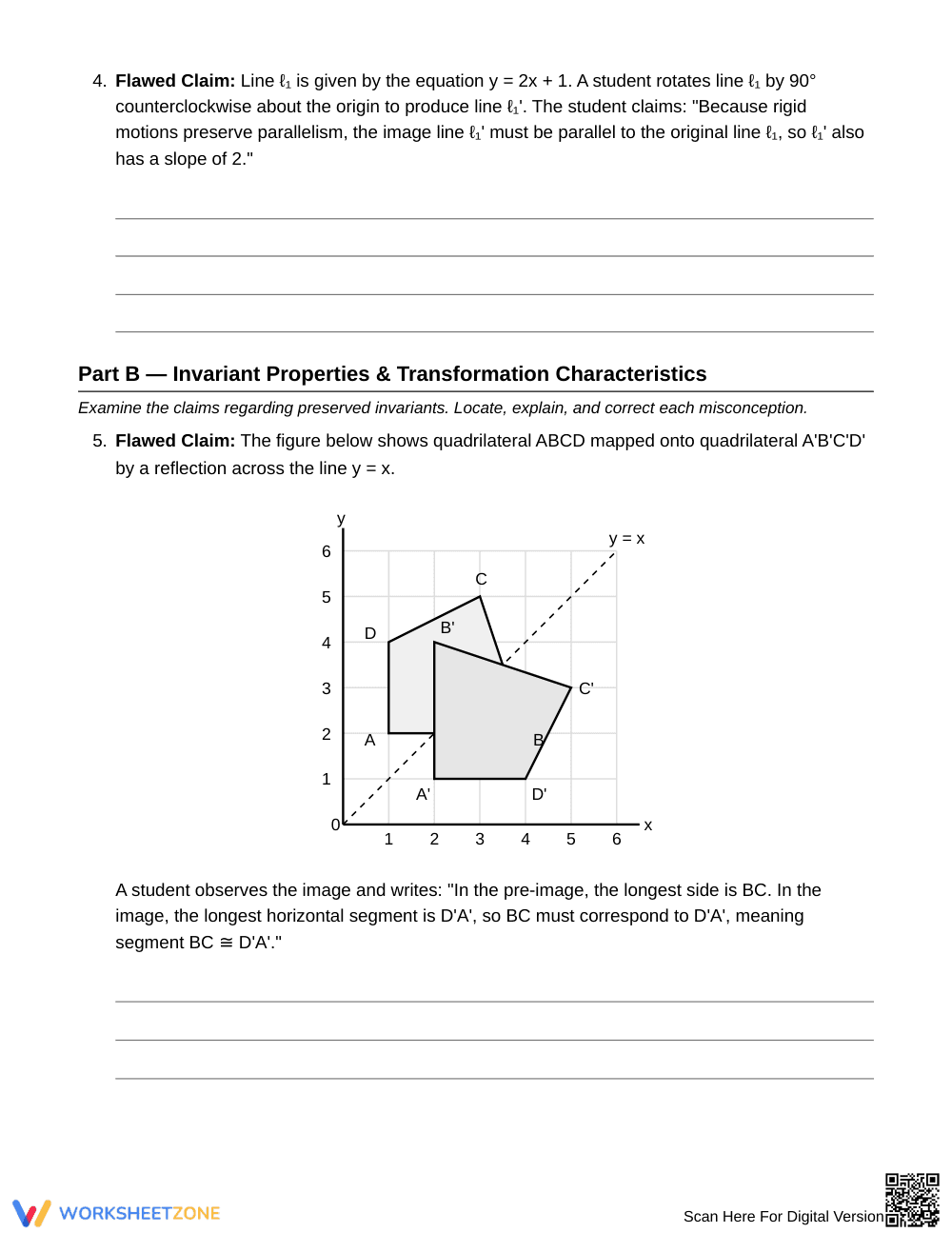
- Supported Practice (Part B, Problems 5–7): Examines invariant properties, challenging students to critique false claims about segment lengths, coordinate scalings, and rotational arc lengths.
- Independent Practice (Part C, Problems 8–10): Targets advanced deductions concerning composite reflections, area-perimeter fallacies, and line symmetry fixed points.
This sequence utilizes the gradual-release framework to move students from guided correspondence checks to independent geometric deduction.
Standards Alignment
This worksheet aligns to HSG-CO.B.6: Use geometric descriptions of rigid motions to transform figures and predict congruence. It also supports standard HSG-CO.A.5 through composite reflections and rotations. Both standard codes can be copied directly into lesson plans, IEP goals, or district curriculum mapping tools.
How to Use It
Use this worksheet after direct instruction on isometries to solidify conceptual clarity before triangle congruence proofs. In a paired-learning activity, students discuss each error before drafting written repairs, completing the 10 tasks in 45 to 60 minutes. As a formative assessment tip, check whether students determine correspondence using cyclic vertex order or coordinate values to identify lingering spatial misconceptions.
Who It's For
Designed for Grade 10 Geometry students preparing for formal proof units, this resource aids learners needing explicit non-examples. Pair this worksheet with coordinate plane diagrams or a transformation anchor chart to reinforce rigid motion properties.
Secondary mathematics researchers emphasize that error analysis solidifies deductive reasoning in transformation geometry far more effectively than repetitive calculation. According to Fisher & Frey (2014), analyzing authentic non-examples and repairing flawed peer explanations directly guides learners from surface procedural compliance toward durable conceptual mastery. This instructional resource directly targets standard HSG-CO.B.6, requiring Grade 10 students to critique flawed mathematical arguments concerning rigid motions, vertex correspondence, and invariant geometric properties. By systematically evaluating ten targeted claims involving reflections, rotations, coordinate mappings, and dilations, high school geometers isolate logical breakdowns, verify whether distance and angle measure remain invariant, and re-establish rigorous vertex-to-vertex congruence statements. As students replace incorrect assumptions with formal deductive justifications, they build the precise mathematical vocabulary and logical reasoning essential for coordinate and Euclidean proofs. This structured error-correction protocol establishes a reliable evidence-based foundation for understanding transformation-based congruence across secondary mathematics curricula.


