































Complete Half-Life Worksheet | Grades 9–12 Science

Paste this activity's link or code into your existing LMS (Google Classroom, Canvas, Teams, Schoology, Moodle, etc.).
Students can open and work on the activity right away, with no student login required.
You'll still be able to track student progress and results from your teacher account.
This high school science worksheet equips students to master half-life calculations through real-world scenarios in archaeology, medicine, and environmental science. Learners calculate elapsed half-lives, interpret exponential decay curves, and predict isotope quantities over time. Structured tasks connect theoretical decay rates to authentic quantitative data across 32 practice items.
At a Glance
- Grade: Grades 9–12 · Subject: Science
- Standard: Physical Science Core — Model radioactive decay and calculate elapsed half-lives in samples
- Skill Focus: Half-Life Calculations and Data Analysis
- Format: 4 pages · 32 problems · Answer key included · PDF
- Best For: Nuclear chemistry practice and formative assessment
- Time: 45–60 minutes
What's Inside
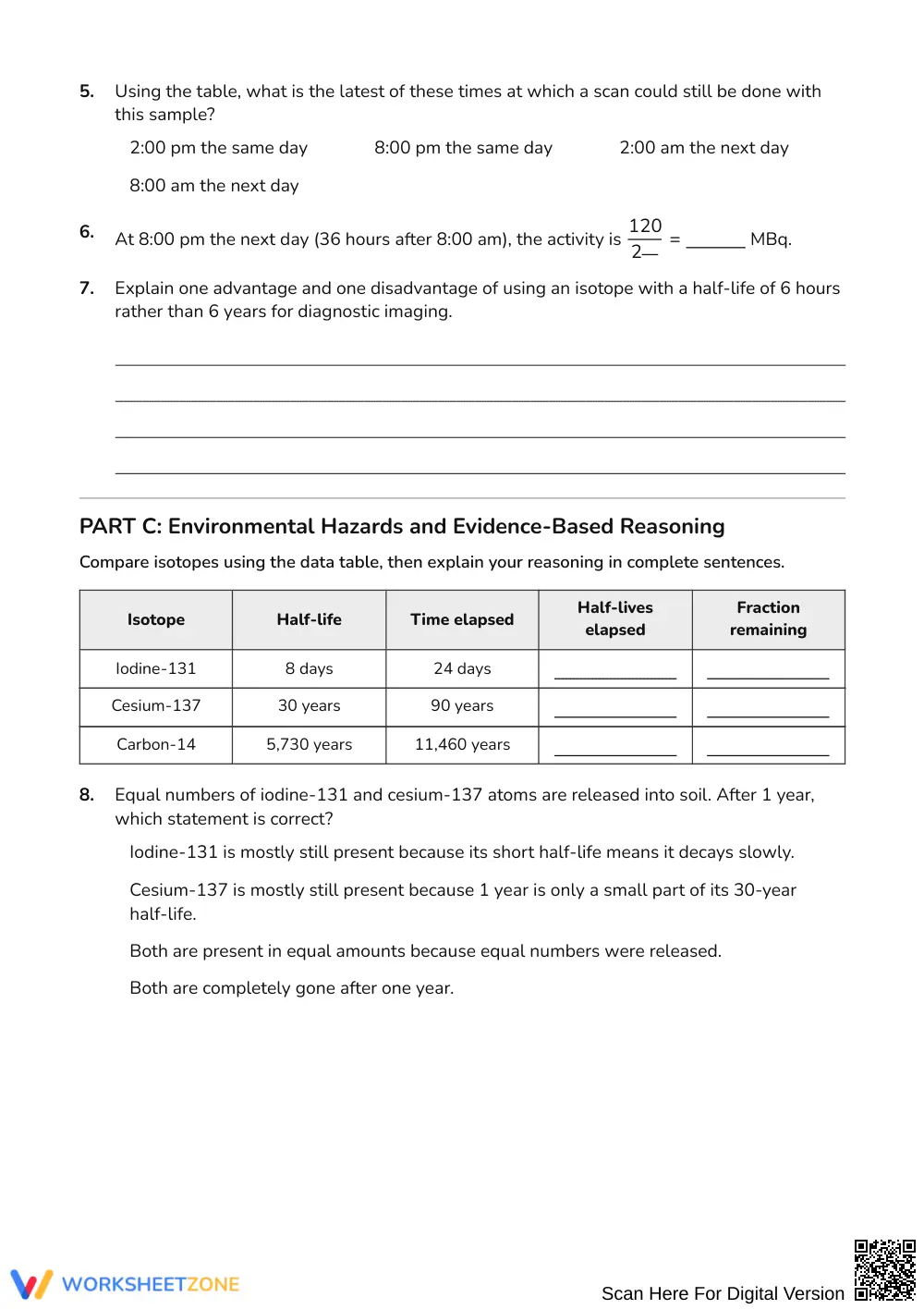
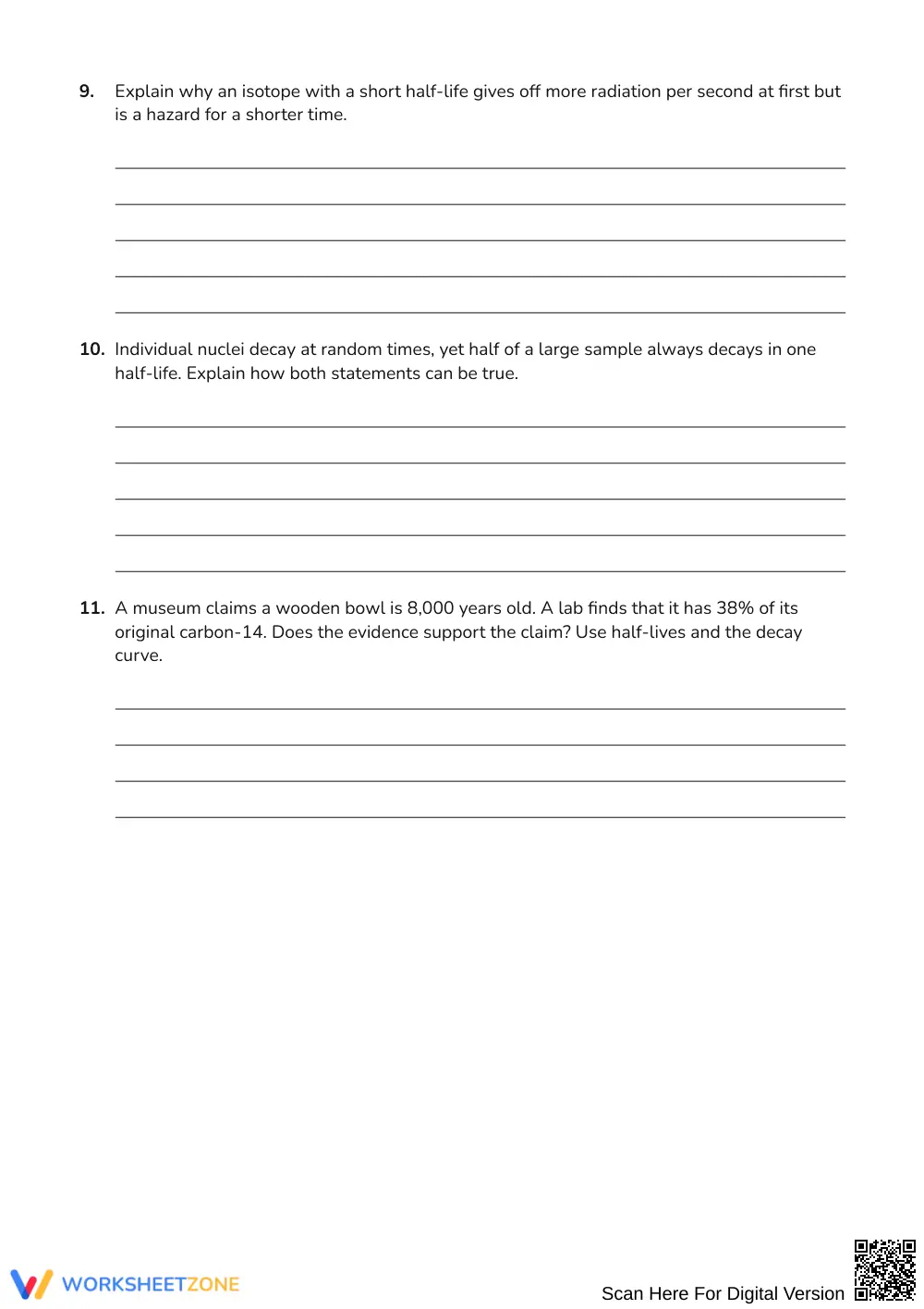
The 4-page worksheet organizes 32 problems across three real-world investigations: carbon-14 artifact dating, technetium-99m medical imaging, and environmental isotope decay. Features include complete decay tables, decay curve graphs, multiple-choice checks, and open-response questions requiring evidence-based reasoning. A comprehensive 4-page answer key provides numeric solutions and detailed explanations.
Skill Progression
- Guided Practice: Part A guides students through carbon-14 dating with labeled tables and decay curve models.
- Supported Practice: Part B presents clinical scenarios on hospital radiotracers with reduced graphic scaffolding.
- Independent Practice: Part C challenges students to compare isotope decay rates and construct evidence-based justifications.
This gradual-release structure moves students from supported data interpretation to independent quantitative modeling.
Standards Alignment
This worksheet addresses secondary physical science standards governing nuclear chemistry and radioactive decay. Students use mathematical representations to model decay fractions, daughter isotopes, and half-life intervals across distinct timescales. Both standard codes can be copied directly into lesson plans, IEP goals, or district curriculum mapping tools.
How to Use It
Deploy this worksheet during independent practice following a lecture on radioactive decay, or assign parts during collaborative lab stations. During class, monitor student calculations of elapsed half-lives in Part A to diagnose misconceptions regarding exponential decay. Expected completion time is 45 to 60 minutes.
Who It's For
This resource targets high school Chemistry, Physics, and Earth Science students exploring nuclear processes. Structured data tables support emerging learners, while analytical prompts challenge advanced students. Pair this worksheet directly with an introductory nuclear decay simulation or a lesson on isotopic half-life properties.
According to research from Fisher & Frey (2014), structured cognitive work that moves systematically from guided data analysis to independent scientific writing accelerates conceptual mastery and retention in secondary STEM courses. This worksheet supports that progression by training high school students to calculate radioactive half-lives, evaluate nuclear decay curves, and apply mathematical models to real-world contexts in medicine and archaeology. Students repeatedly calculate remaining sample fractions, interpret non-linear decay graphs, and evaluate empirical claims using isotopic evidence. By confronting common misconceptions—such as misapplying carbon-14 dating to ancient geological eras—students build robust quantitative literacy and scientific communication skills. The 32 structured tasks and accompanying 4-page answer key provide secondary science educators with rigorous, research-aligned materials suitable for standards-based assessment and targeted intervention.


