































Complete Half-Life Worksheet | Grades 9-12 Science

Paste this activity's link or code into your existing LMS (Google Classroom, Canvas, Teams, Schoology, Moodle, etc.).
Students can open and work on the activity right away, with no student login required.
You'll still be able to track student progress and results from your teacher account.
This comprehensive half-life calculation worksheet develops high school science students' ability to model radioactive decay, interpret exponential curves, and calculate isotope ages. Through structured data analysis and conceptual problem-solving, learners connect decay rates to real-world applications including medical imaging and radiometric dating, building quantitative mastery across 30 scaffolded tasks.
At a Glance
- Grade: Grades 9–12 · Subject: Science
- Standard: High School Physical Science — Model radioactive decay and quantitative relationships in nuclear processes
- Skill Focus: Half-life calculations, decay models, and isotope classification
- Format: 4 pages · 30 problems · Answer key included · PDF
- Best For: Nuclear chemistry and Earth science units
- Time: 45–60 minutes
What's Inside
The 4-page student activity features four structured parts containing 30 total tasks. Students analyze isotope categorization charts, interpret an iodine-131 decay graph, complete a phosphorus-32 decay table, and evaluate atomic particle diagrams. The resource includes a full 4-page answer key with step-by-step mathematical reasoning, sample explanations, and misconception analyses.
Skill Progression
- Guided practice (Part A): Students classify five isotopes by half-life spans and match isotopes to practical applications with categorical criteria.
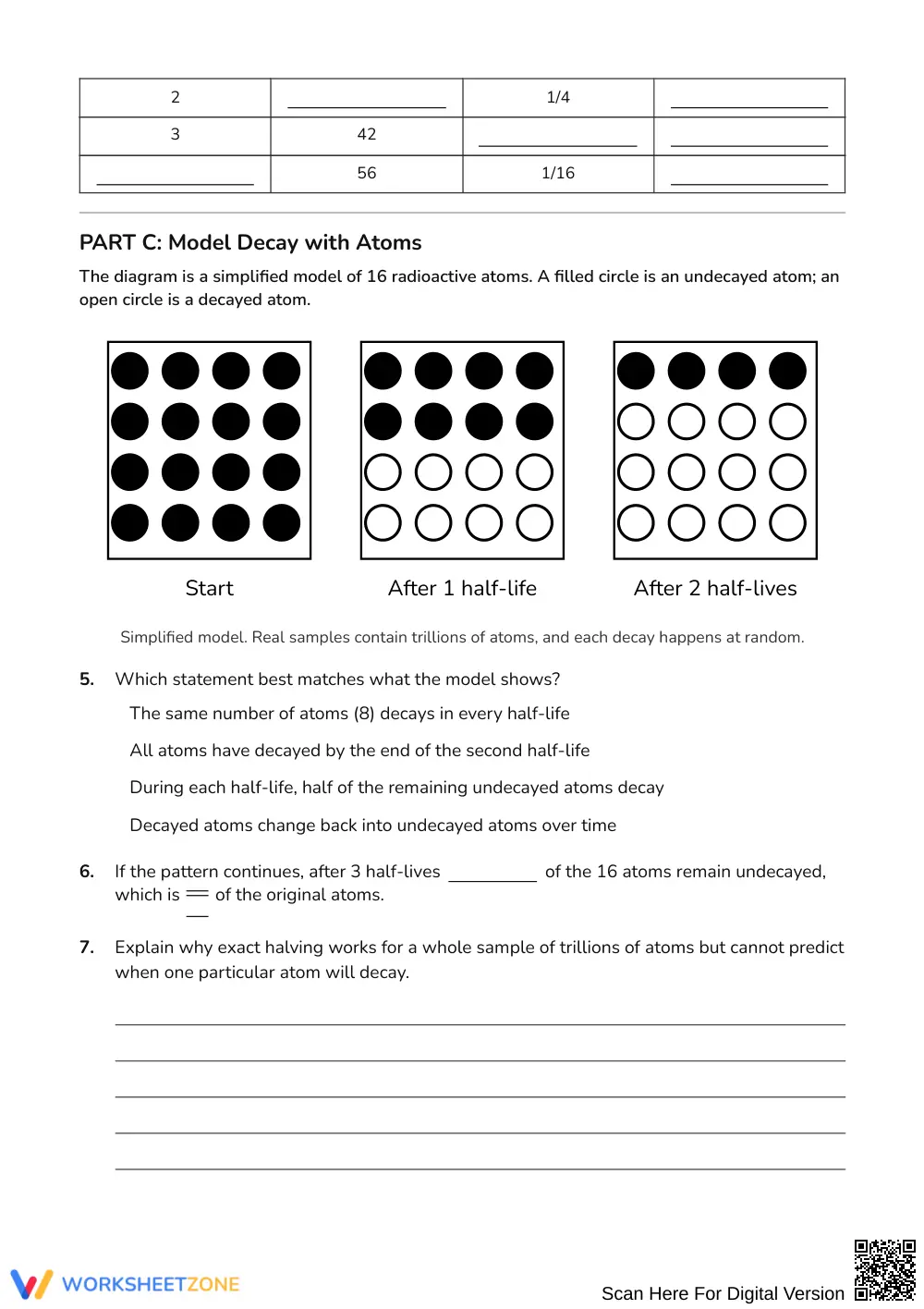
- Supported practice (Parts B & C): Learners analyze decay curves, complete a four-step mass-fraction table, and evaluate a 16-atom visual model showing decay probability.
- Independent practice (Part D): Students independently solve multi-step dating equations, compare decay speeds between competing samples, and refute common conceptual errors.
This structured progression reflects the gradual-release instructional model, moving students from guided categorization toward independent quantitative evaluation.
Standards Alignment
This resource aligns with high school physical science performance expectations requiring students to develop models illustrating nuclear changes and calculate quantitative half-life relationships over time. Supporting standards address radiometric dating in historical geology. These instructional targets can be copied directly into lesson plans, IEP goals, or district curriculum mapping tools.
How to Use It
Use this worksheet directly after introducing nuclear decay concepts to transition students from qualitative definitions to quantitative problem-solving. During classwork, monitor Part C to check whether students recognize that half-life represents statistical probability across large atomic populations rather than deterministic timing for single atoms. Completion time averages 45 to 60 minutes.
Who It's For
This practice set serves general chemistry, physical science, and Earth science students in grades 9 through 12. Visual diagrams and tabular scaffolds support developing learners, while multi-step calculations challenge advanced students. Pair this activity with an introductory lecture or radioactive decay simulation lab.
Mastering half-life calculations requires high school science students to coordinate proportional reasoning, graphical analysis, and nuclear concepts. According to Fisher & Frey (2014), student achievement increases significantly when complex quantitative tasks are organized into structured, gradual-release sequences that move from concrete visual models to abstract multi-step calculations. This four-page science worksheet embeds these evidence-based principles across 30 rigorous items. Learners begin by categorizing isotopes and matching them to technological applications, examine exponential decay curves and particle probability diagrams, and culminate in independent radiometric dating calculations. By integrating visual representations of decaying atoms alongside mathematical ratio tables, the resource directly targets persistent student misconceptions regarding sample disappearance and decay randomness. The accompanying four-page answer key provides complete mathematical steps and conceptual explanations, making this printable activity an effective, rigorous instructional tool for high school chemistry and physical science classrooms.


