

































Complete Half-Life Decay Worksheet | Grades 9-12 Science

Paste this activity's link or code into your existing LMS (Google Classroom, Canvas, Teams, Schoology, Moodle, etc.).
Students can open and work on the activity right away, with no student login required.
You'll still be able to track student progress and results from your teacher account.
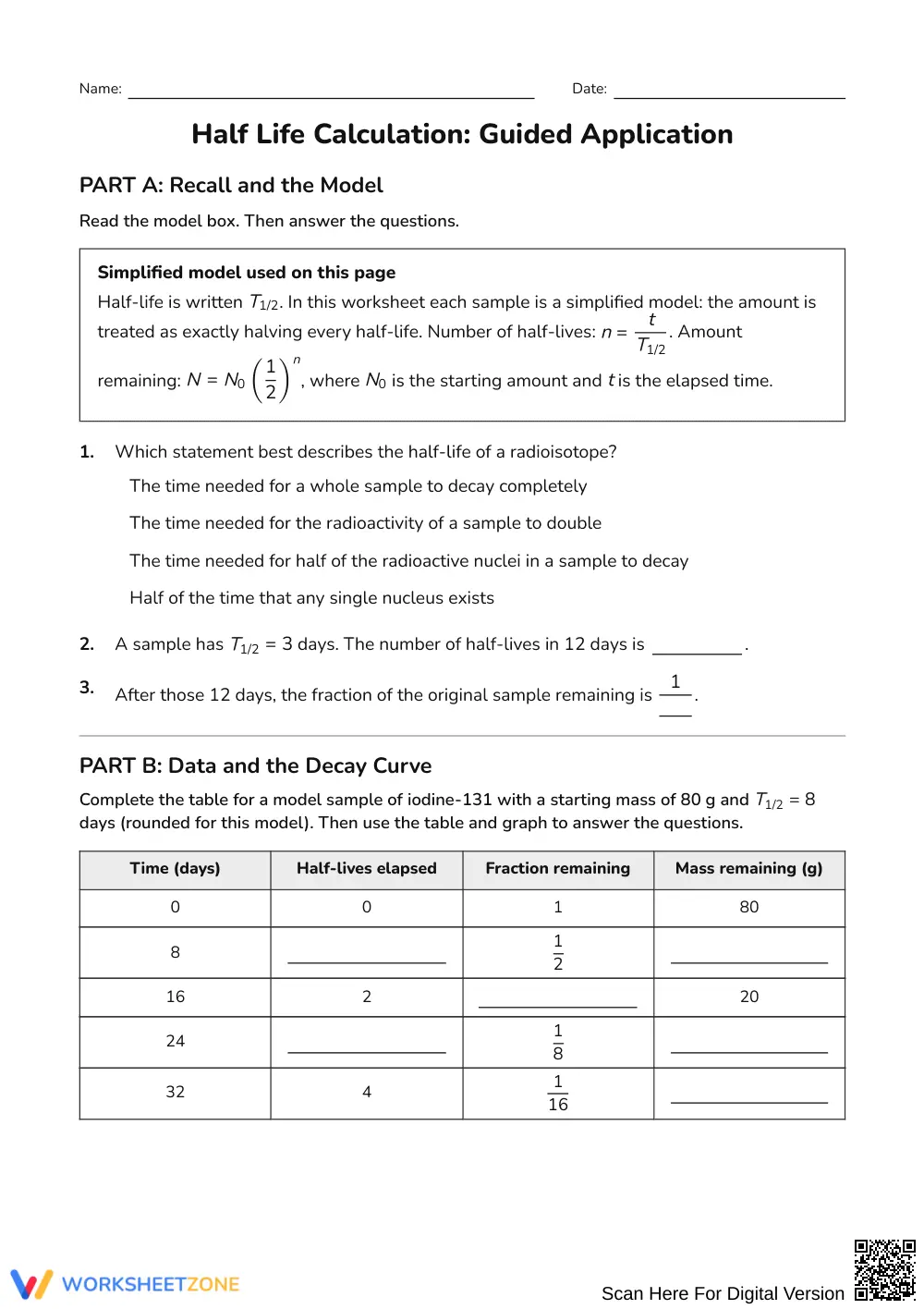
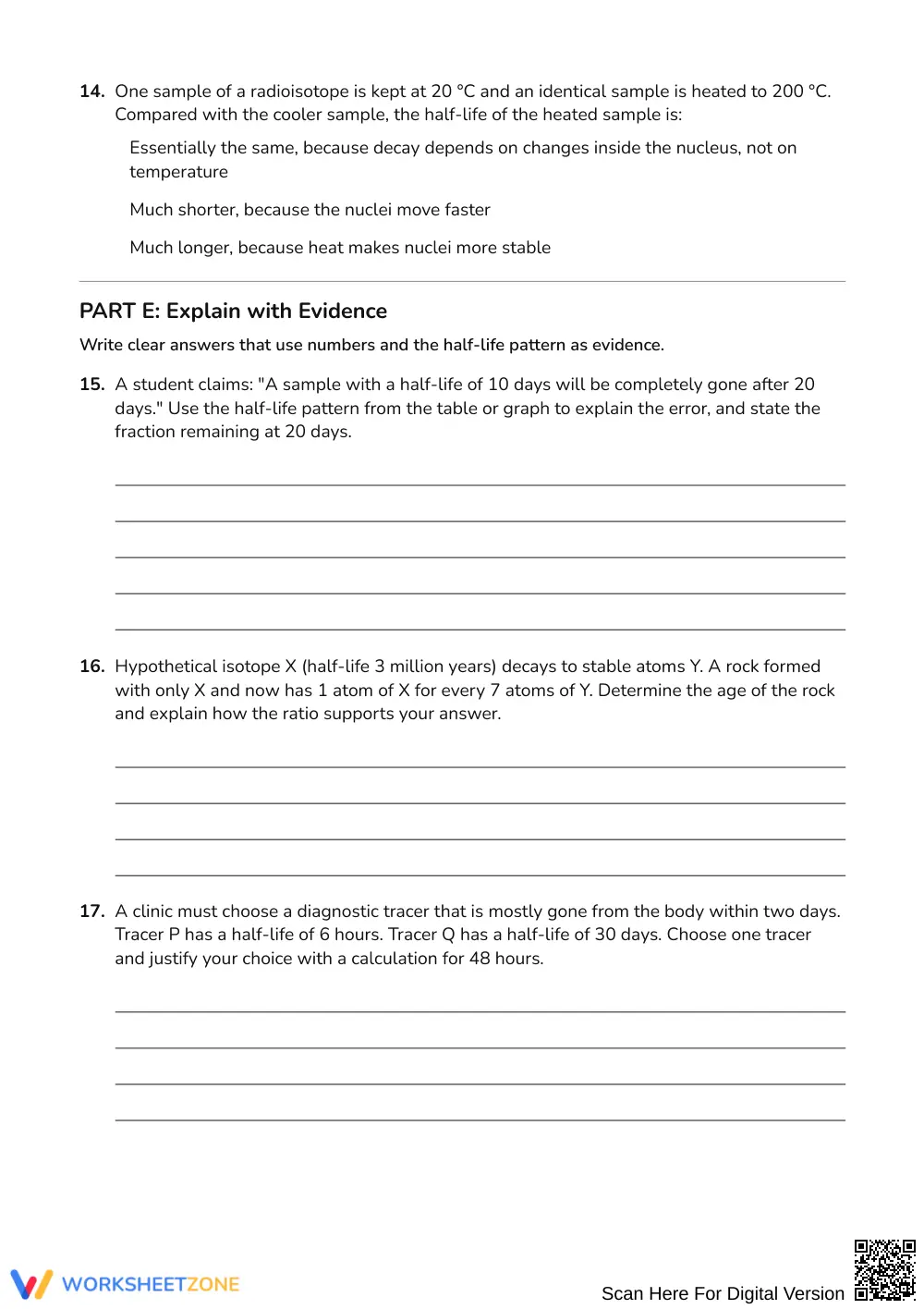
This comprehensive half-life calculation worksheet guides high school physical science and chemistry students through nuclear decay using authentic mathematical models, graphical decay curves, and real-world isotopic dating scenarios. Learners calculate elapsed half-lives, evaluate exponential decay tables, analyze random nuclear behavior, and justify clinical and geological decisions with quantitative evidence across 24 structured questions.
At a Glance
- Grade: Grades 9–12 · Subject: Science
- Standard: Model radioactive decay mechanisms, calculate half-life intervals, and evaluate isotopic decay data
- Skill Focus: Half-life mathematical problem-solving, decay curves, and evidence-based scientific reasoning
- Format: 4 pages · 24 problems · Answer key included · PDF
- Best For: Guided instruction, homework, or unit review
- Time: 45–60 minutes
What's Inside
Across four student-facing pages, this resource features a clear exponential decay equation box, an iodine-131 data table and decay curve graph, a 16-nuclei probabilistic visual grid, and multi-step word problems involving carbon-14 dating and medical radioisotope selection. A complete four-page step-by-step teacher answer key provides full mathematical derivations, fraction progressions, and model scientific explanations.
Skill Progression
- Guided practice (Tasks 1–4): Explicit foundational review where students define isotope half-life from a reference formula box and calculate basic interval fractions.
- Supported practice (Tasks 5–11): Scaffolded data interpretation requiring students to complete a decay table, track mass loss curves, and evaluate discrete 16-nuclei probability grids.
- Independent practice (Tasks 12–24): Authentic transfer problems demanding multi-step carbon dating calculations, medical tracer activity analysis, and written evidence-based justifications refuting common misconceptions.
This sequence follows a gradual-release instructional model that transitions high school learners systematically from concrete computational recall to sophisticated qualitative reasoning.
Standards Alignment
This resource aligns with high school physical science standards addressing nuclear processes and radioactive decay equations. Students use mathematical representations and physical models to explain how unstable atomic nuclei decay exponentially over characteristic time constants. Both standard descriptions and cross-cutting concepts can be copied directly into lesson plans, IEP goals, or district curriculum mapping tools.
How to Use It
Implement this packet immediately after direct instruction on nuclear stability and half-life formulas. Conduct Parts A and B collaboratively during class to secure graphing fluency, then assign Parts C through E for paired problem-solving or independent homework. During independent work, conduct a formative assessment check on Part E: ensure students recognize that half-life measures the decay of the remaining fraction rather than a linear subtraction from the initial total. Expected completion time is 45 to 60 minutes.
Who It's For
Designed for Grades 9–12 chemistry, physical science, and Earth science classrooms, this worksheet supports general education and honors tracks alike. For developing learners, the provided decay equation and step-by-step data tables scaffold mathematical manipulation. Pair this activity naturally with a radioactive decay simulator, cloud chamber demonstration, or nuclear chemistry anchor chart.
According to research by Fisher & Frey (2014) on effective gradual-release frameworks, structured problem sets that move deliberately from modeled worked examples to autonomous problem-solving significantly increase student self-efficacy in STEM disciplines. This worksheet operationalizes that pedagogical principle by embedding 24 targeted tasks across four instructional pages, systematically bridging the gap between abstract mathematical formulas and tangible scientific phenomena. By coupling quantitative decay calculations with qualitative explanations of nuclear randomness, the resource addresses persistent misconceptions identified in secondary science education. Students do not simply calculate numbers mechanically; they interpret graphical decay curves, evaluate real-world isotopes like iodine-131 and carbon-14, and construct evidence-based arguments regarding isotope selection in nuclear medicine. The included four-page answer key provides complete rationales, establishing a rigorous instructional tool that reinforces analytical reasoning and quantitative literacy across secondary science curricula.


