
































Complete Half-Life Decay Worksheet | Grades 9-12 Science

Paste this activity's link or code into your existing LMS (Google Classroom, Canvas, Teams, Schoology, Moodle, etc.).
Students can open and work on the activity right away, with no student login required.
You'll still be able to track student progress and results from your teacher account.
This 4-page science worksheet equips high school students to calculate and compare radioactive decay across radioisotopes. Students move beyond basic definitions to contrast exponential decay rates of Iodine-131 and Carbon-14 using data tables, graphs, and mathematical expressions, building deep conceptual understanding of nuclear half-life principles.
At a Glance
- Grade: Grades 9–12 · Subject: Science
- Standard: High School Physical Science — Model radioactive decay and compare isotope half-life rates
- Skill Focus: Compare and contrast half-life calculations
- Format: 4 pages · 34 problems · Answer key included · PDF
- Best For: Nuclear chemistry and physics units
- Time: 45–60 minutes
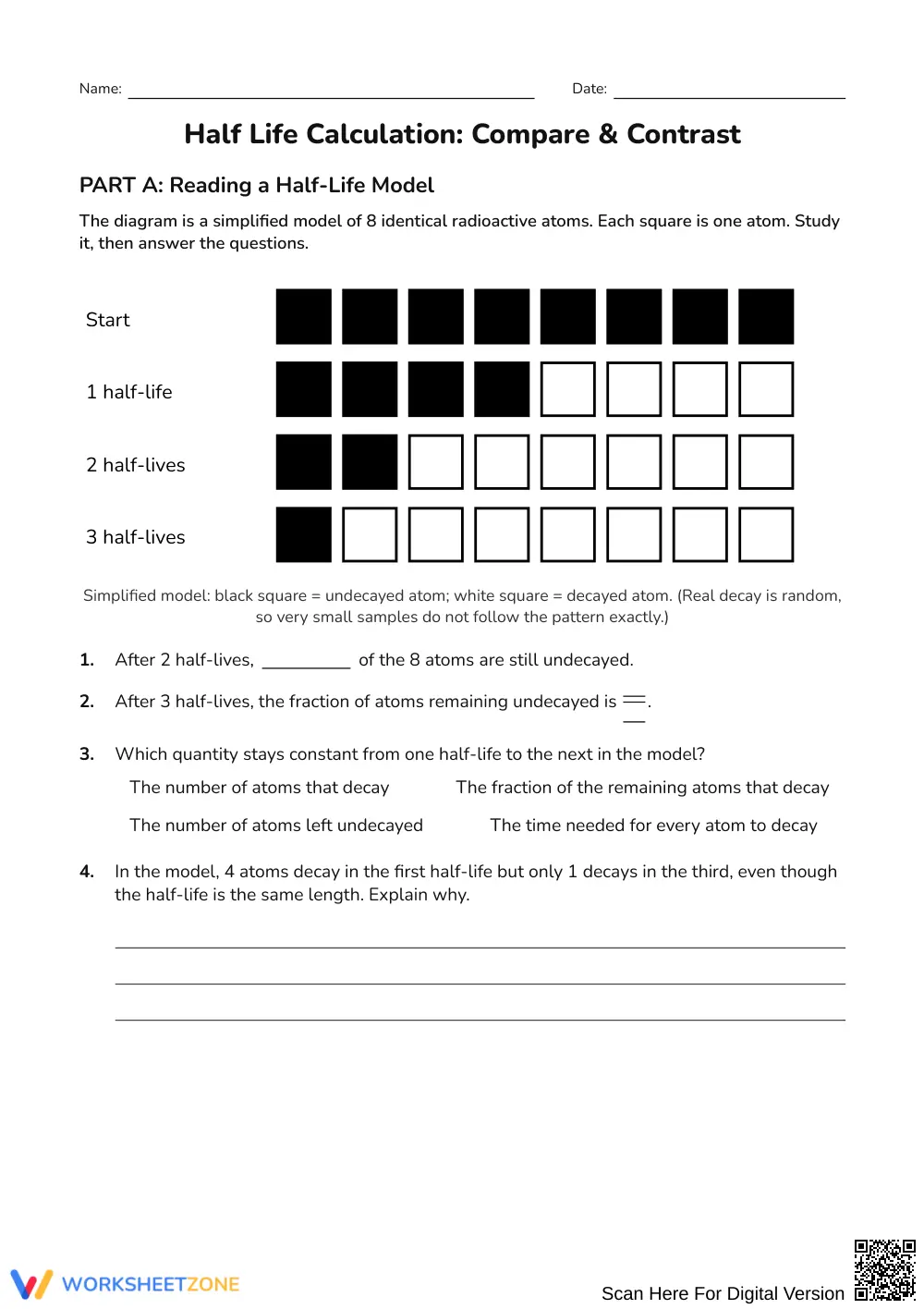
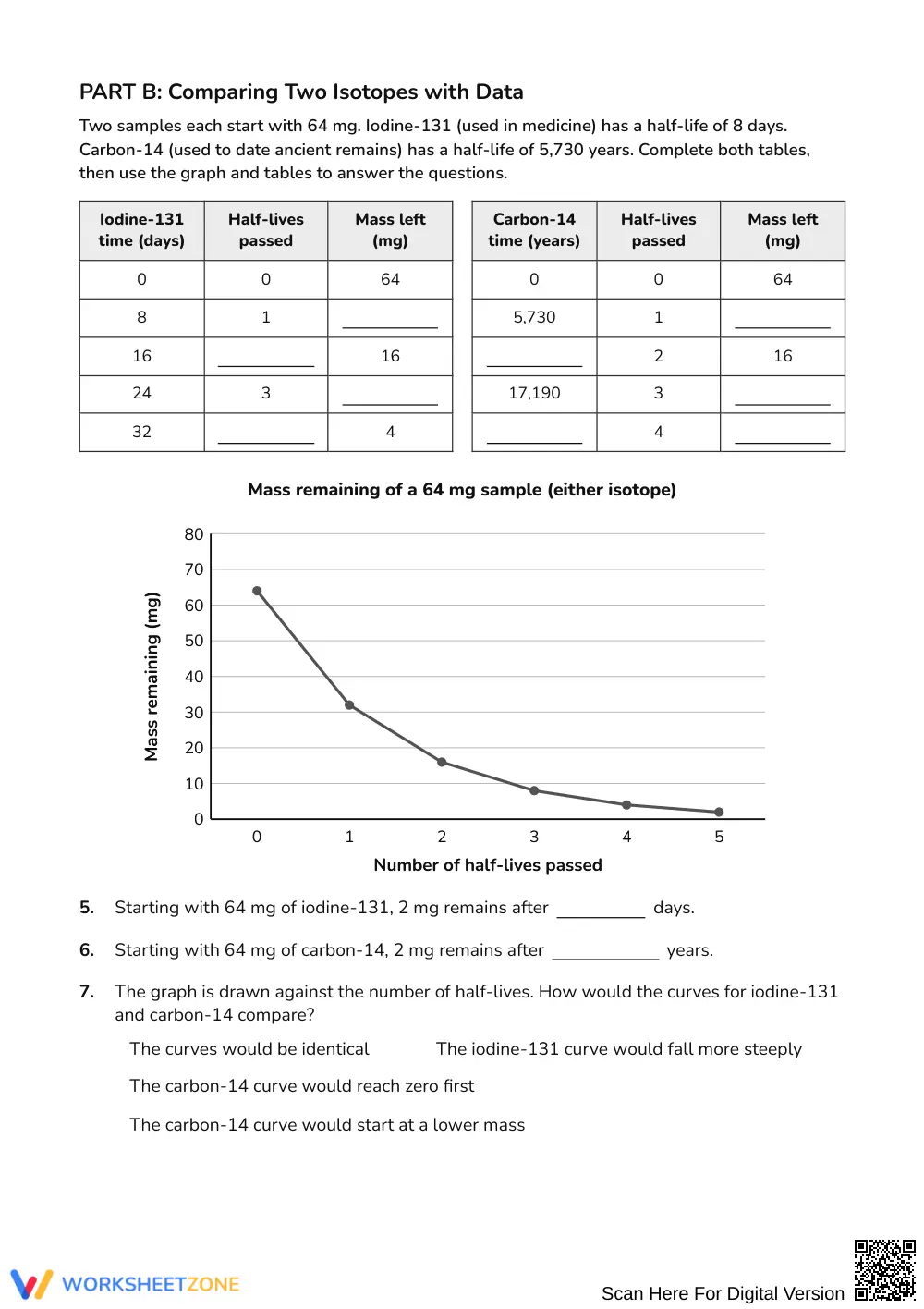
The resource contains 34 targeted questions across 4 pages, supported by a 4-page complete teacher answer key. Students interact with an 8-atom visual decay model, complete parallel data tables for two isotopes, interpret decay curves, evaluate student claims about isotope danger, and calculate remaining masses using exponential decay formulas.
Skill Progression
- Guided practice (Part A, 4 tasks): Students examine an 8-atom visual model with scaffolds to identify that the fraction decaying remains constant while atom count drops.
- Supported practice (Part B, 14 tasks): Students populate parallel decay tables for Iodine-131 and Carbon-14, analyze decay graphs, and compare elapsed time against half-lives.
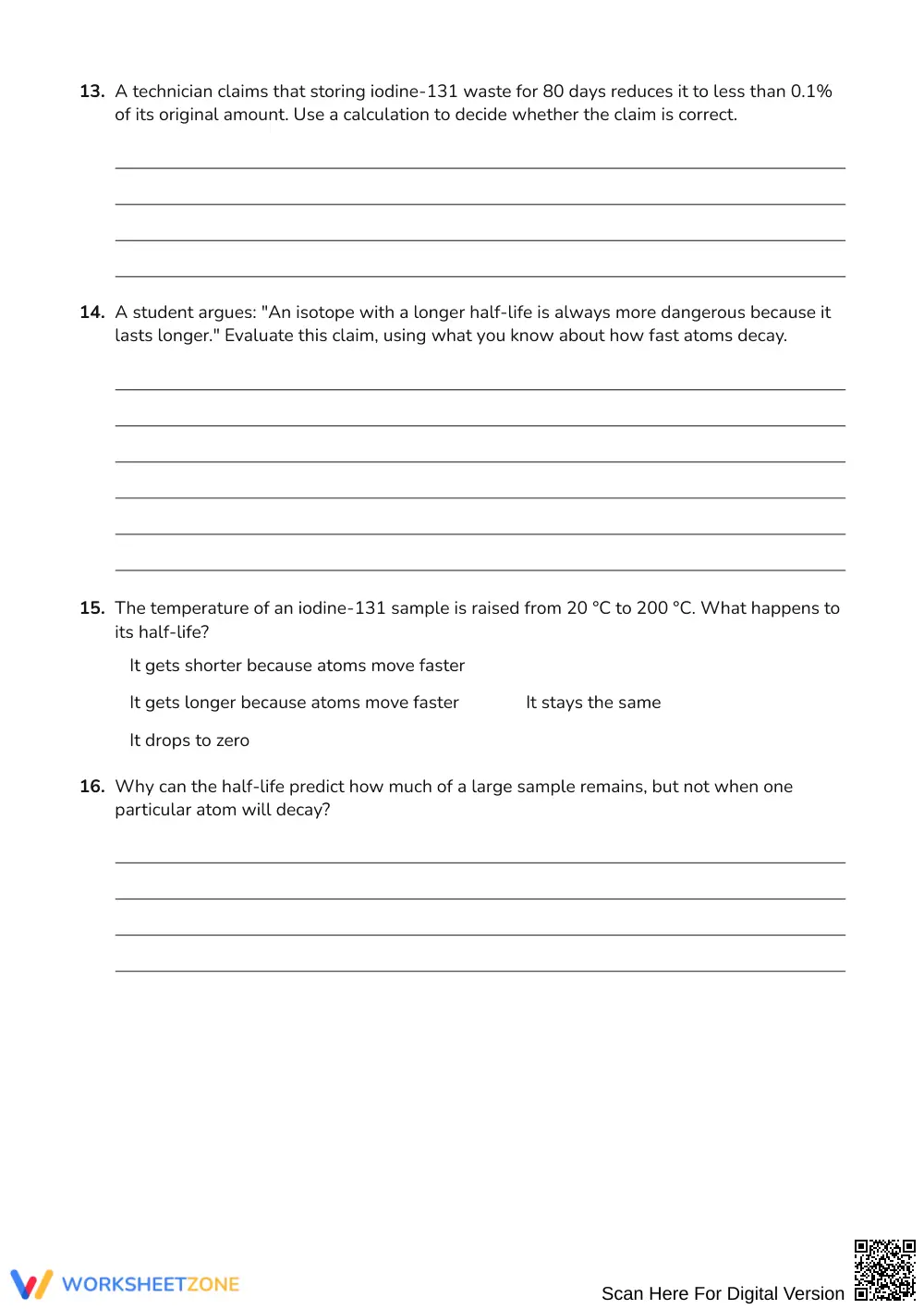
- Independent practice (Part C, 16 tasks): Students complete an isotope comparison matrix, solve radiometric dating problems, evaluate safety claims, and explain random decay behavior.
This gradual-release sequence moves learners smoothly from visual interpretation to independent quantitative synthesis.
Standards Alignment
This resource aligns with high school physical science standards requiring students to develop models illustrating nuclear decay processes. Students quantify decay rates and evaluate real-world radiometric dating scenarios. Both standard codes can be copied directly into lesson plans, IEP goals, or district curriculum mapping tools.
How to Use It
Implement this worksheet after direct instruction on nuclear decay as collaborative practice or an independent assessment spanning 45 to 60 minutes. During Part B, check whether students recognize that both isotopes produce identical curves when graphed against half-life intervals rather than calendar days.
Who It's For
This resource serves high school chemistry and physics students in grades 9 through 12, offering built-in data scaffolds for emerging learners and conceptual evaluation tasks for advanced students. Pair this activity with an introductory isotope lesson or a decay simulation.
This high school science curriculum resource systematically targets compare and contrast skills within nuclear half-life calculations through 34 structured practice tasks. Grounded in the gradual-release framework established by Fisher & Frey (2014), the worksheet scaffolds student reasoning from concrete particle diagrams to multi-step quantitative isotope comparisons. Learners contrast short-lived medical tracers like Iodine-131 with long-lived geological isotopes like Carbon-14, reconciling the constant fractional rate of decay with variable physical lifespans. By actively interpreting paired data tables and evaluating authentic safety claims, students build robust conceptual frameworks that connect mathematical decay equations with physical nuclear behaviors. Research from Fisher & Frey (2014) confirms that transitioning students through guided visual modeling, collaborative data analysis, and independent conceptual defense significantly deepens long-term retention of abstract physical science principles, making this 4-page worksheet an effective diagnostic and instructional asset.


