
































Complete Half-Life Decay Worksheet | Grades 9-12 Science

Paste this activity's link or code into your existing LMS (Google Classroom, Canvas, Teams, Schoology, Moodle, etc.).
Students can open and work on the activity right away, with no student login required.
You'll still be able to track student progress and results from your teacher account.
Build foundational mastery of nuclear chemistry with this comprehensive radioactive decay packet. Students explore the core principles of isotopes, half-life decay rates, and atomic stability through 27 targeted questions. By analyzing quantitative models and graphical decay curves, learners eliminate common misconceptions and prepare for advanced multi-step half-life calculations.
At a Glance
- Grade: Grades 9–12 · Subject: Science
- Standard: High School Physical Science — Model radioactive decay and explain half-life rates of change
- Skill Focus: Half-life foundations, vocabulary, and decay curves
- Format: 4 pages · 27 problems · Answer key included · PDF
- Best For: Nuclear chemistry introductory units and practice
- Time: 45–60 minutes
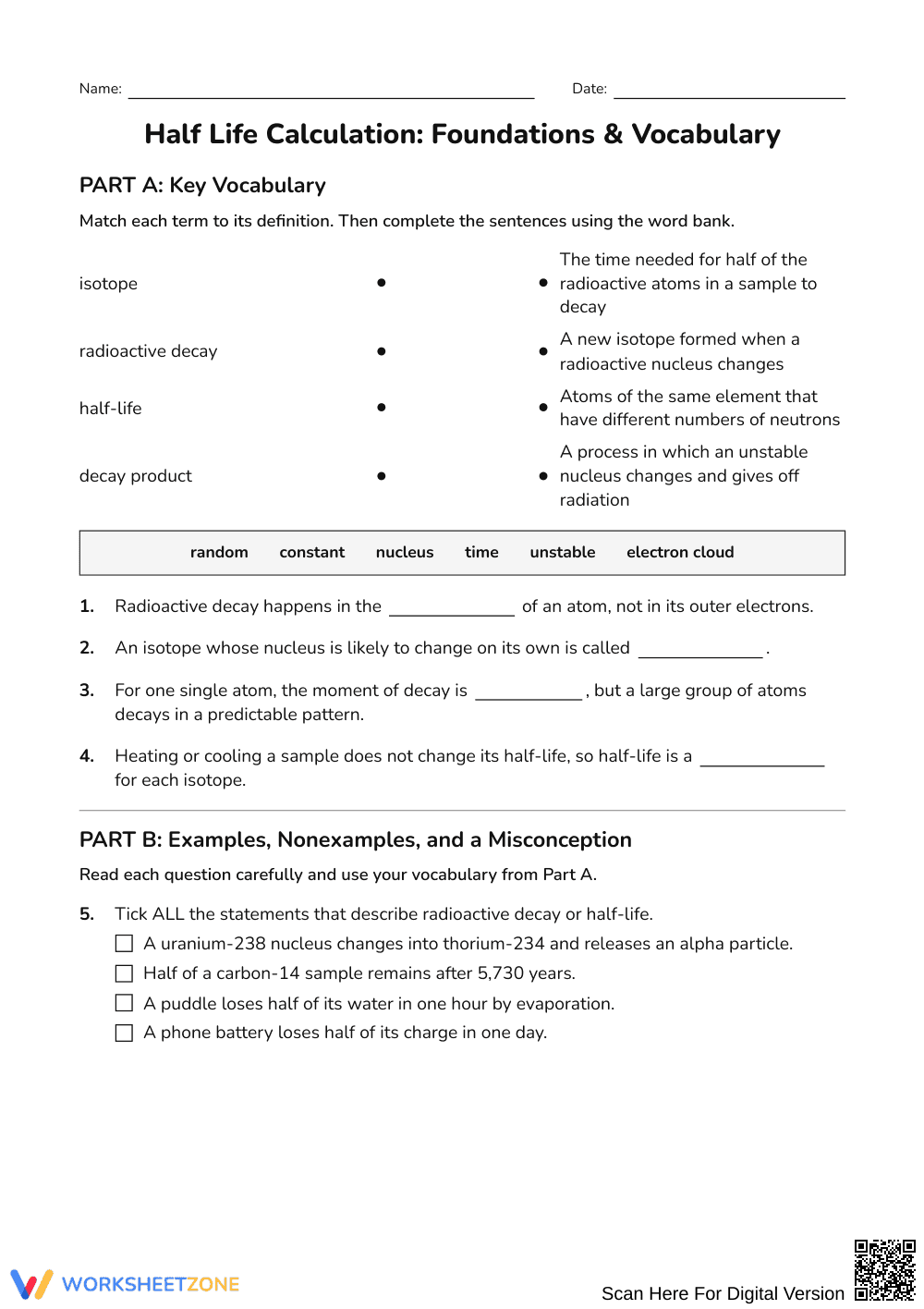
What's Inside: This 4-page student packet features matching vocabulary tasks, cloze sentences with a dedicated word bank, conceptual nonexamples, data tables, and decay curve analysis. A full 4-page answer key provides step-by-step mathematical reasoning and model explanations to simplify grading and student self-assessment.
Skill Progression
- Guided practice (Part A): Students define key terms—including isotope, radioactive decay, half-life, and decay product—using a reference word bank to establish accurate scientific terminology.
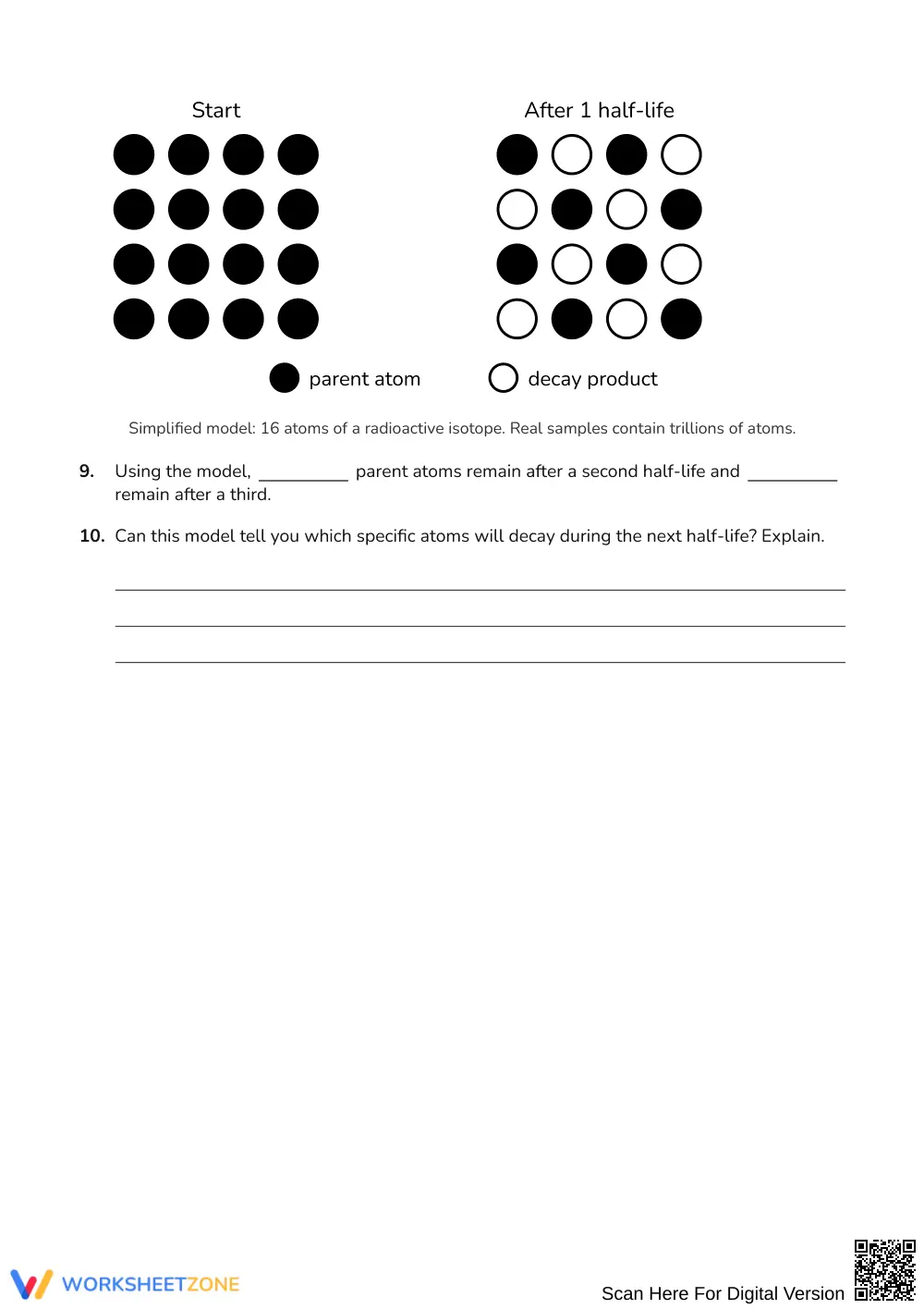
- Supported practice (Parts B & C): Learners evaluate common misconceptions, complete structured data tables for iodine-131, and analyze discrete atomic models to observe exponential decay patterns.
- Independent practice (Part D): Students independently interpret technetium-99m decay graphs, calculate elapsed time intervals, and solve multi-step mass decay problems.
This structured progression reflects the gradual-release framework, moving learners from conceptual recall to independent mathematical application.
Standards Alignment
This resource aligns with high school physical science standards addressing nuclear processes and radioactive decay models. Students develop and use models to illustrate the predictable exponential decay of unstable nuclei over constant time intervals. The curriculum objectives can be copied directly into lesson plans, IEP goals, or district curriculum mapping tools.
How to Use It
Deploy this worksheet immediately after direct instruction on atomic structure and isotopes to solidify conceptual understanding before introducing complex algebraic formulas. It also serves as an effective formative assessment checkpoint; monitor student responses on Part B to identify whether learners mistakenly believe a sample fully disappears after two half-lives. Expect completion in 45 to 60 minutes.
Who It's For
This resource is designed for high school chemistry, physical science, and Earth science students tackling nuclear decay. Scaffolding supports mixed-ability classes, while visual models assist English learners. Pair this printable with a direct instruction slide deck or an introductory isotope decay simulation to deepen student engagement.
Mastering radioactive decay requires students to synthesize qualitative nuclear models with quantitative exponential decay relationships. According to Fisher & Frey (2014), scaffolding conceptual scientific vocabulary prior to quantitative problem-solving significantly improves procedural fluency and prevents persistent misconceptions. This worksheet addresses core high school physical science standards by guiding students through 27 targeted questions that bridge atomic definitions, tabular models, and decay curve interpretations. By addressing the common error that two half-lives deplete a sample to zero, the resource reinforces that half-life is a constant rate where 50 percent of the remaining parent isotope decays in each interval. Whether deployed during initial direct instruction or as a formative assessment check, this instructional tool provides educators with clear diagnostic insight into student readiness for advanced nuclear chemistry calculations and authentic scientific data analysis.


