




























Views
Downloads


Complete GCF Factoring Worksheet | Grade 9 Algebra I

Paste this activity's link or code into your existing LMS (Google Classroom, Canvas, Teams, Schoology, Moodle, etc.).
Students can open and work on the activity right away, with no student login required.
You'll still be able to track student progress and results from your teacher account.
This Algebra I worksheet equips Grade 9 students to factor polynomial expressions by extracting greatest common factors across 16 problems. Learners identify monomial divisors, handle multivariable terms, reverse binomial signs, and construct expressions, developing procedural fluency and conceptual mastery for advanced algebraic factoring.
At a Glance
- Grade: 9 · Subject: Algebra I
- Standard:
HSA-SSE.A.2— Use structure to identify and factor greatest common factors in polynomials- Skill Focus: Factors and Greatest Common Factors
- Format: 5 pages · 16 problems · Answer key included · PDF
- Best For: Independent practice and factoring mastery
- Time: 40–50 minutes
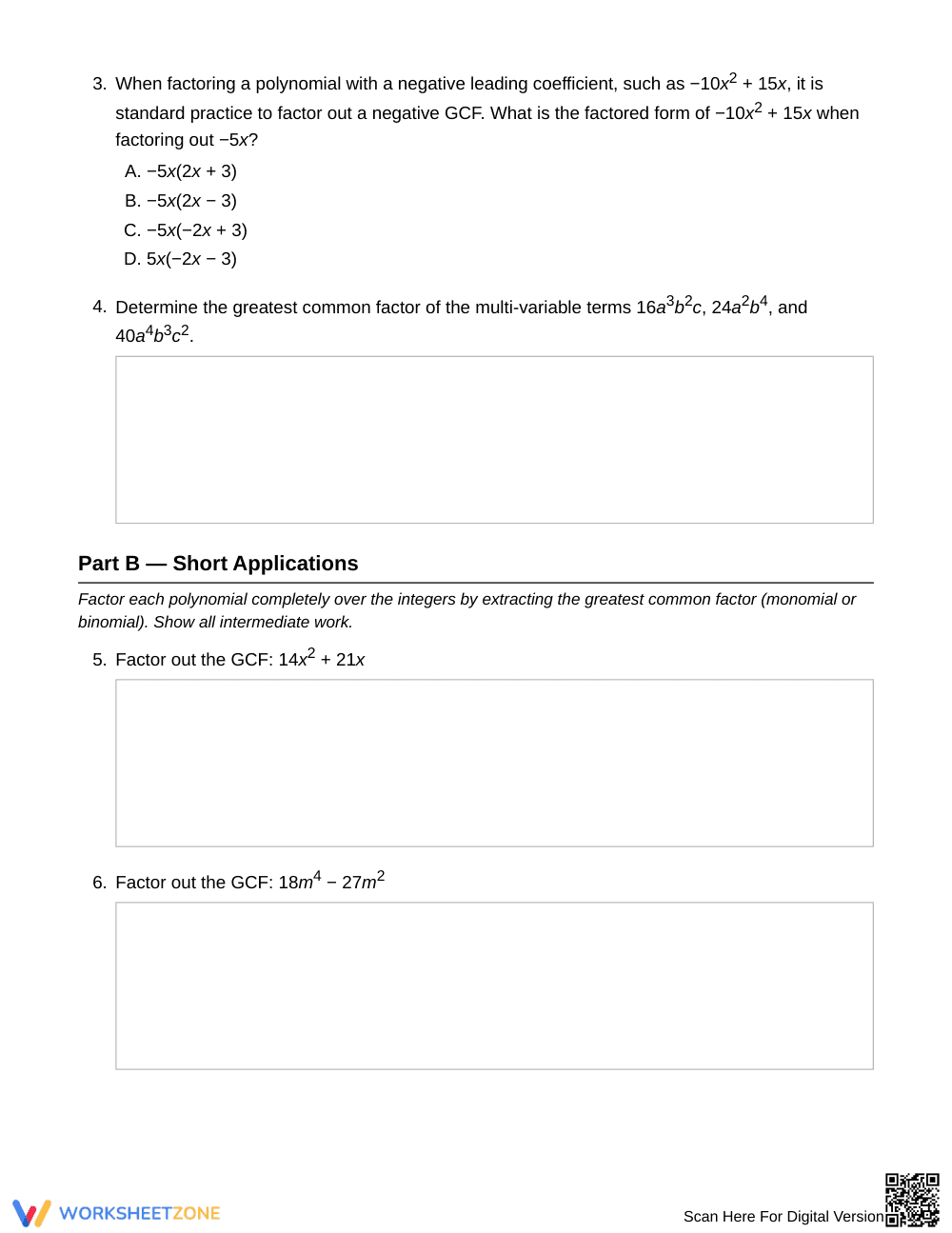
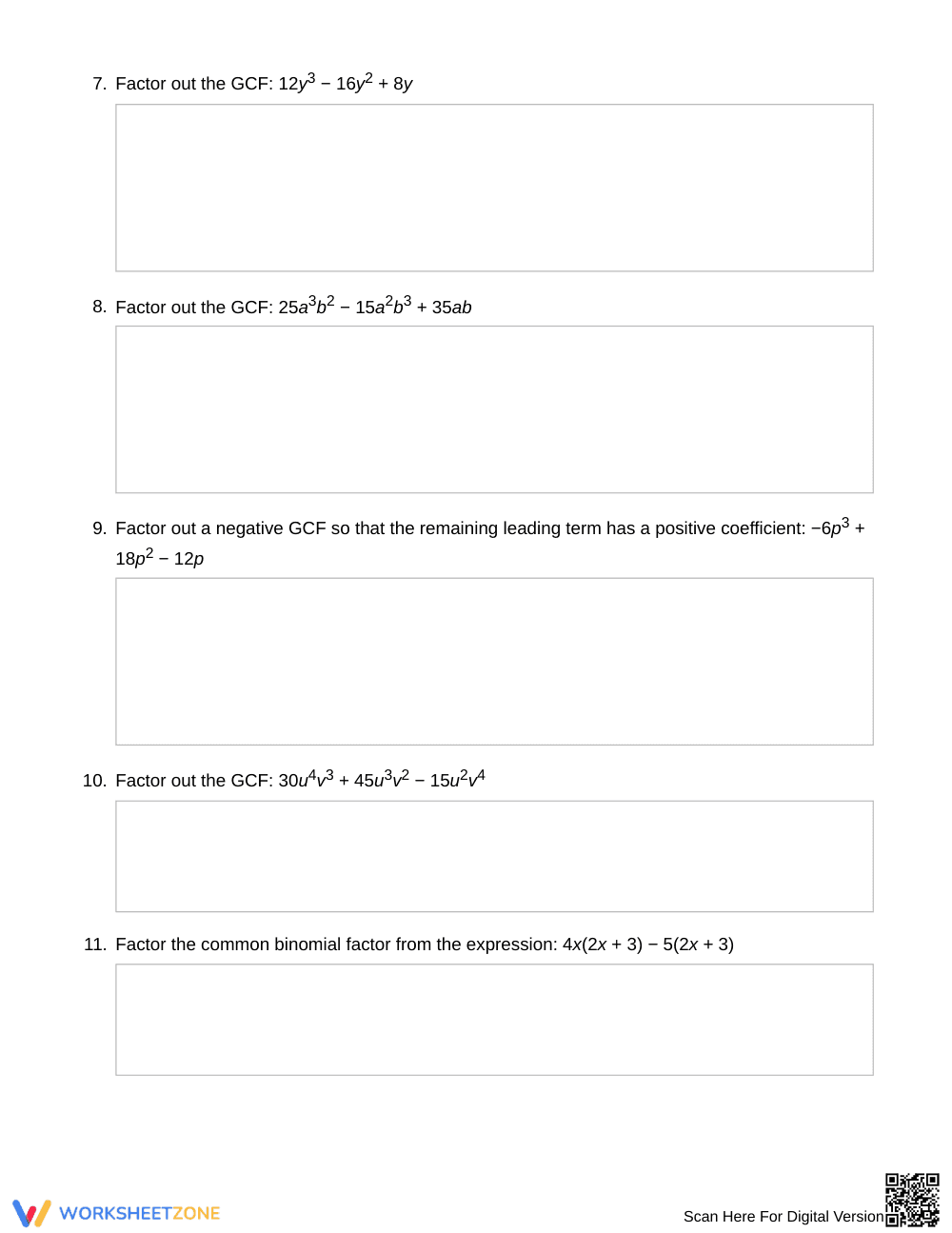
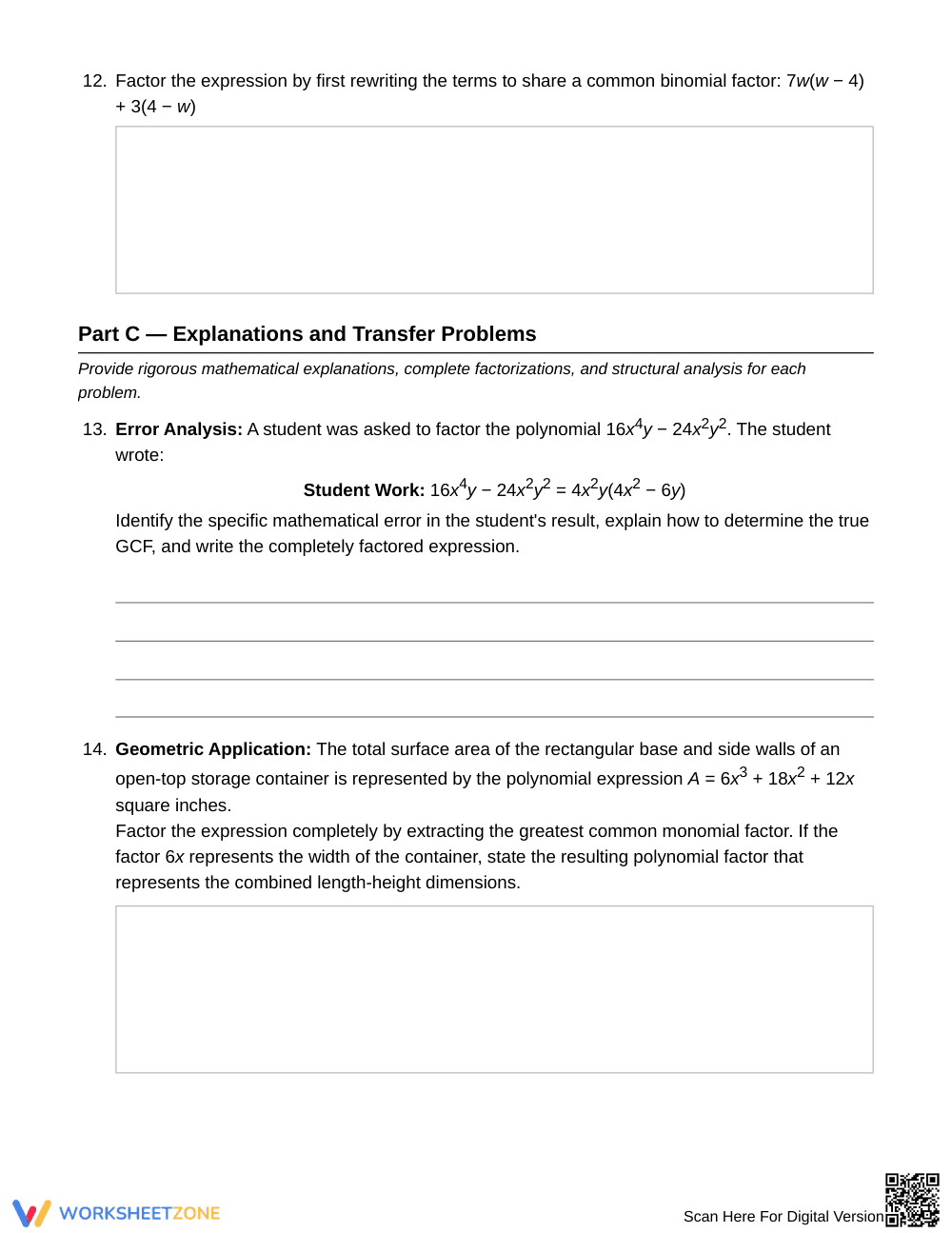
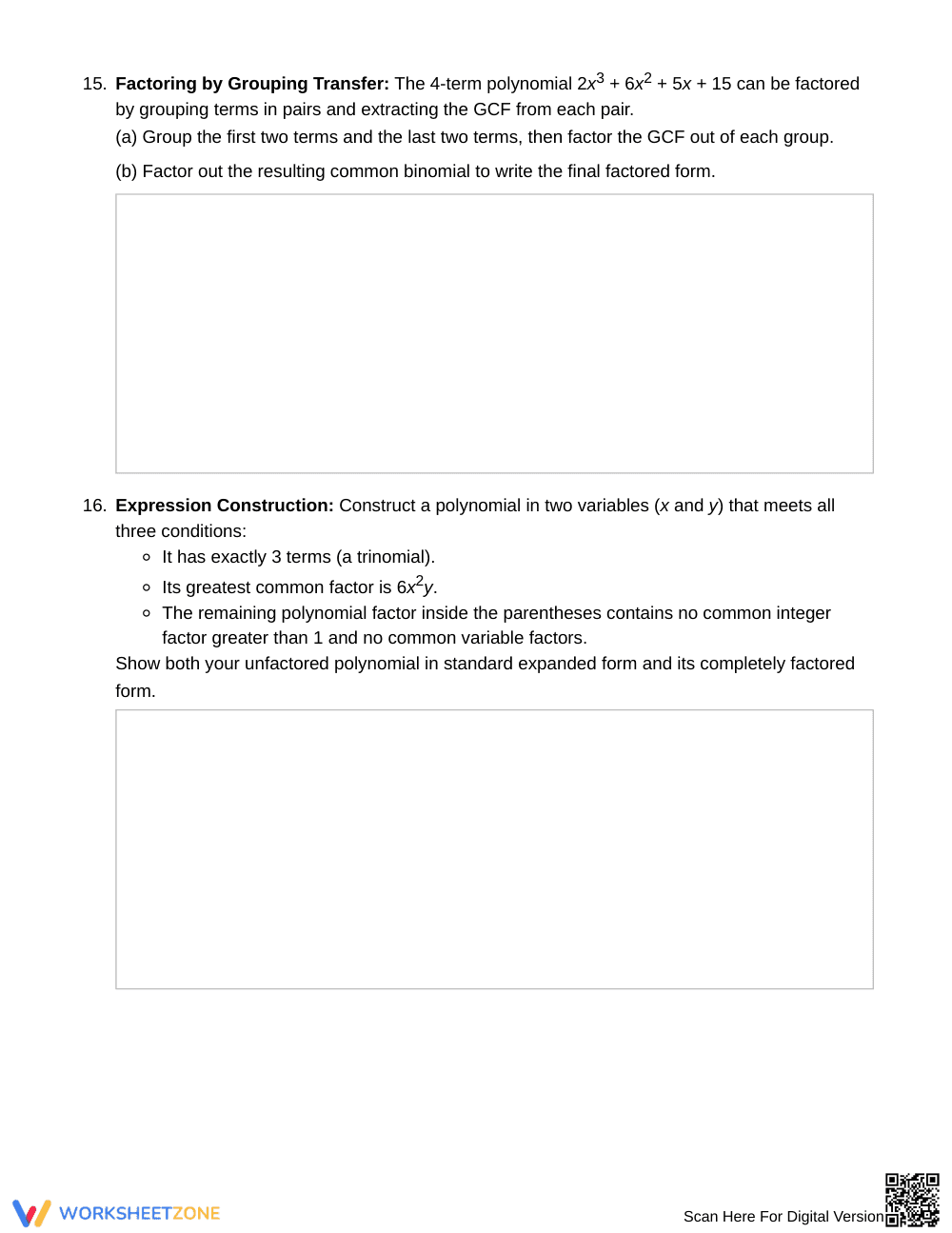
The 5-page worksheet includes a Core Principles anchor box defining GCF rules and complete factorization over integers. Part A features 4 concept questions on exponents and negative leading coefficients. Part B provides 8 computational problems across single-variable, multivariable, and binomial common factors. Part C presents 4 multi-step tasks: error analysis, geometric area application, grouping transfer, and trinomial construction. A 4-page answer key provides complete solutions.
Skill Progression
- Guided practice (Part A, 4 tasks): Scaffolds foundational concepts through multiple-choice questions and conceptual comparisons of common numerical divisors and variable powers.
- Supported practice (Part B, 8 tasks): Builds procedural fluency through multivariable monomials, negative factor extraction, and binomial factor rewriting.
- Independent practice (Part C, 4 tasks): Develops autonomous mastery through error correction, geometric dimension modeling, grouping transfer, and original trinomial construction.
This sequence follows gradual release principles to build lasting structural understanding.
Standards Alignment
This resource targets HSA-SSE.A.2: Use structure to identify ways to rewrite polynomial expressions using greatest common factors. It also supports HSA-SSE.A.1.A by requiring students to interpret individual terms and factors in geometric contexts. Both standard codes can be copied directly into lesson plans, IEP goals, or district curriculum mapping tools.
How to Use It
Use Parts A and B during direct instruction or station work after introducing greatest common factors. Assign Part C after instruction for synthesis or homework. Formatively assess whether students correctly extract negative leading coefficients in Part B before attempting grouping. The entire activity takes approximately 40 to 50 minutes.
Who It's For
This worksheet serves Grade 9 Algebra I students and older learners needing targeted factoring remediation. Provide the Core Principles reference box for emerging learners, while assigning Part C construction tasks for advanced students. Pair this printable resource with algebra tile modeling or a direct instruction lesson on polynomial distribution.
Mastering polynomial structure under standard HSA-SSE.A.2 requires students to recognize greatest common factors and understand algebraic expressions as unified systems rather than isolated calculations. Research by Fisher & Frey (2014) demonstrates that structured gradual release frameworks—moving from concept discrimination to procedural fluency and transfer tasks—significantly boost high school algebra retention and problem-solving confidence. This 16-problem Grade 9 worksheet operationalizes that pedagogical model by pairing direct monomial extraction with rigorous error analysis, geometric area decomposition, and factoring-by-grouping extensions. By requiring learners to justify why an expression is completely factored over the integers, the resource develops structural decomposition habits essential for subsequent quadratic factoring and rational function simplification. High school mathematics educators can implement this complete 5-page curriculum-aligned resource to verify mastery of fundamental polynomial factoring and support data-driven intervention.


