




























Complete Garden Wildlife Word Search | Grades 7–8 Science
Paste this activity's link or code into your existing LMS (Google Classroom, Canvas, Teams, Schoology, Moodle, etc.).
Students can open and work on the activity right away, with no student login required.
You'll still be able to track student progress and results from your teacher account.
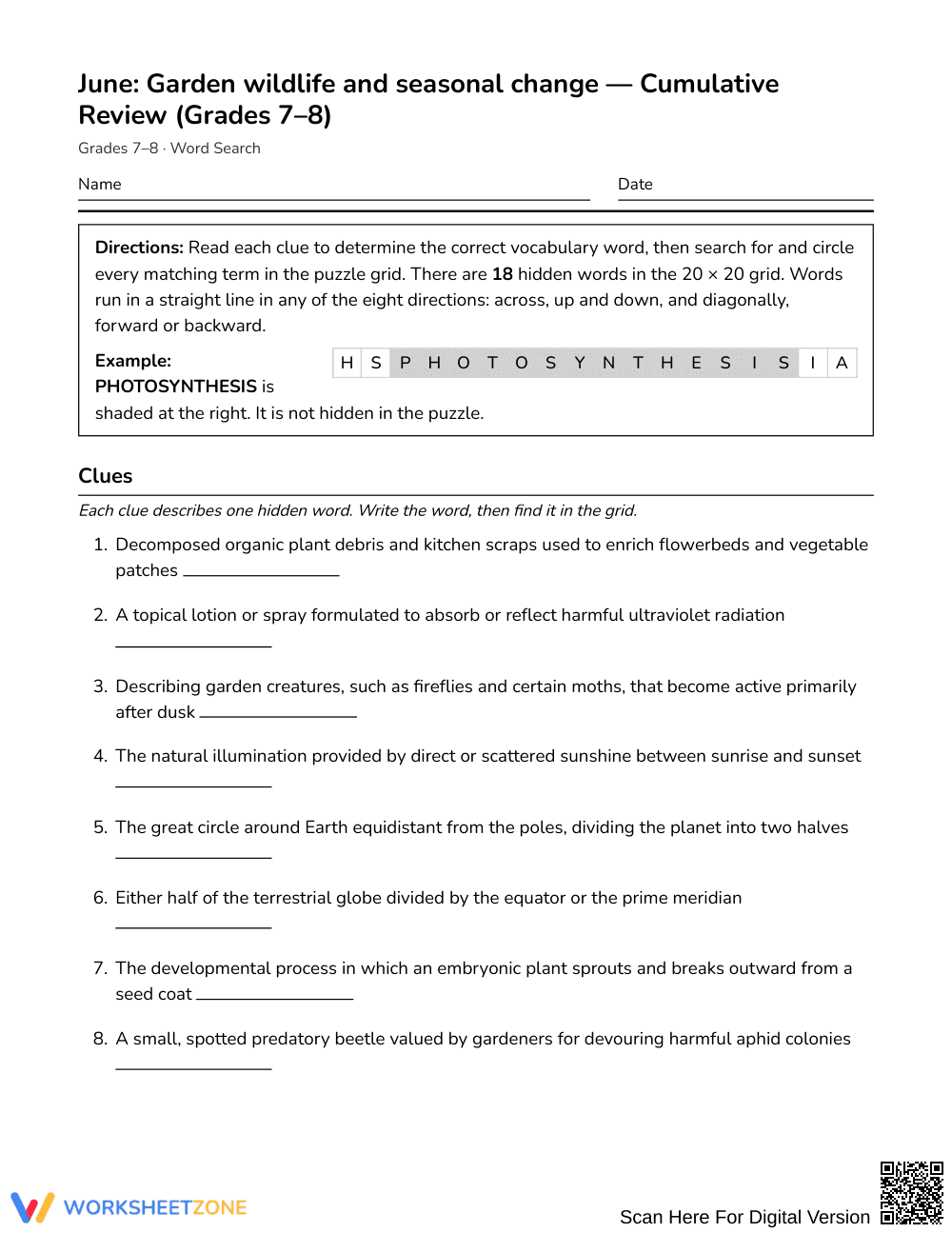
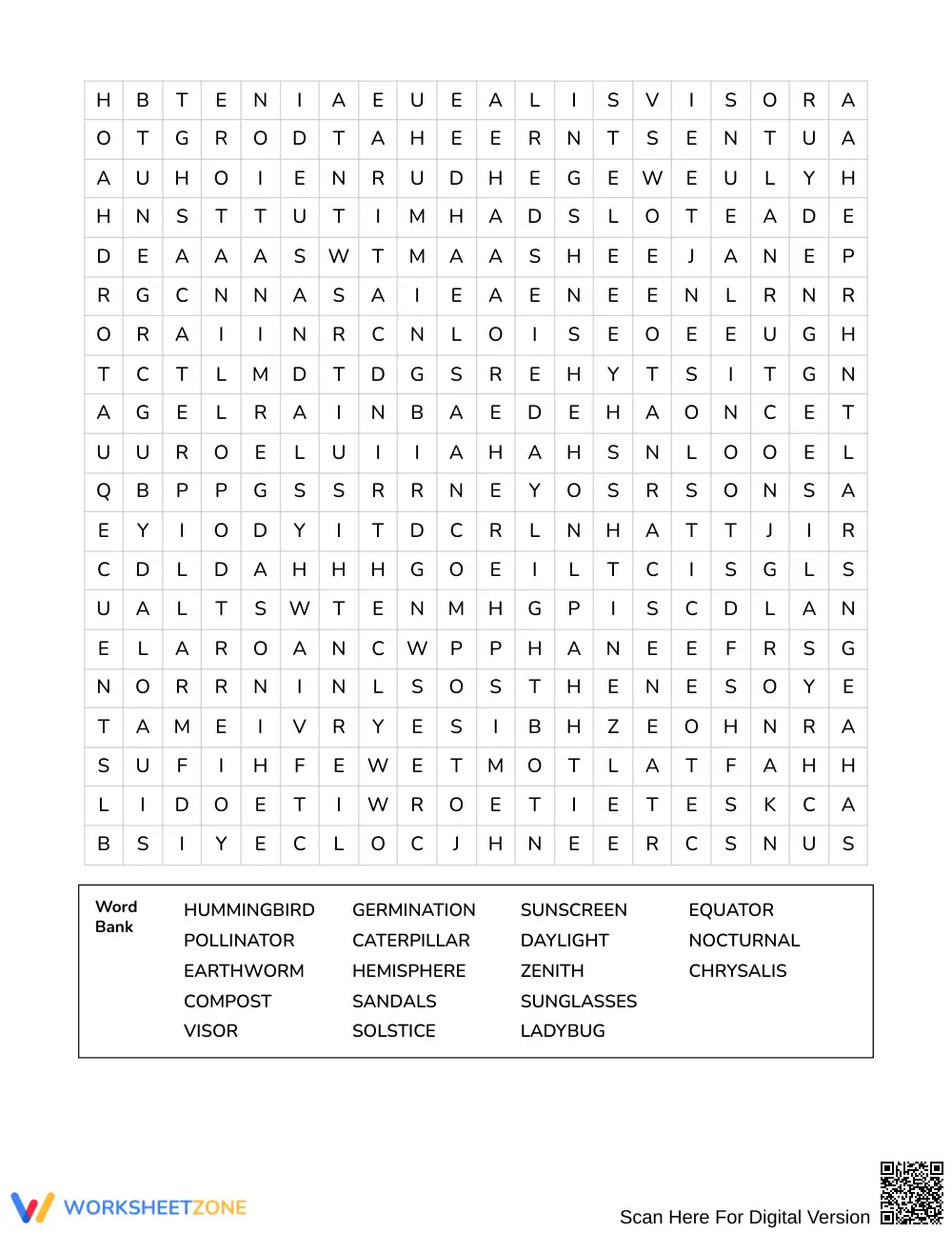
This middle school science word search reinforces vocabulary related to garden wildlife and seasonal change through active definition matching and spatial search. Grades 7–8 students analyze 18 domain-specific science terms spanning ecological interactions and astronomical transitions, using descriptive clues to identify each concept before searching across the letter grid.
At a Glance
- Grade: Grades 7–8 · Subject: Middle School Science
- Standard: Not standards-assessed — vocabulary enrichment for middle school science
- Skill Focus: Garden wildlife, ecology, and seasonal change
- Format: 3 printable pages · 18 vocabulary words · Full answer key included · PDF
- Best For: End-of-unit cumulative review and independent vocabulary reinforcement
- Time: 25–35 minutes of focused student work
What's Inside
This 3-page printable science resource provides an 18-word review set pairing rigorous biological and physical science descriptions with an engaging puzzle format. Each entry presents an academic clue covering topics such as germination, metamorphosis, solar geometry, and outdoor ultraviolet protection. A comprehensive answer key displays the exact location and path of every vocabulary word within the puzzle.
Puzzle Mechanics and Structure
The puzzle centers on a 20×20 letter grid containing 18 hidden vocabulary terms. Words are placed across eight possible directions: north, northeast, east, southeast, south, southwest, west, and northwest. Rather than searching from a simple alphabetical list, students read thorough scientific clues that describe each organism, process, or concept, linking semantic comprehension directly to visual letter recognition.
Standards Alignment
This activity serves strictly as vocabulary enrichment and is not aligned to a specific state or national curriculum standard. Instead of formal standards assessment, it supports interdisciplinary science literacy across middle school life science and Earth systems units by reinforcing key ecological terminology, seasonal astronomical events, and environmental vocabulary.
How to Use It
Deploy this activity after direct instruction on seasonal cycles and backyard ecosystems as an independent culminating review. It functions effectively during station rotations or as a productive, low-stress bridge activity before summative testing. For formative assessment, circulate as students match clues to evaluate whether they correctly deduce terms like chrysalis or solstice before locating them. Most learners complete the activity in 25 to 35 minutes.
Who It's For
Designed specifically for Grades 7–8 science classrooms, this word search accommodates general education students, early finishers, and learners seeking supplemental vocabulary practice. Pair this puzzle with an illustrated anchor chart depicting solar angles and life cycles to assist visual learners in connecting terms to physical models.
According to Fisher & Frey (2014), intentional domain-specific vocabulary practice strengthens reading comprehension in secondary science classrooms by consolidating conceptual terminology into long-term memory. This 3-page word search supports Grades 7–8 learners in mastering 18 critical terms related to garden wildlife and seasonal change, including pollination, germination, and the June solstice. By requiring students to decode rigorous scientific clues rather than passive word lists, the 20×20 puzzle promotes cognitive engagement with ecological and Earth science concepts. Although designed for non-standards-assessed vocabulary enrichment rather than standardized assessment reporting, the activity provides teachers with a structured formative checkpoint. Educators can rapidly evaluate conceptual retention, identify vocabulary misconceptions, and reinforce foundational scientific literacy during independent practice, science stations, or seasonal review sessions.


