
































Complete Function Transform Worksheet | Grade 12 Precalculus

Paste this activity's link or code into your existing LMS (Google Classroom, Canvas, Teams, Schoology, Moodle, etc.).
Students can open and work on the activity right away, with no student login required.
You'll still be able to track student progress and results from your teacher account.
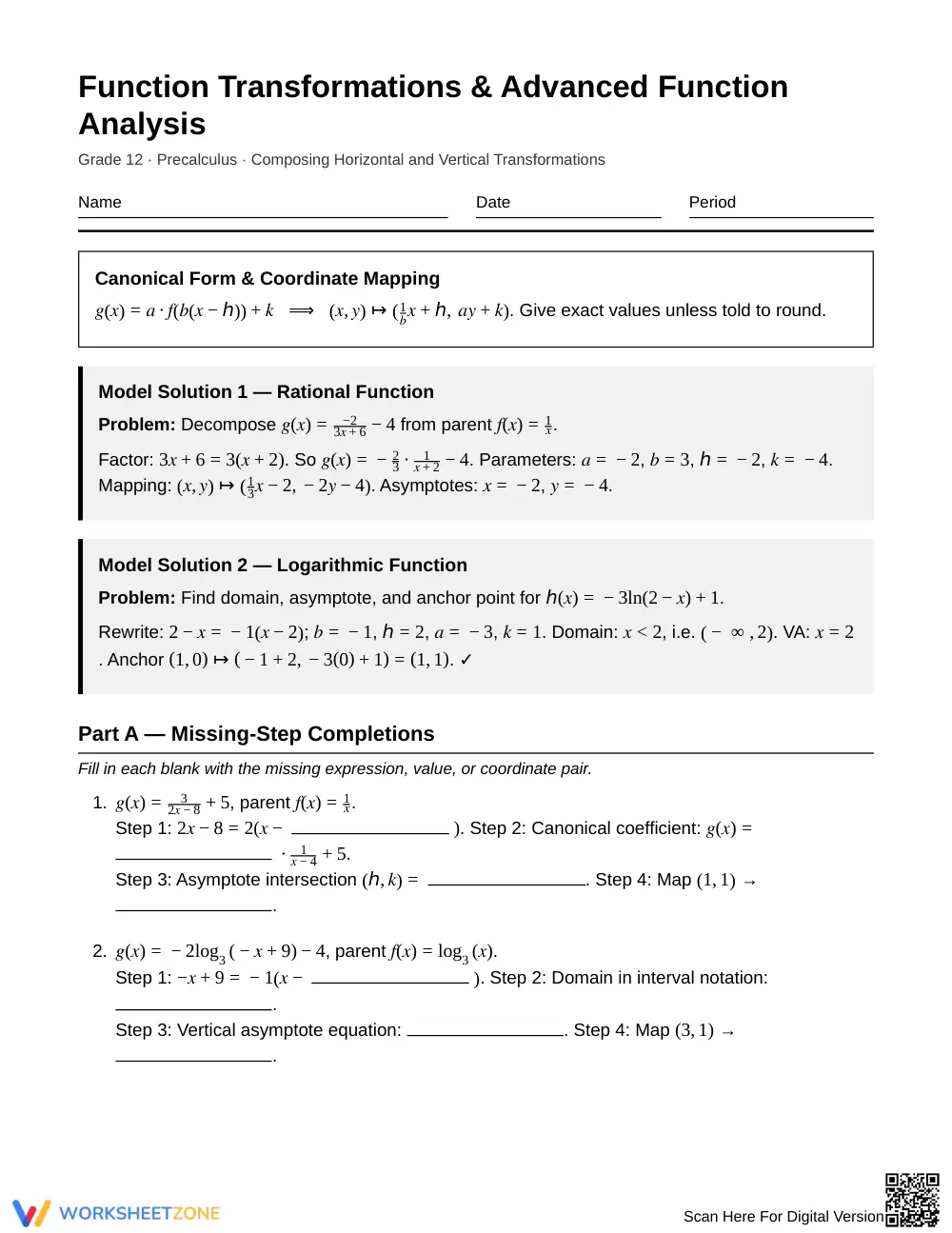
This advanced Precalculus worksheet equips Grade 12 students to master multi-step function transformations across rational, logarithmic, exponential, and polynomial parent functions. By decomposing algebraic expressions into canonical form and applying coordinate mapping rules, learners build rigorous analytical skills to determine domain restrictions, asymptotes, invariant points, and inverse relationships.
At a Glance
- Grade: 12 · Subject: Precalculus
- Standard:
HSF-BF.B.3— Identify the effect of replacing f(x) by f(x+k), kf(x), f(kx), and combinations- Skill Focus: Compose Horizontal and Vertical Transformations
- Format: 4 pages · 12 problems · Answer key included · PDF
- Best For: Independent practice and exam preparation
- Time: 45–60 minutes
What's Inside
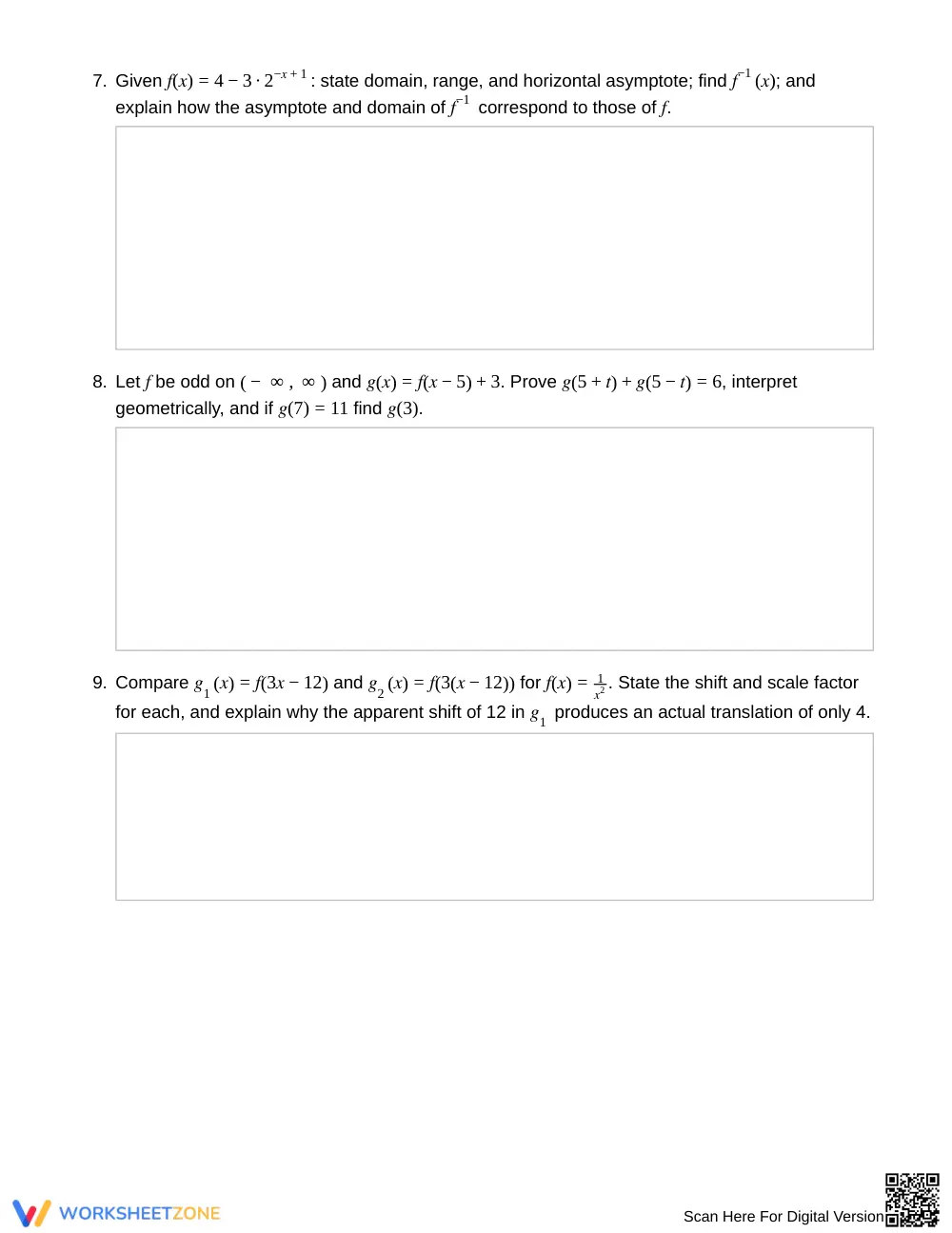
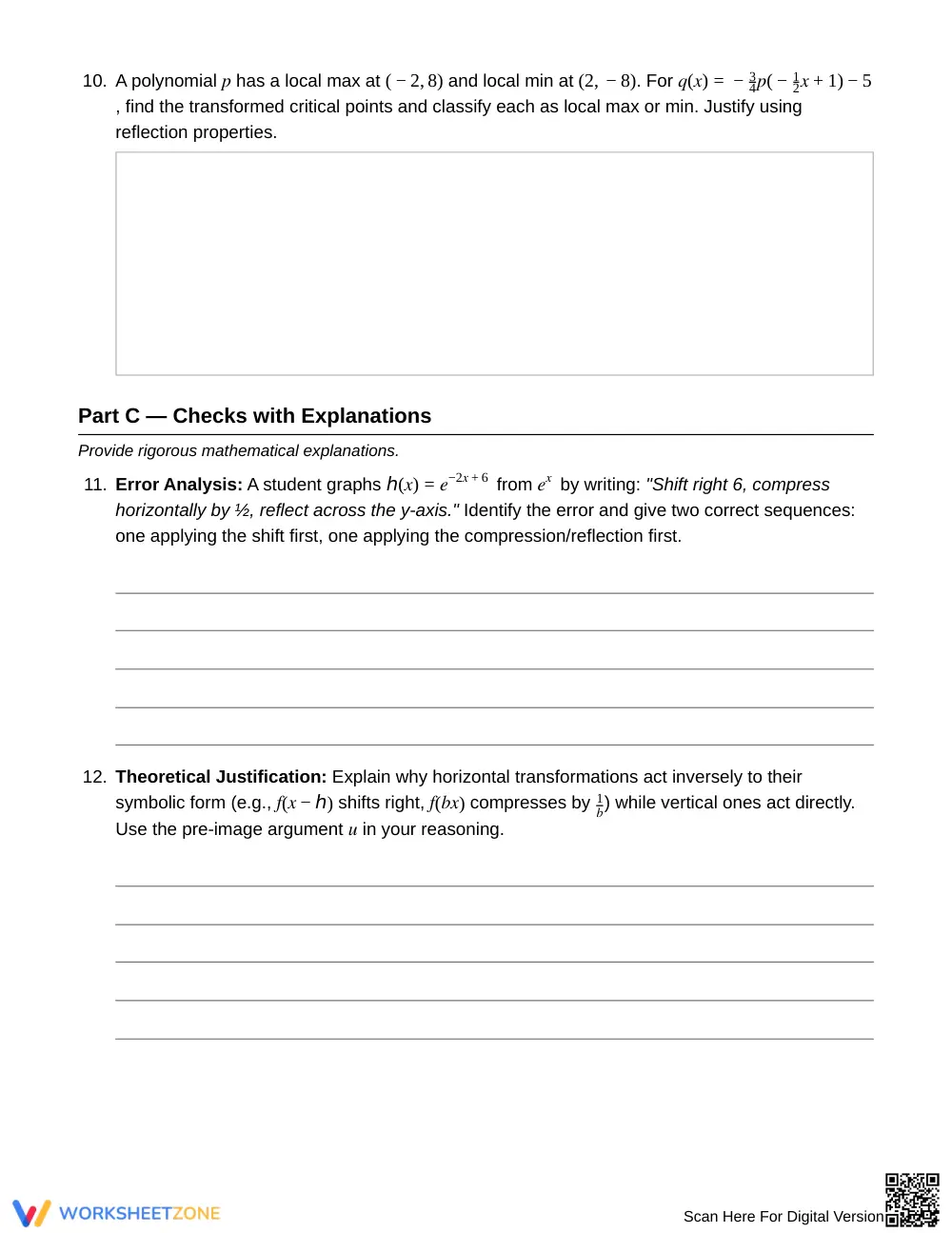
The 4-page student document features 2 annotated model solutions, 12 rigorous analytical tasks, and a complete 2-page step-by-step answer key. Students engage with structured completion items, free-response derivations involving point symmetry and rational forms, and rigorous proof-based theoretical explanations.
Skill Progression
- Guided Practice (Part A, 4 tasks): Scaffolded missing-step completions guide students through factoring horizontal coefficients, calculating asymptote intersections, and mapping key anchor points.
- Supported Practice (Part B, 6 tasks): Independent multi-step problems require students to convert rational functions to canonical forms, track critical points across reflections, and verify odd symmetry under translation.
- Independent Practice (Part C, 2 tasks): Advanced conceptual items require error analysis of multi-transformation sequences and formal mathematical justification of horizontal inverse operations.
This structured sequence follows the gradual release of responsibility model, moving students from guided parameter identification to deep algebraic justification.
Standards Alignment
Primary Standard: `HSF-BF.B.3` — Identify the effect on the graph of replacing f(x) by f(x + k), k f(x), f(kx), and f(x + k) for specific values of k (both positive and negative); find the value of k given the graphs. Experiment with cases and illustrate an explanation of the effects on the graph using technology. Both standard codes can be copied directly into lesson plans, IEP goals, or district curriculum mapping tools.
How to Use It
Deploy this resource during the core practice phase of a function analysis unit or as intensive review before a college-level calculus placement test. During guided work, check Part A Step 1 to ensure students factor horizontal scaling factors out of binomial arguments before translating coordinates. Expected completion time is 45 to 60 minutes.
Who It's For
Designed for Grade 12 Precalculus, Honors Algebra II, or AP Precalculus students requiring rigorous algebraic practice. Pair this worksheet directly with coordinate mapping anchor charts or dynamic graphing software to verify analytical transformations visually.
According to Fisher & Frey (2014), structured instructional progressions that bridge guided modeling with independent theoretical justification significantly enhance conceptual retention in advanced mathematics. When students encounter composite transformations, cognitive load increases substantially because horizontal scalings and horizontal translations interact within function notation. By providing explicit scaffolding that transitions from missing-step anchor items to autonomous verification, educators can mitigate common misconceptions surrounding function dilation and reflection. This instructional resource operationalizes standard HSF-BF.B.3 by training Grade 12 learners to decompose complex function parameters, map coordinate pairs systematically, and justify graphical behaviors through precise algebraic proofs. Structured practice ensures that students do not simply memorize transformation algorithms, but instead internalize how domain alterations impact structural features like vertical asymptotes and intervals of decrease. Consequently, high school seniors develop the analytical fluency and critical reasoning essential for collegiate calculus coursework.


