




























Views
Downloads



Complete Function Evaluation Worksheet | Grade 9 Algebra I

Paste this activity's link or code into your existing LMS (Google Classroom, Canvas, Teams, Schoology, Moodle, etc.).
Students can open and work on the activity right away, with no student login required.
You'll still be able to track student progress and results from your teacher account.
This Algebra I worksheet equips high school students to master function notation by evaluating algebraic rules, selecting optimal algebraic strategies, and interpreting outputs within authentic contexts. Students progress from foundational algebraic substitutions to strategic problem-solving and multi-step real-world applications, building lasting mathematical fluency.
At a Glance
- Grade: 9 · Subject: Algebra I
- Standard:
HSF-IF.A.2— Evaluate functions for specific inputs and interpret practical statements using notation- Skill Focus: Mix Evaluation, Substitution, and Interpretation
- Format: 4 pages · 16 problems · Answer key included · PDF
- Best For: Skill mastery and contextual practice
- Time: 40–50 minutes
What's Inside
Across four well-structured pages, this resource delivers 16 targeted tasks distributed into three distinct sections: direct numerical evaluation, strategic method selection, and contextual problem-solving. It includes diverse function families such as linear, quadratic, radical, and rational equations. A complete 2-page answer key provides clear solutions for rapid grading or self-checking.
Skill Progression
- Guided practice (Part A, 4 problems): Students compute numerical values for polynomial and radical functions, developing procedural accuracy with integers, decimals, and irrational inputs under low scaffolded complexity.
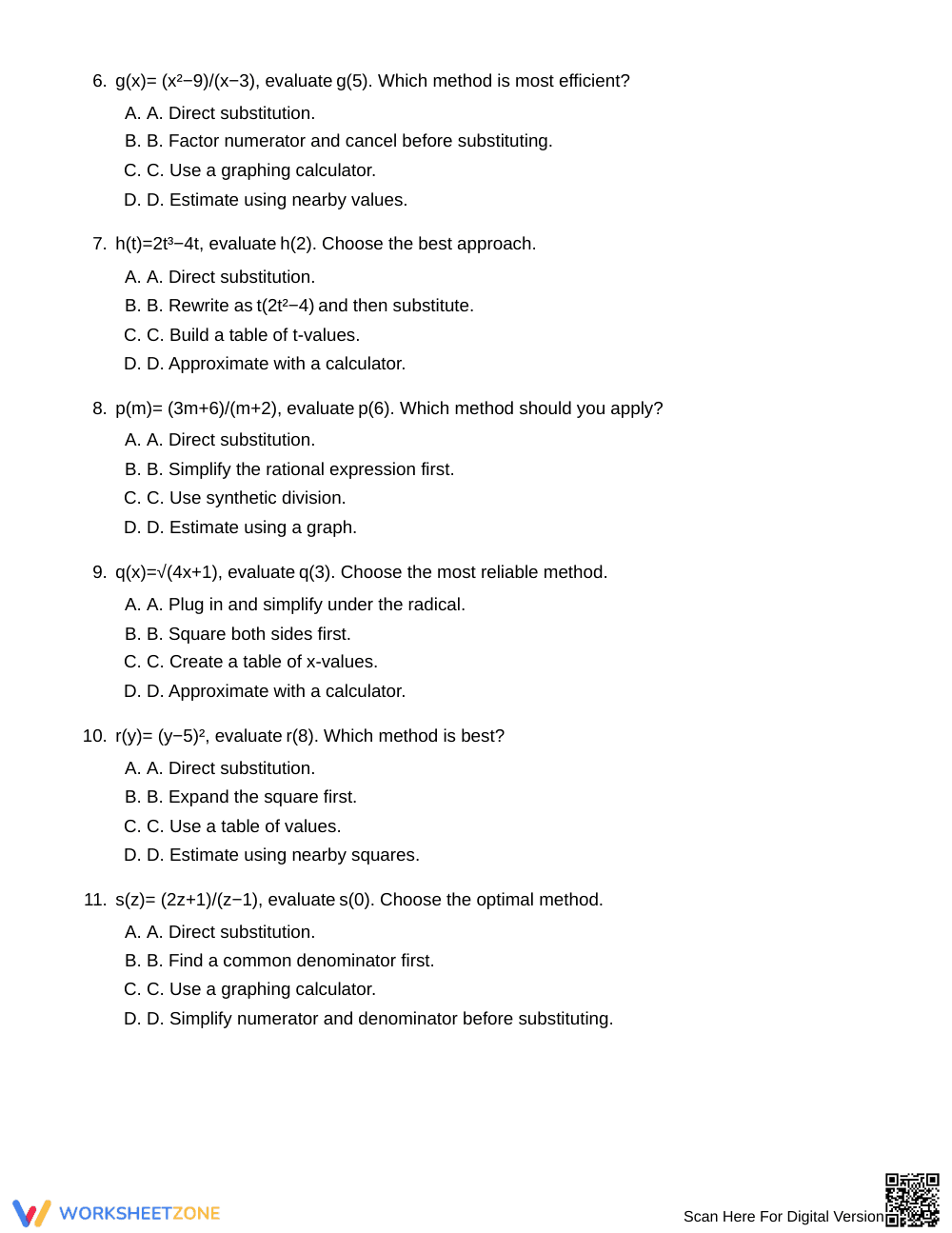
- Supported practice (Part B, 8 problems): Learners evaluate eight diverse functions by analyzing and selecting the most efficient mathematical method, shifting focus from raw computation to strategic problem analysis.
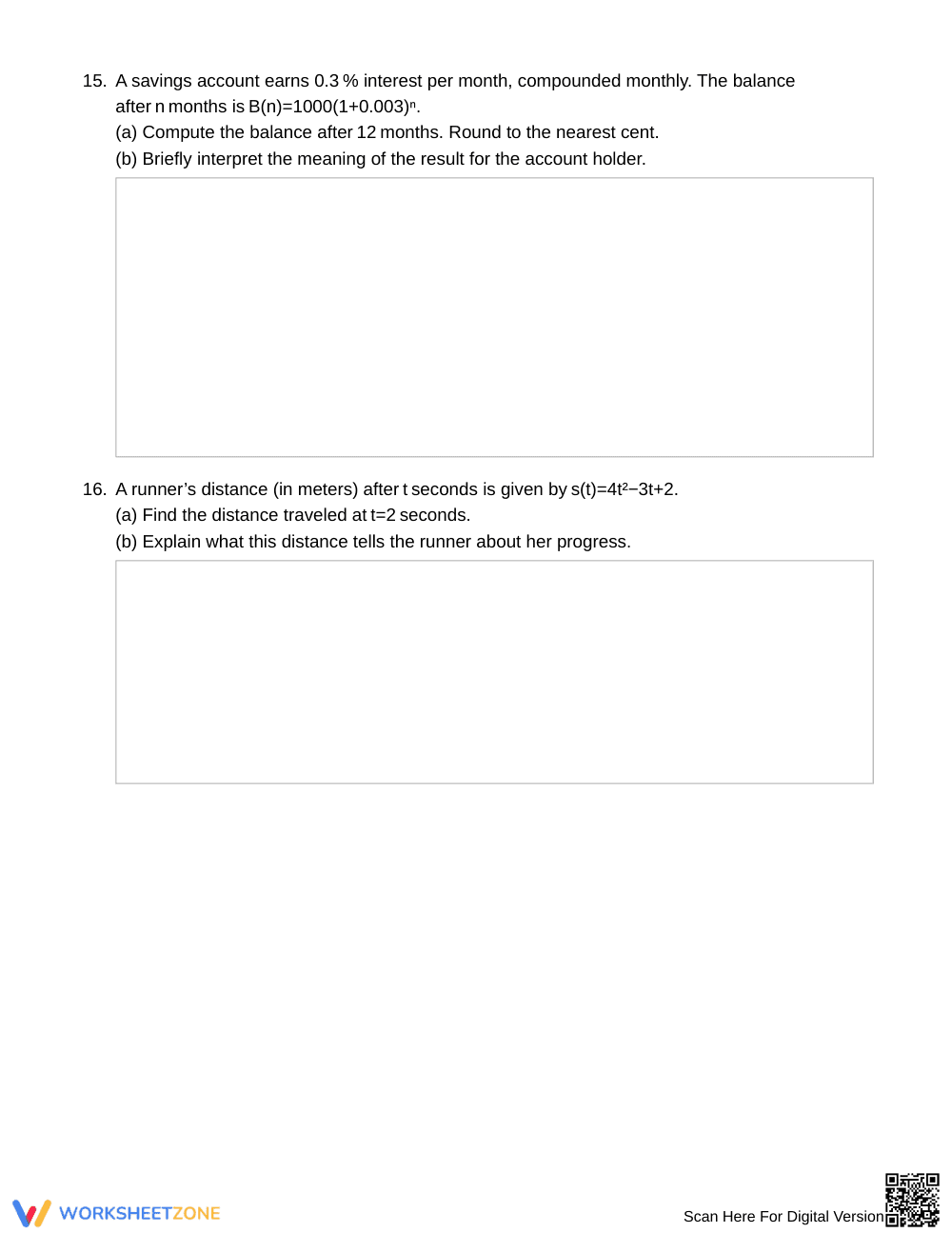
- Independent practice (Part C, 4 multi-part problems): High schoolers apply function rules to real-world scenarios—including travel costs, temperature conversion, compounding interest, and kinematics—calculating values and interpreting functional meaning in complete sentences.
This sequential design follows the gradual-release framework, enabling students to establish procedural fluency before applying analytical reasoning to contextual modeling.
Standards Alignment
This resource directly aligns with primary standard HSF-IF.A.2: Use function notation, evaluate functions for inputs in their domains, and interpret statements that use function notation in terms of a context. It also supports standard HSA-SSE.A.1 by asking students to interpret the structure of algebraic expressions. Both standard codes can be copied directly into lesson plans, IEP goals, or district curriculum mapping tools.
How to Use It
Deploy this worksheet immediately after direct instruction on function notation. In a primary use case, assign Parts A and B during mid-period guided practice to identify operational misconceptions before students begin the word problems in Part C. Alternatively, assign the entire set as an end-of-unit review or homework assignment. For formative assessment, observe student reasoning in Part B: identify whether students default blindly to manual arithmetic or recognize when algebraic factoring simplifies evaluation. Expect completion within 40 to 50 minutes.
Who It's For
This activity serves Grade 9 Algebra I students learning function notation or Grade 10 students requiring targeted remediation. Differentiate by providing formula sheets or calculators for Part A while challenging advanced learners to justify their method choices in Part B. Pair this document smoothly with a direct instruction lesson on domain and range or real-world modeling anchor charts.
According to research from Fisher & Frey (2014) on purposeful instructional design, structured learning progressions that shift from focused procedural practice to contextual application substantially improve student conceptual transfer in secondary mathematics. Standard HSF-IF.A.2 establishes that high school students must not only calculate values mechanically using function notation but also interpret statements in terms of everyday contexts. This 16-task worksheet operationalizes that pedagogical framework by combining direct substitution, strategic reasoning, and written contextual explanations across four cohesive pages. As students evaluate quadratic, rational, and exponential functions, they build both procedural fluency and algebraic literacy required for advanced STEM coursework. The included 2-page answer key supports rapid formative feedback and verified evidence of mastery.


