




























Complete Function Analysis Worksheet | Grade 12 Precalculus
Paste this activity's link or code into your existing LMS (Google Classroom, Canvas, Teams, Schoology, Moodle, etc.).
Students can open and work on the activity right away, with no student login required.
You'll still be able to track student progress and results from your teacher account.
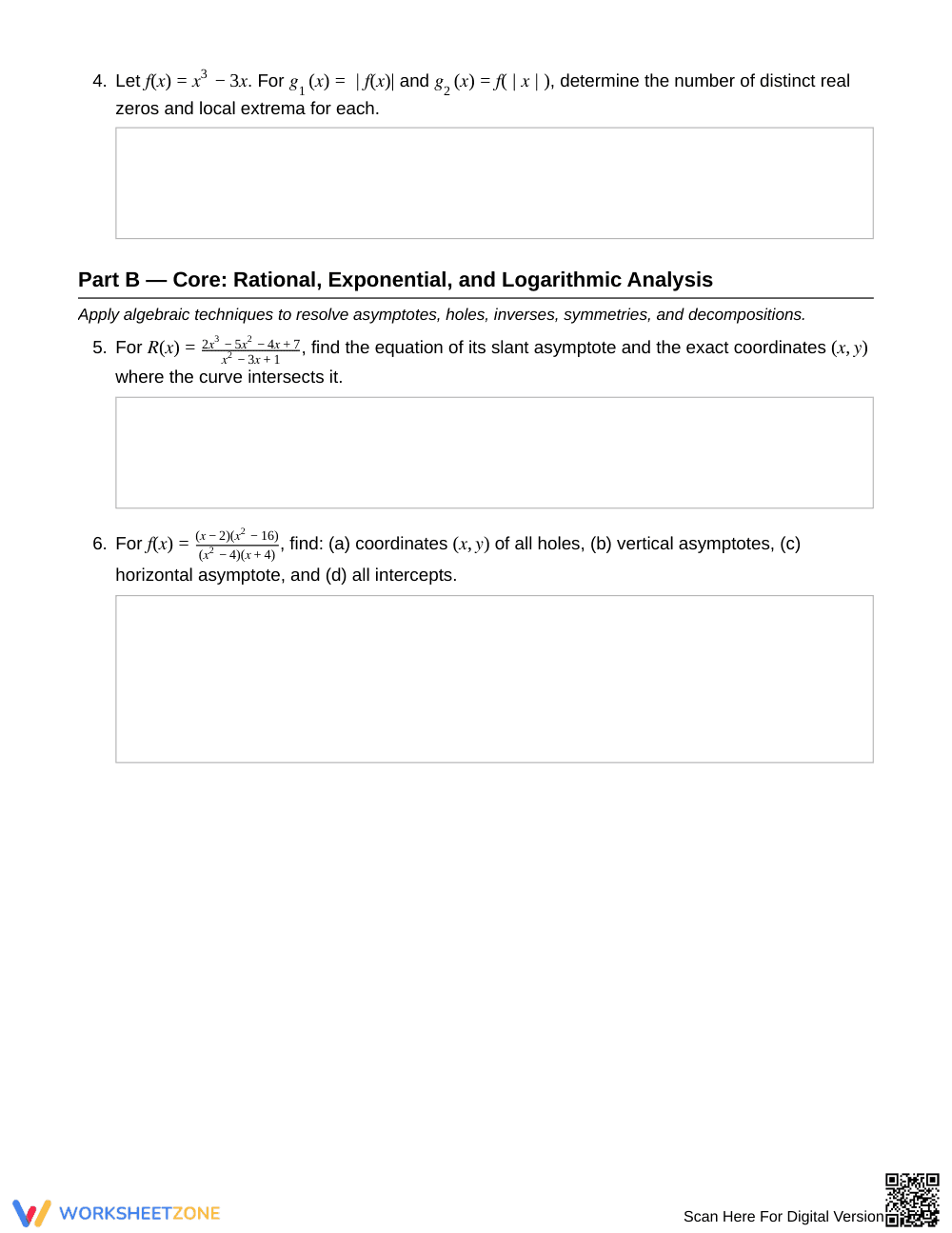
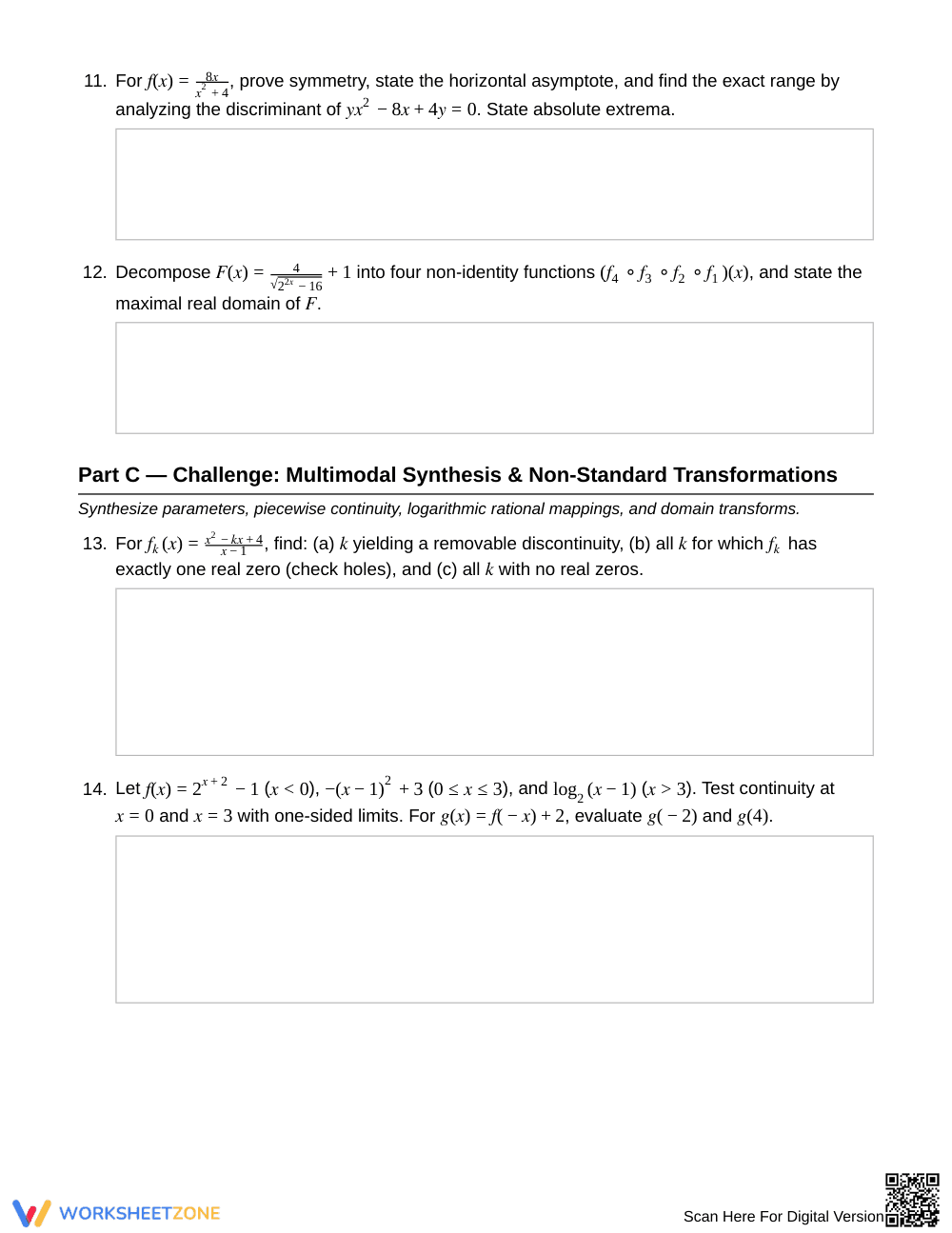
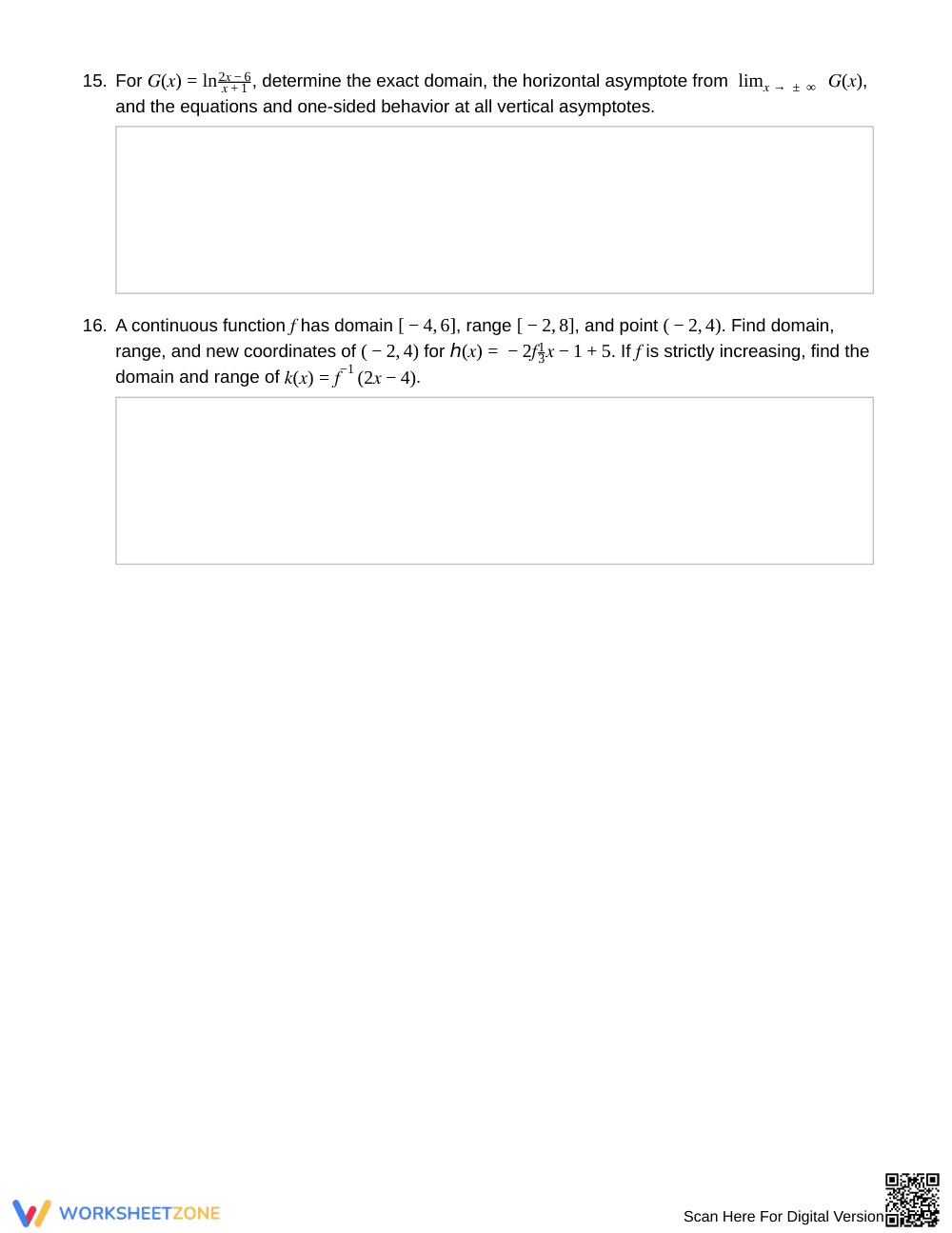
This precalculus worksheet guides Grade 12 students through advanced analysis of functions, asymptotes, and algebraic transformations. Learners evaluate polynomial end behavior, resolve slant asymptotes, verify function symmetry analytically, and manipulate non-standard composite relations across three structured parts. Working through these rigorous functional invariants solidifies algebraic foundations for college calculus.
At a Glance
- Grade: 12 · Subject: Precalculus
- Standard:
HSF-IF.C.7— Graph functions symbolically and show key features of the graph- Skill Focus: Advanced Function Analysis
- Format: 5 pages · 16 problems · Answer key included · PDF
- Best For: Unit assessment or exam review
- Time: 60–90 minutes
Inside this 5-page printable document, students engage with 16 multi-step problems spanning rational, exponential, logarithmic, and absolute value functions. The packet includes a concise algebraic reference header defining transformation parameters and slant asymptotes. Tasks require exact simplified values, limit notation, discriminant-based range proofs, and multi-tier function decomposition, supported by a 2-page answer key.
Skill Progression
- Guided practice (Part A — Foundation): Four multi-part problems establish core fluency with transformation parameters, leading coefficients, logarithmic domains, and absolute value behaviors using reference rules.
- Supported practice (Part B — Core): Eight comprehensive tasks challenge students to determine slant asymptotes, holes, radical inverses, and analytical symmetry proofs with discriminant analysis.
- Independent practice (Part C — Challenge): Four synthesis problems demand non-standard transformations, parametric discontinuity analysis, piecewise limits, and composite domain mapping.
This structured progression reflects the gradual-release model, building student stamina toward precalculus mastery.
Standards Alignment
This worksheet aligns with HSF-IF.C.7: Graph functions expressed symbolically and show key features of the graph, including rational, exponential, and logarithmic functions. Supporting tasks reinforce HSF-BF.B.3 through algebraic transformations. Both standard codes can be copied directly into lesson plans, IEP goals, or district curriculum mapping tools.
How to Use It
Assign this packet after instruction on rational and composite functions as a two-day review or summative assessment. During Part B, observe whether students apply algebraic division correctly when finding slant asymptotes and removable discontinuities. Students typically complete the 16 tasks in 60 to 90 minutes.
Who It's For
This resource serves Grade 12 Precalculus and accelerated STEM students preparing for AP Calculus. Differentiate by assigning Parts A and B for targeted review and Part C for honors extensions. Pair this document with an anchor chart on rational asymptote rules.
According to EdReports 2024 evaluations of college- and career-ready mathematics, rigorous high school curricula require sustained focus on mathematical reasoning and coherent conceptual progression rather than isolated computational drills. This advanced precalculus worksheet addresses standard HSF-IF.C.7 by prompting students to analytically determine key graphical and algebraic features across diverse function families, including rational, logarithmic, and piecewise structures. Rather than merely plotting coordinates, Grade 12 students engage in rigorous inquiry: deducing asymptotic behavior via limit notation, testing continuity at piecewise boundaries, solving parametric removable discontinuities, and calculating functional ranges using algebraic discriminants. By connecting symbolic equations directly to structural invariants, the 16 tasks bridge foundational high school algebra to post-secondary calculus demands. When secondary educators implement structured materials reflecting validated progression frameworks, upper-level learners cultivate the analytical stamina, algebraic precision, and problem-solving flexibility vital for subsequent STEM coursework.


