
































Complete Free Body Diagram Worksheet | Grade 9 Science

Paste this activity's link or code into your existing LMS (Google Classroom, Canvas, Teams, Schoology, Moodle, etc.).
Students can open and work on the activity right away, with no student login required.
You'll still be able to track student progress and results from your teacher account.
Mastering net force requires students to interpret vectors across varying physical orientations. This 4-page physics worksheet provides 18 structured problems guiding secondary science learners through horizontal forces, inclined planes, and graphical force analysis. Students evaluate equilibrium, calculate acceleration using Newton's second law, and explain terminal velocity with force models.
At a Glance
- Grade: 8–12 · Subject: Science
- Standard: Physical Science — Analyze force vectors to calculate net force and resulting acceleration
- Skill Focus: Free Body Diagram: Guided Application
- Format: 4 pages · 18 problems · Answer key included · PDF
- Best For: High school vector force practice
- Time: 45–60 minutes
What's Inside
The worksheet contains 18 tasks across three analytical sections. Students analyze point-mass diagrams featuring horizontal friction, inclined plane trigonometry, and force-acceleration graph data. A complete 4-page answer key provides worked calculations and conceptual explanations for every prompt.
Skill Progression
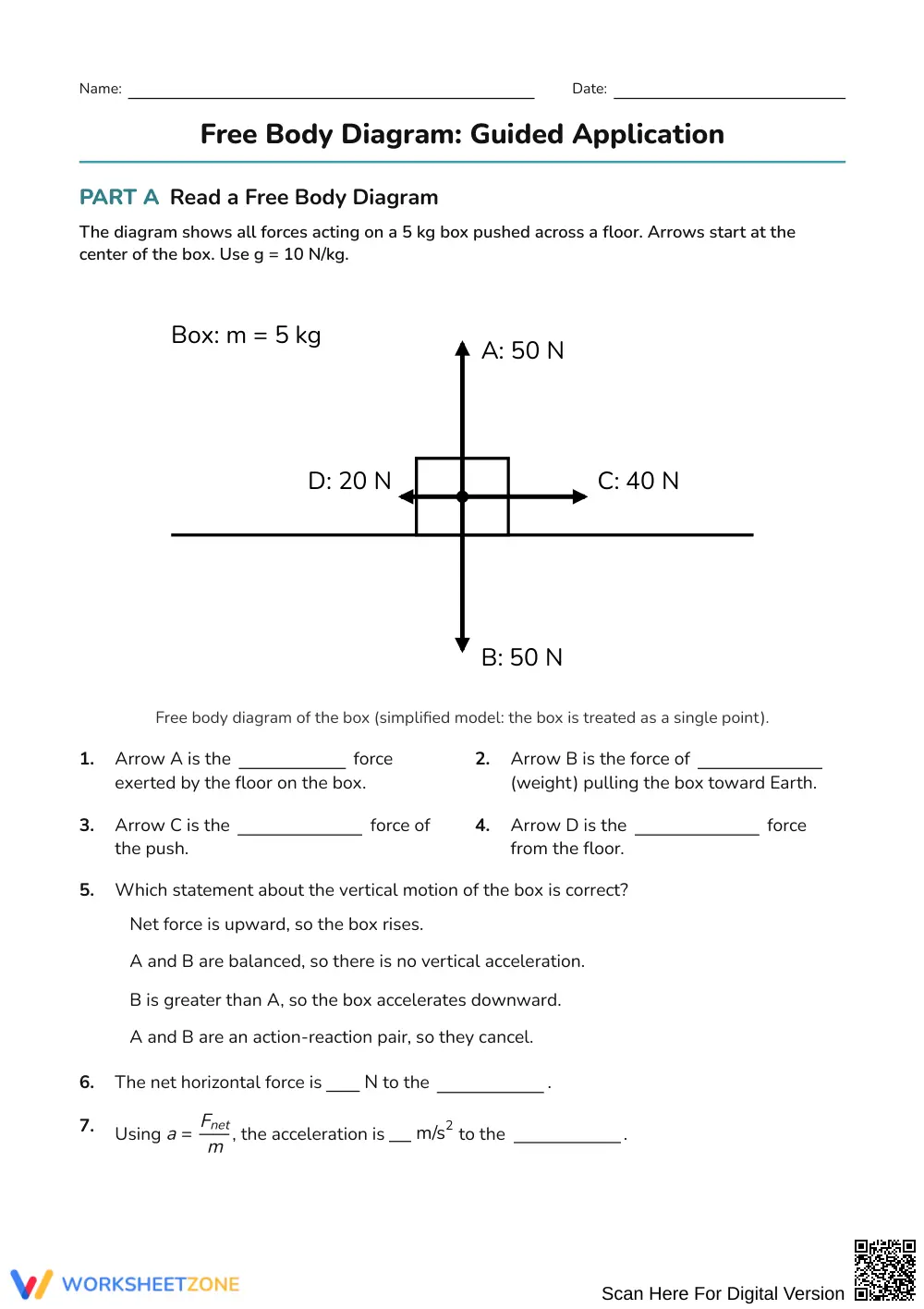
- Guided practice (Part A): Scaffolds horizontal vector reading on a box to calculate net force and acceleration.
- Supported practice (Part B): Introduces an inclined plane where students resolve normal force and calculate ramp acceleration.
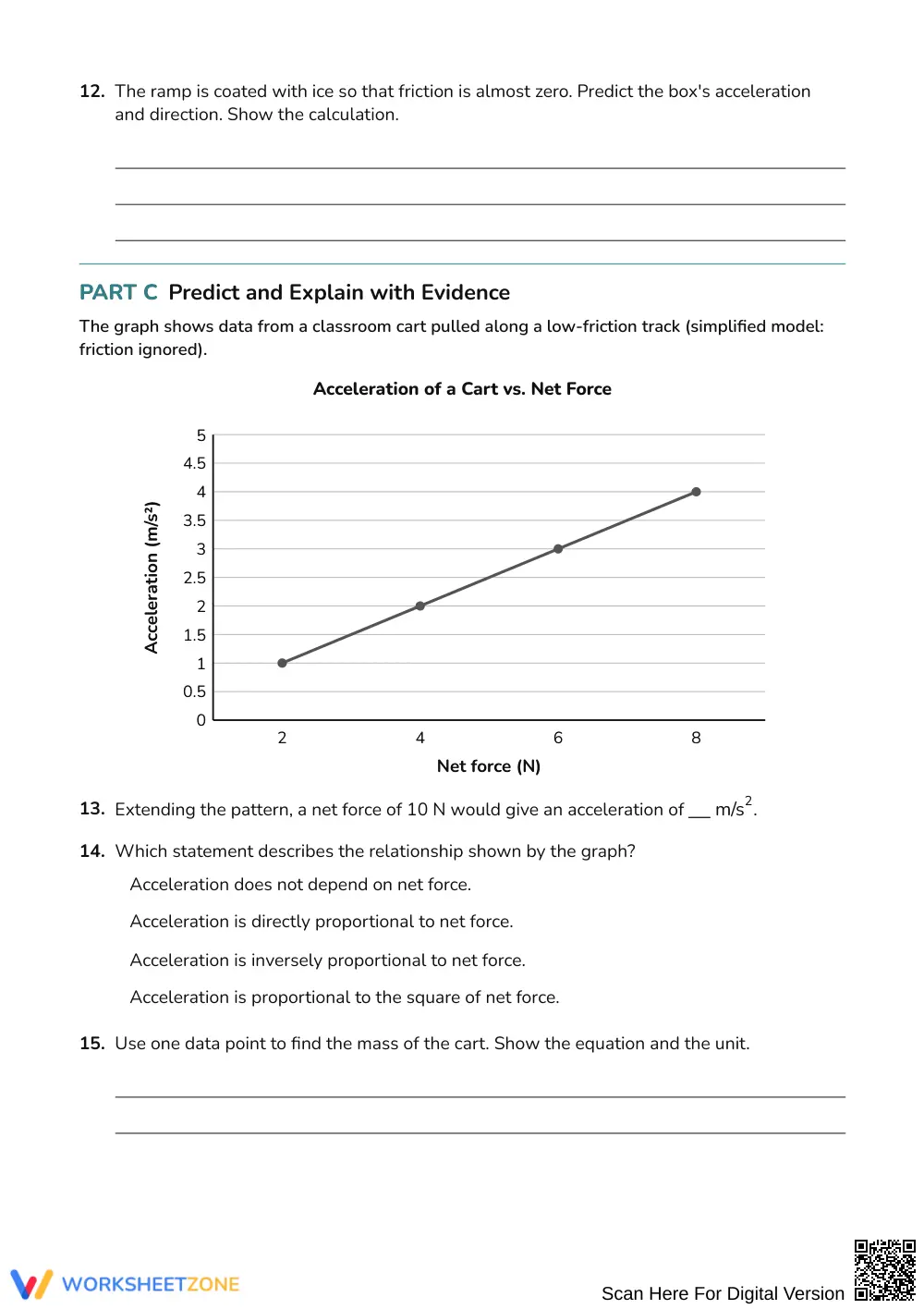
- Independent practice (Part C): Requires students to interpret cart graph data, find mass, and explain terminal velocity.
This gradual-release sequence moves learners systematically from identifying labeled vectors to synthesizing multi-force systems.
Standards Alignment
This resource aligns with physical science standards on forces and interactions. The primary standard requires students to analyze force vectors, calculate net forces, and predict acceleration using Newton's second law. Supporting standards cover proportional relationships between force and mass. Both standard descriptions can be copied directly into lesson plans, IEP goals, or district curriculum mapping tools.
How to Use It
Deploy this resource during the guided practice phase immediately following direct instruction on force vectors and Newton's laws. For a targeted formative check, observe whether students correctly orient the normal force perpendicular to the ramp surface in Part B. Alternatively, use Part C as an independent post-lab activity where students analyze cart acceleration data. Expected completion time is 45 to 60 minutes.
Who It's For
Designed for introductory physics and physical science students in grades 8 through 12. Teachers can scaffold the inclined plane tasks by pre-calculating trigonometric components for emerging learners. It pairs naturally with low-friction dynamics cart investigations and Newton's second law simulation models.
According to Fisher & Frey (2014), instructional frameworks that scaffold visual and quantitative modeling through gradual release significantly strengthen conceptual retention in secondary science. Free body diagrams present substantial hurdles because students frequently confuse normal force orientation or struggle to resolve orthogonal components on ramps. This 18-task worksheet addresses these challenges by moving systematically from balanced horizontal models to multi-variable ramp systems and empirical cart graphs. By isolating individual force vectors before requiring algebraic substitutions, learners construct stable mental schemas for Newtonian mechanics. Evaluating graph data in Part C directly reinforces proportional reasoning, illustrating how acceleration scales with net applied force. Incorporating explicit written explanations alongside quantitative computations ensures students build computational fluency and deep conceptual understanding, facilitating reliable, measurable mastery of physical science force and motion standards across diverse secondary classrooms.


