



























Complete Flower Tools Word Search | Grades 6–7 Science
Paste this activity's link or code into your existing LMS (Google Classroom, Canvas, Teams, Schoology, Moodle, etc.).
Students can open and work on the activity right away, with no student login required.
You'll still be able to track student progress and results from your teacher account.
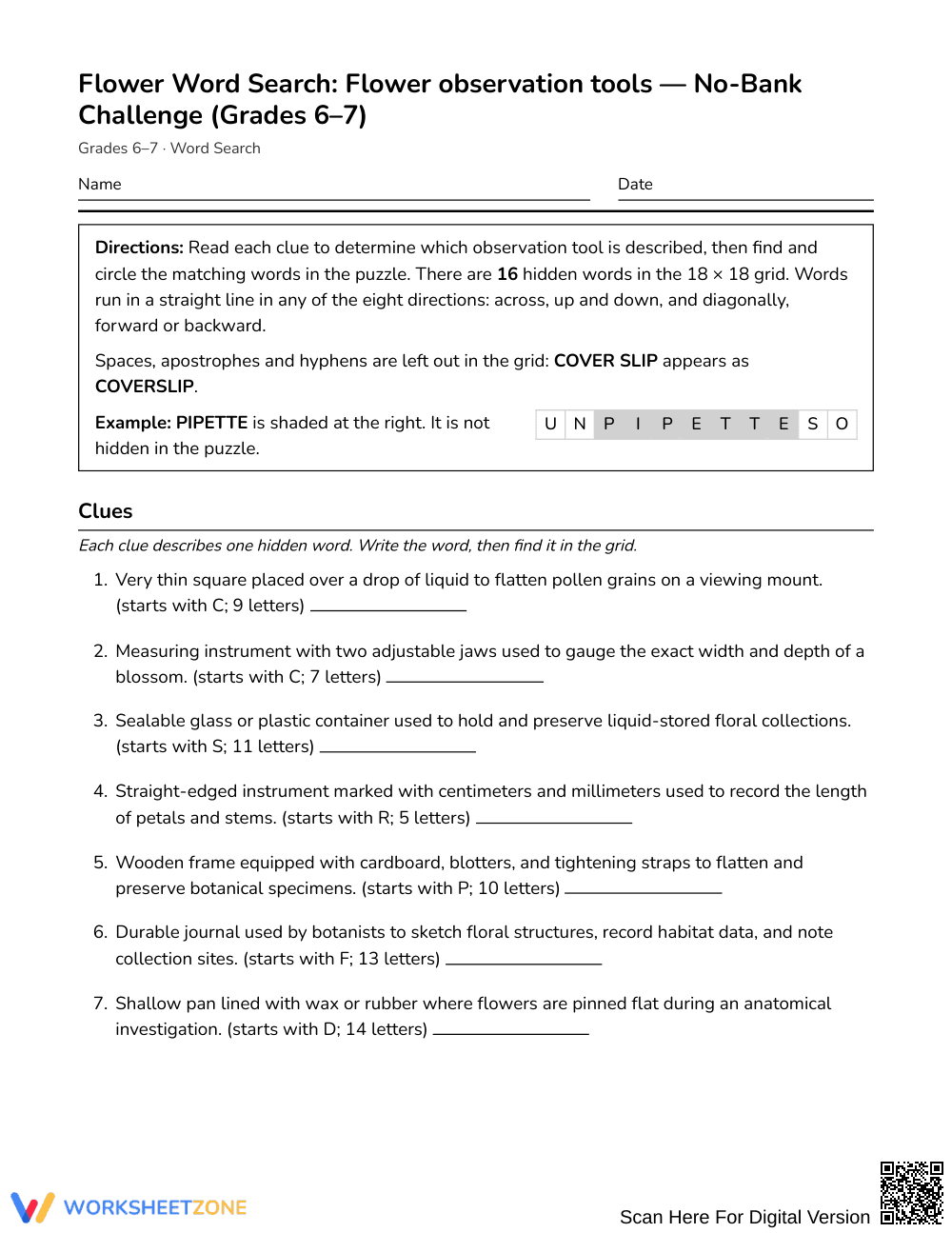
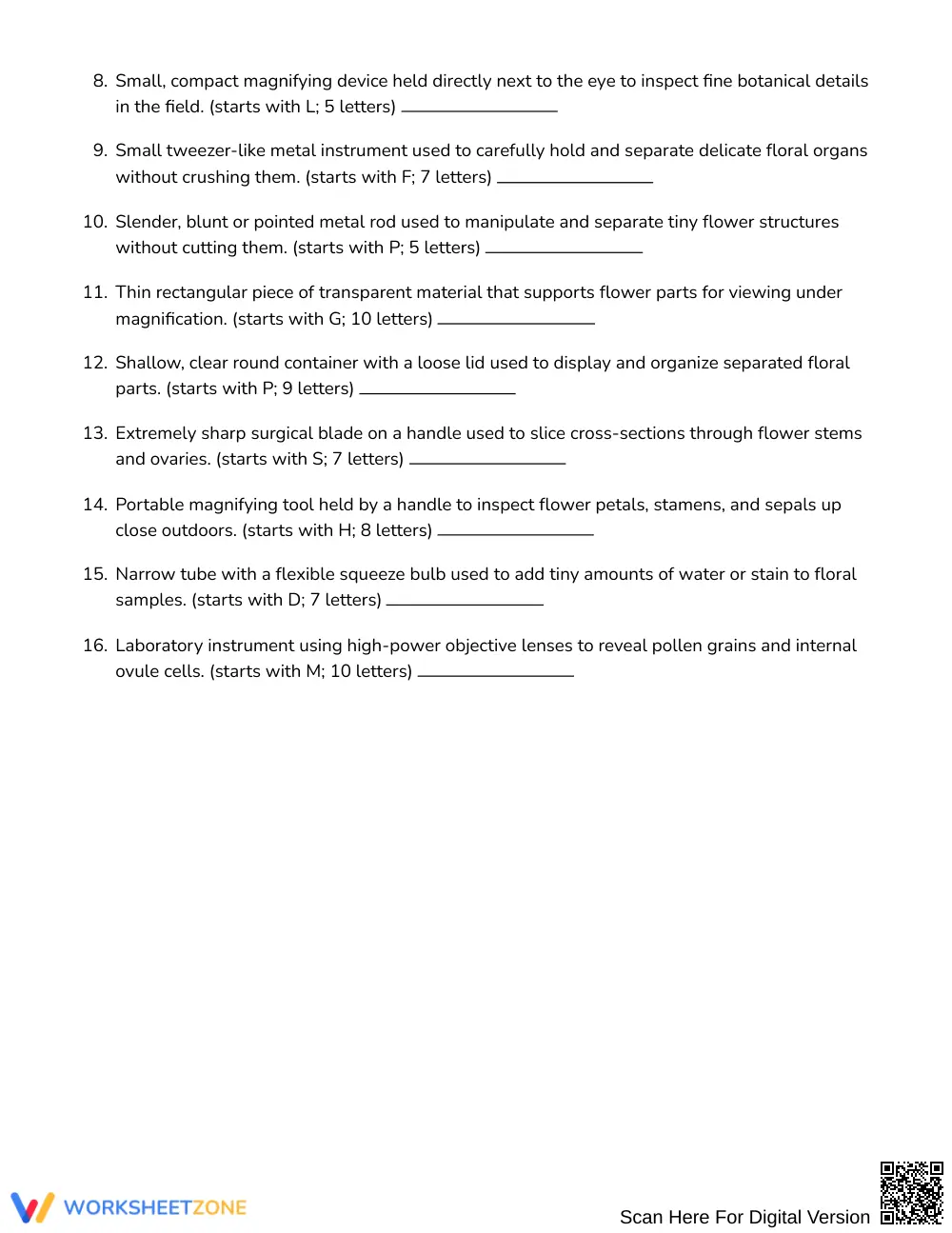
This botanical science activity strengthens middle school students' mastery of scientific apparatus used in plant biology. Learners read descriptive botanical definitions to identify 16 specialized laboratory and field instruments, then locate each term hidden in an intricate grid. The challenge promotes accurate recall of laboratory equipment terminology essential for hands-on botany dissections and microscopic investigations.
At a Glance
- Grade: Grades 6–7 · Subject: Science
- Standard: Not standards-assessed — targeted botanical vocabulary enrichment reinforcing laboratory tool identification
- Skill Focus: Flower observation tools and scientific botanical field equipment
- Format: 3 student pages · 16 hidden words · Complete 4-page answer key included · Printable PDF
- Best For: Hands-on botanical lab introduction, vocabulary reinforcement, and sub plans
- Time: 25–35 minutes
This 3-page science resource features a comprehensive 16-word botanical puzzle paired with a complete 4-page teacher answer key. Rather than providing an overt word bank, the activity supplies 16 technical clues defining essential botanical tools such as calipers, scalpels, dissecting trays, and field notebooks. Students must analyze each functional clue to deduce the correct scientific term before searching the puzzle grid.
The activity challenges students through specific puzzle mechanics designed to deepen vocabulary engagement:
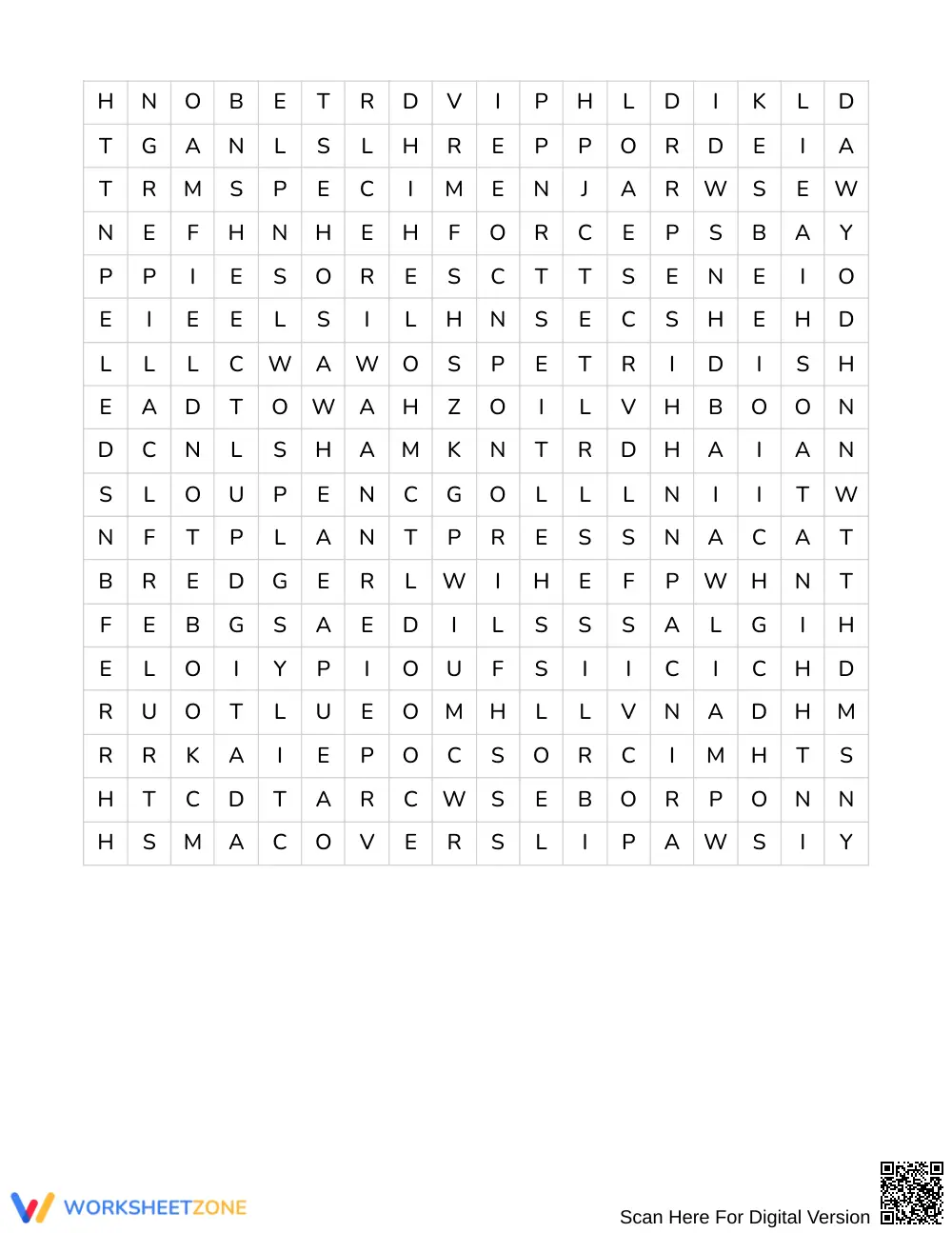
- Dense Letter Grid: An 18 × 18 letter matrix conceals all 16 target botanical terms amidst randomized distractor letters.
- Multi-Directional Search: Words run across all 8 compass directions, including north, northeast, east, southeast, south, southwest, west, and northwest, demanding rigorous visual scanning.
- Clue-Driven Retrieval: The absence of a visible word bank requires learners to actively retrieve terminology from descriptive functional clues rather than merely matching letter sequences.
This word search is designed specifically for vocabulary enrichment and is not formally aligned to an assessed state standard. It reinforces foundational scientific terminology necessary for middle school life science units, laboratory safety protocols, and plant dissection investigations.
This resource functions effectively across multiple instructional moments during a plant biology or microscopy unit:
- Pre-Lab Tool Orientation: Assign this activity prior to a flower dissection lab so students familiarize themselves with delicate tools like forceps, scalpels, and probes. Teachers can formatively assess student readiness by observing whether learners correctly match definitions without prompting.
- Independent Station or Sub Plan: Use the activity as a self-contained station rotation or ready sub plan requiring 25 to 35 minutes for completion.
This activity is created for Grades 6–7 science students exploring plant anatomy, botanical field studies, or microscopy techniques. It serves general education classes, introductory life science courses, and botanical science clubs needing engaging vocabulary practice. For maximum instructional impact, pair this puzzle with a hands-on flower dissection lab or an introductory microscope slide preparation lesson.
According to Fisher & Frey (2014), intentional disciplinary vocabulary instruction directly enhances content-area comprehension and supports long-term knowledge retention in secondary science education. This Grades 6–7 science word search reinforces 16 essential flower observation tools by requiring students to deduce specialized botanical instruments from functional descriptions rather than passive recognition. By engaging students in clue-based retrieval, the activity strengthens the mental associations between scientific apparatus—such as scalpels, calipers, petri dishes, and dissecting trays—and their precise laboratory functions. Research emphasizes that semantic elaboration combined with active visual search aids vocabulary consolidation across middle school learners preparing for hands-on biological investigations. The absence of an explicit word bank raises the cognitive demand from surface-level orthographic scanning to active cognitive recall, ensuring students internalize foundational botanical terminology before entering microscope laboratories or executing intricate floral dissections.


