


























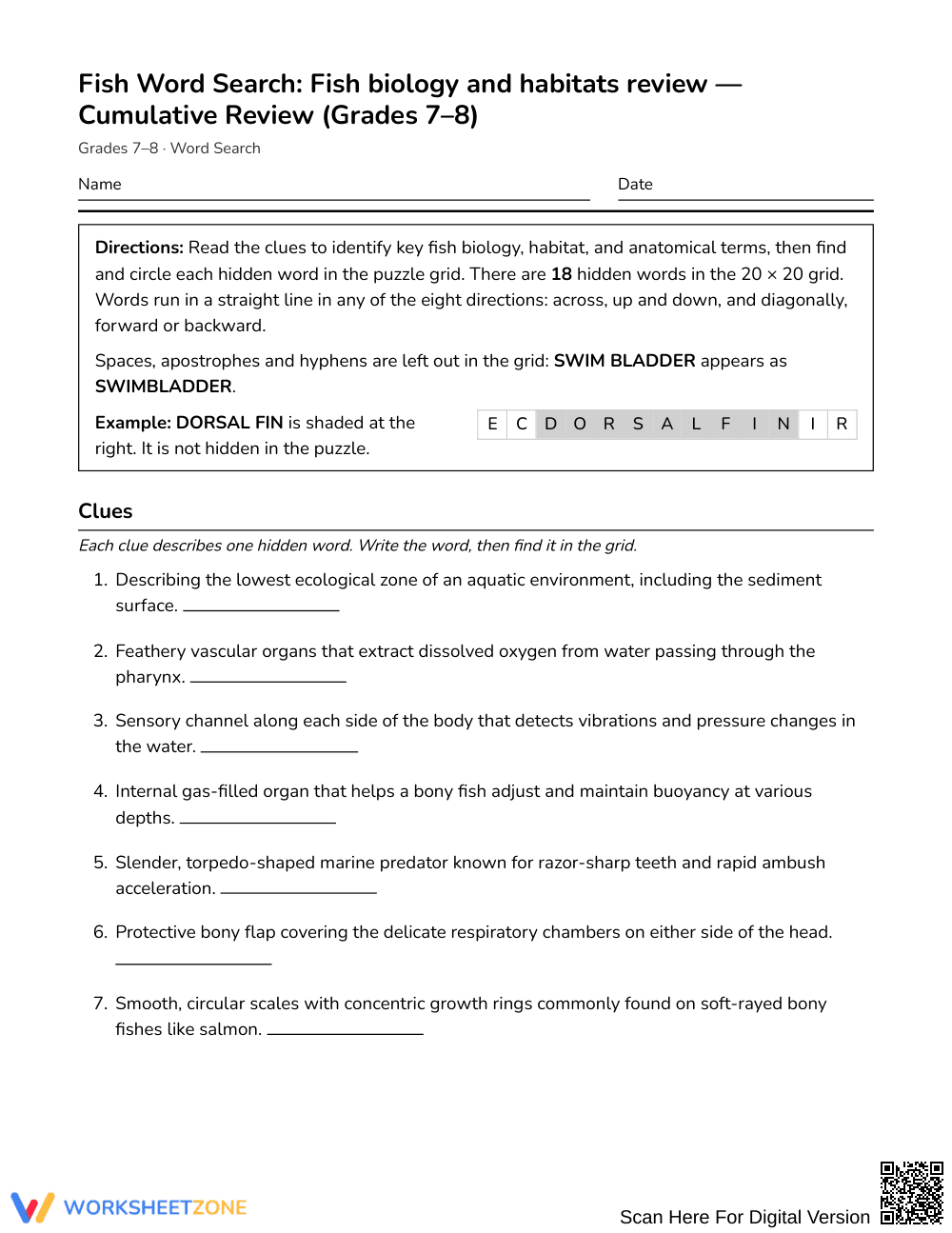


Complete Fish Biology Word Search | Grades 7–8 Science
Paste this activity's link or code into your existing LMS (Google Classroom, Canvas, Teams, Schoology, Moodle, etc.).
Students can open and work on the activity right away, with no student login required.
You'll still be able to track student progress and results from your teacher account.
This Grades 7–8 science word search reinforces foundational marine biology concepts and aquatic terminology. Students review complex anatomical adaptations and habitat classifications by connecting detailed descriptive clues to specific organism and organ names. The activity strengthens domain-specific vocabulary retention, encouraging students to actively analyze scientific definitions as they identify key vocabulary across the puzzle grid.
At a Glance
- Grade: Grades 7–8 · Subject: Science
- Standard: Not standards-assessed — vocabulary enrichment
- Skill Focus: Fish biology and habitats review
- Format: 3 pages · 18 words · Answer key included · PDF
- Best For: Cumulative vocabulary review and sub plans
- Time: 25–35 minutes
What's Inside
This 3-page printable activity features an extensive puzzle set centering on marine and freshwater biology. The resource includes a full list of scientific clues defining essential adaptations, scale types, and marine ecological zones, alongside an organized word bank containing 18 targeted vocabulary terms. A complete 4-page answer key provides full visual solutions showing exact coordinate paths for quick verification.
Puzzle Mechanics and Structure
The activity is built upon a dense 20 by 20 letter grid designed to provide rigorous engagement without overwhelming intermediate learners. Hidden terms run in all eight possible compass directions: north, northeast, east, southeast, south, southwest, west, and northwest. Students read descriptive definitions rather than simple rote words, pairing conceptual identification with letter-grid searching across a shuffled term bank.
Standards Alignment
This review activity serves as pure vocabulary enrichment and is not aligned to a specific state or national curriculum standard. Instead, it provides supplemental reinforcement for general middle school life science units covering vertebrate anatomy, marine ecosystems, and ecological niches, helping students cement biological terminology through repetitive retrieval.
How to Use It
Deploy this puzzle as an independent review station following direct instruction on aquatic life and marine zones. Alternatively, assign it as an engaging, zero-prep activity for substitute teachers or early finishers. While students work, circulate to observe whether they can match morphological terms like operculum or ctenoid scales directly to their functions before scanning the grid. Most students will finish within 25 to 35 minutes.
Who It's For
This resource is tailored for Grades 7–8 life science and marine biology learners needing structured vocabulary reinforcement. Pair this puzzle with an introductory reading passage on ocean biomes or an anatomical diagram labeling exercise to deepen conceptual mastery before cumulative assessments.
Scientific vocabulary acquisition requires deliberate cognitive retrieval rather than passive rote memorization. According to Fisher & Frey (2014), purposeful word-learning routines that connect precise structural definitions with active student engagement build lasting domain-specific literacy. This fish biology review targets 18 essential anatomical and ecological concepts—such as lateral line functions, benthic zones, and placoid dermal scales—through contextual clue identification. By translating complex physiological descriptions into identified terms across a 20 by 20 grid, middle school learners consolidate multi-syllabic terminology into long-term memory. The inclusion of full 8-directional placement challenges spatial recognition while cementing accurate scientific spelling and morphological meaning, ensuring students retain vital foundational concepts for subsequent life science coursework.


