


























Views
Downloads



Complete Figure Properties Worksheet | Grade 10 Geometry
Paste this activity's link or code into your existing LMS (Google Classroom, Canvas, Teams, Schoology, Moodle, etc.).
Students can open and work on the activity right away, with no student login required.
You'll still be able to track student progress and results from your teacher account.
This Grade 10 geometry worksheet equips students to prove geometric theorems algebraically by applying slope, distance, and midpoint formulas on the coordinate plane. Learners analyze two-dimensional figures, verify side and diagonal relationships, and determine precise classifications for triangles and quadrilaterals.
At a Glance
- Grade: 10 · Subject: Geometry
- Standard:
HSG-GPE.B.4— Use coordinates to prove simple geometric theorems algebraically- Skill Focus: Determine a Figure’s Properties from Coordinates
- Format: 5 pages · 12 problems · Answer key included · PDF
- Best For: Coordinate geometry proof practice
- Time: 45–60 minutes
What's Inside
The 5-page printable resource includes a comprehensive coordinate geometry reference box, two fully worked model solutions, and 12 structured tasks spanning three distinct sections. A detailed 3-page answer key provides complete algebraic calculations, exact radical simplifications, and explicit geometric justifications for every problem.
Skill Progression
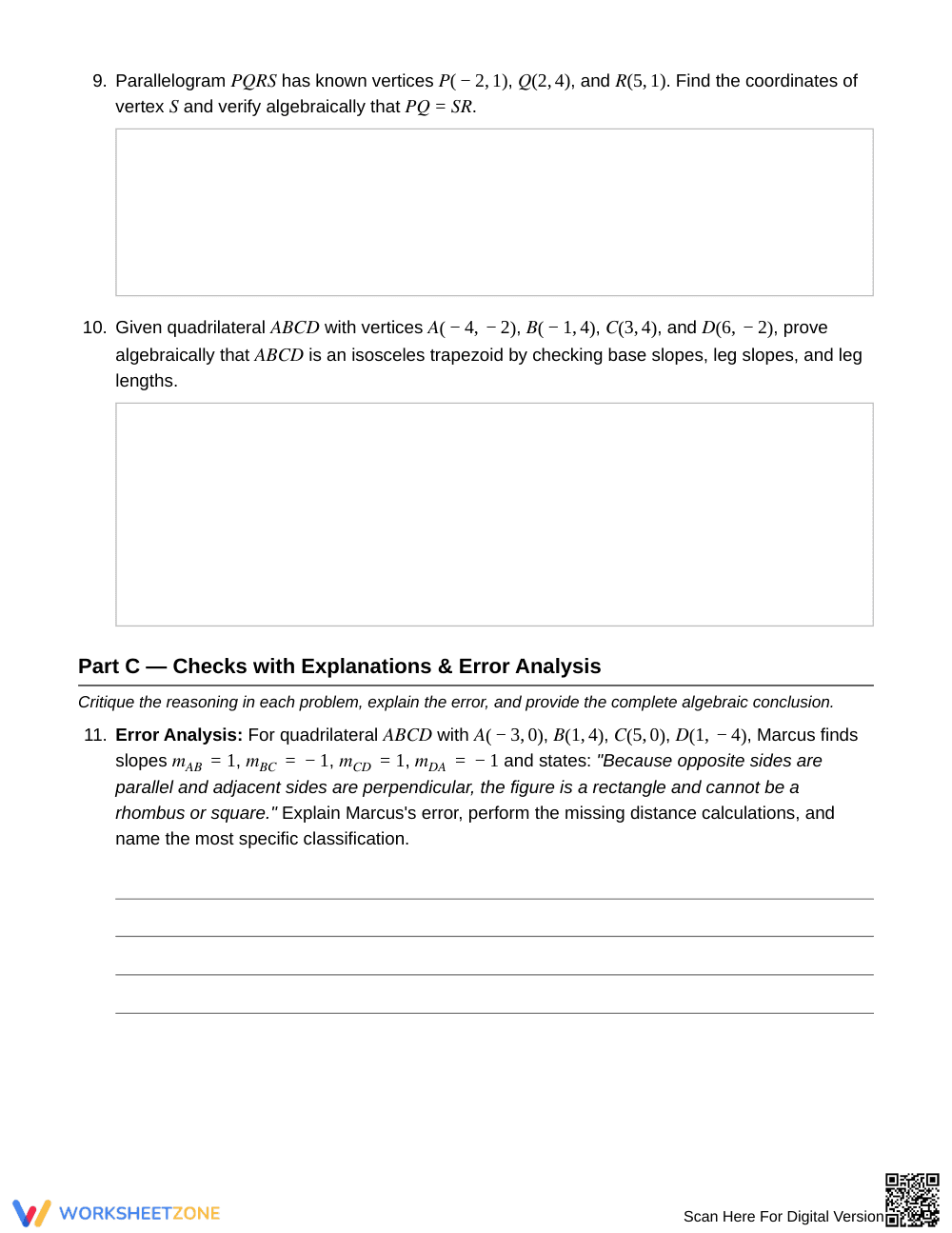
- Guided Practice (Part A, 4 problems): Scaffolds learning with missing-step proofs where students calculate specific slopes, distances, and diagonal midpoints to complete formal classification arguments.
- Supported Practice (Part B, 6 problems): Transitions students to open-ended coordinate proofs requiring complete algebraic set-up to classify scalene triangles, kites, parallelograms, and isosceles trapezoids.
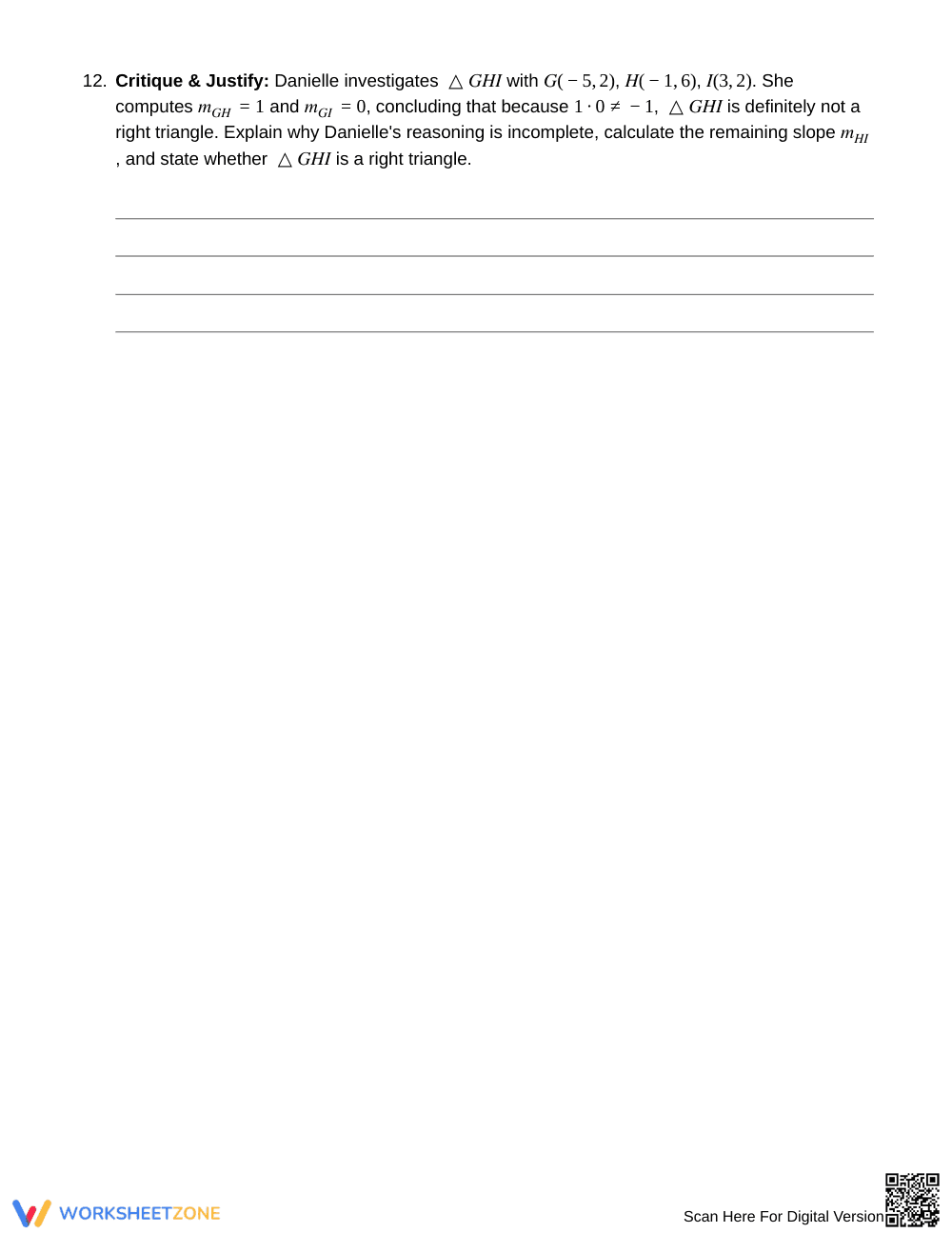
- Independent Analysis (Part C, 2 problems): Challenges learners to critique flawed reasoning and rectify incomplete slope or side-length justifications.
This structured sequence operationalizes the gradual release model, guiding students systematically from guided fill-in verification to autonomous geometric proof.
Standards Alignment
This activity directly targets `HSG-GPE.B.4`, which requires students to use coordinates to prove simple geometric theorems algebraically, such as verifying whether a figure is a rectangle, rhombus, or right triangle. Both standard codes can be copied directly into lesson plans, IEP goals, or district curriculum mapping tools.
How to Use It
Deploy this worksheet after direct instruction on the coordinate distance, midpoint, and slope formulas. For formative assessment, observe student work on Part A to verify that learners calculate negative reciprocal slopes correctly before advancing to unprompted Part B proofs. Students typically complete the 12 problems within a standard 45 to 60 minute instructional block or across two focused small-group stations.
Who It's For
Designed for Grade 10 Geometry students, this resource supports both general education classrooms and targeted remediation groups. Pair this worksheet with an interactive coordinate grid display or a formula reference anchor chart to support visual learners during multi-step proofs.
According to Fisher & Frey (2014), gradual release of responsibility frameworks significantly improve student retention in complex mathematical reasoning by establishing structured scaffolding before independent problem solving. This worksheet aligns with standard HSG-GPE.B.4, enabling Grade 10 learners to determine a figure's geometric properties from coordinates using algebraic slope, midpoint, and distance formulas. By bridging concrete calculations with formal deductive logic, students move from guided fill-in proofs to independent verification and rigorous error analysis. The inclusion of 12 scaffolded tasks allows teachers to monitor procedural accuracy and conceptual understanding simultaneously. As documented in secondary mathematics research, providing explicit model solutions paired with non-routine critique tasks deepens geometric reasoning and prevents common misconceptions surrounding quadrilateral classifications on the Cartesian coordinate plane.


