





























Complete Factor Theorem Worksheet | Grade 11 Algebra II
Paste this activity's link or code into your existing LMS (Google Classroom, Canvas, Teams, Schoology, Moodle, etc.).
Students can open and work on the activity right away, with no student login required.
You'll still be able to track student progress and results from your teacher account.
Help high school Algebra II students master algebraic reasoning with this focused worksheet on the Factor Theorem. Students evaluate polynomial expressions, justify factor relationships using formal definitions, evaluate logical claims, and build rigorous counterexamples to false mathematical statements across eight structured analytical tasks.
At a Glance
- Grade: 11 · Subject: Algebra II
- Standard:
HSA-APR.B.2— Apply the Remainder and Factor Theorems to determine factors of polynomials.- Skill Focus: Justify Factor-Theorem Inferences
- Format: 5 pages · 8 problems · Answer key included · PDF
- Best For: High school polynomial reasoning and test prep
- Time: 40–50 minutes
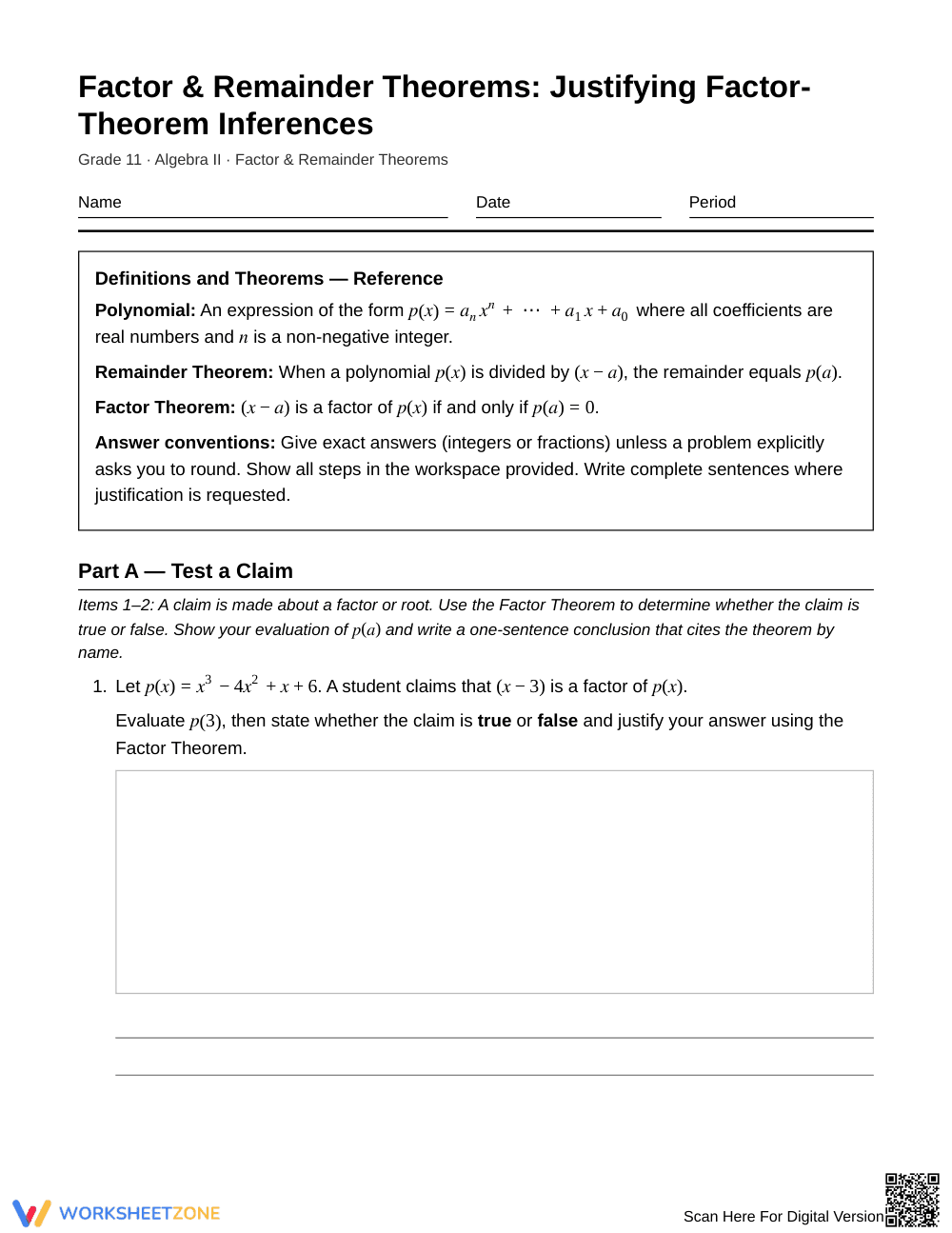
This 5-page printable resource delivers 8 open-response problems organized into three conceptual parts, accompanied by a comprehensive 4-page answer key. It features a reference box containing explicit definitions of polynomials, the Remainder Theorem, and the Factor Theorem, alongside data tables and formal workspace for written algebraic justifications.
- Guided Practice (Part A, Items 1–2): Students test specific binomial factor and root claims by evaluating polynomials at given values and writing formal one-sentence justifications referencing the Factor Theorem.
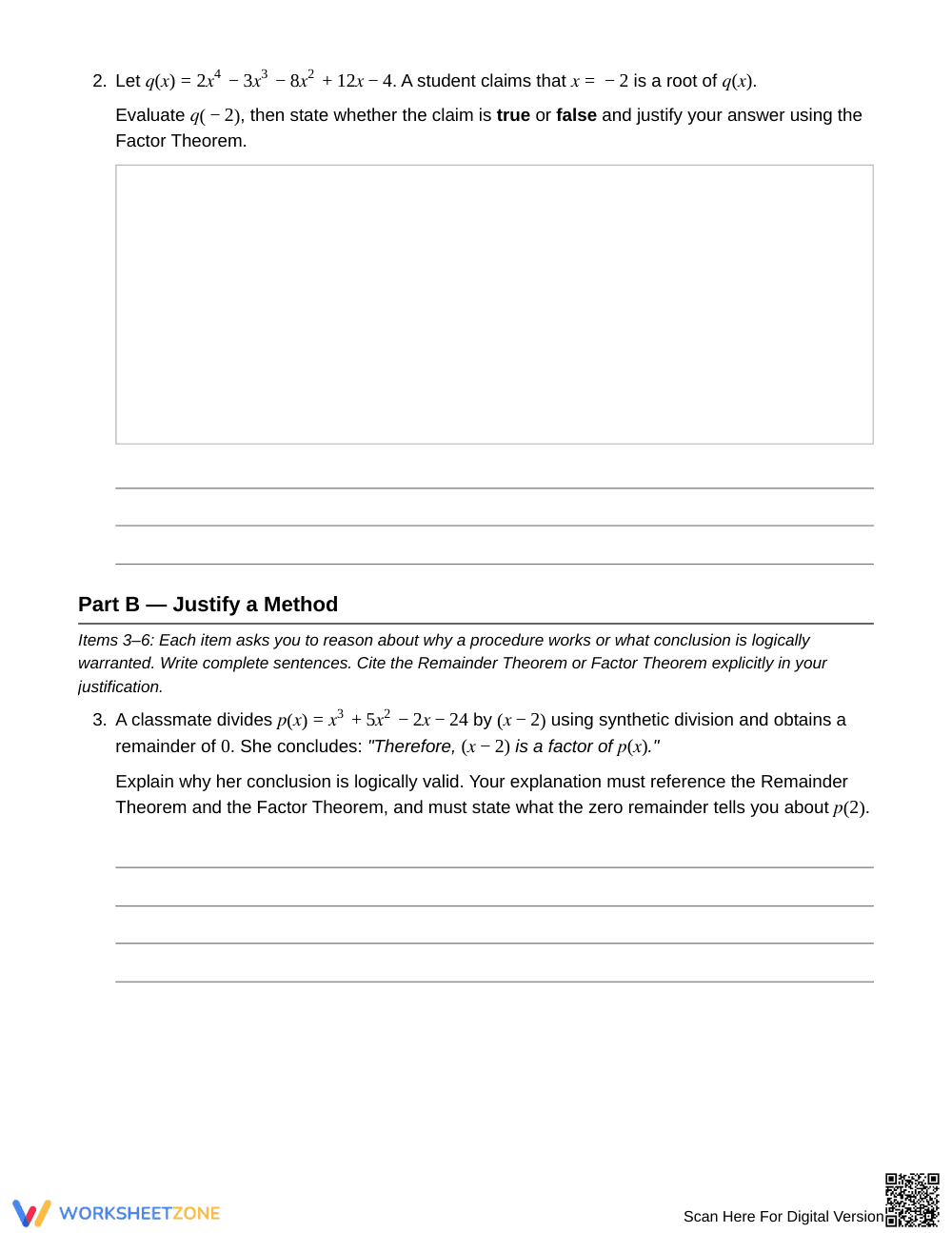
- Supported Practice (Part B, Items 3–6): Students analyze synthetic division results, interpret degree-3 data tables, and identify logical fallacies in polynomial factorization statements.
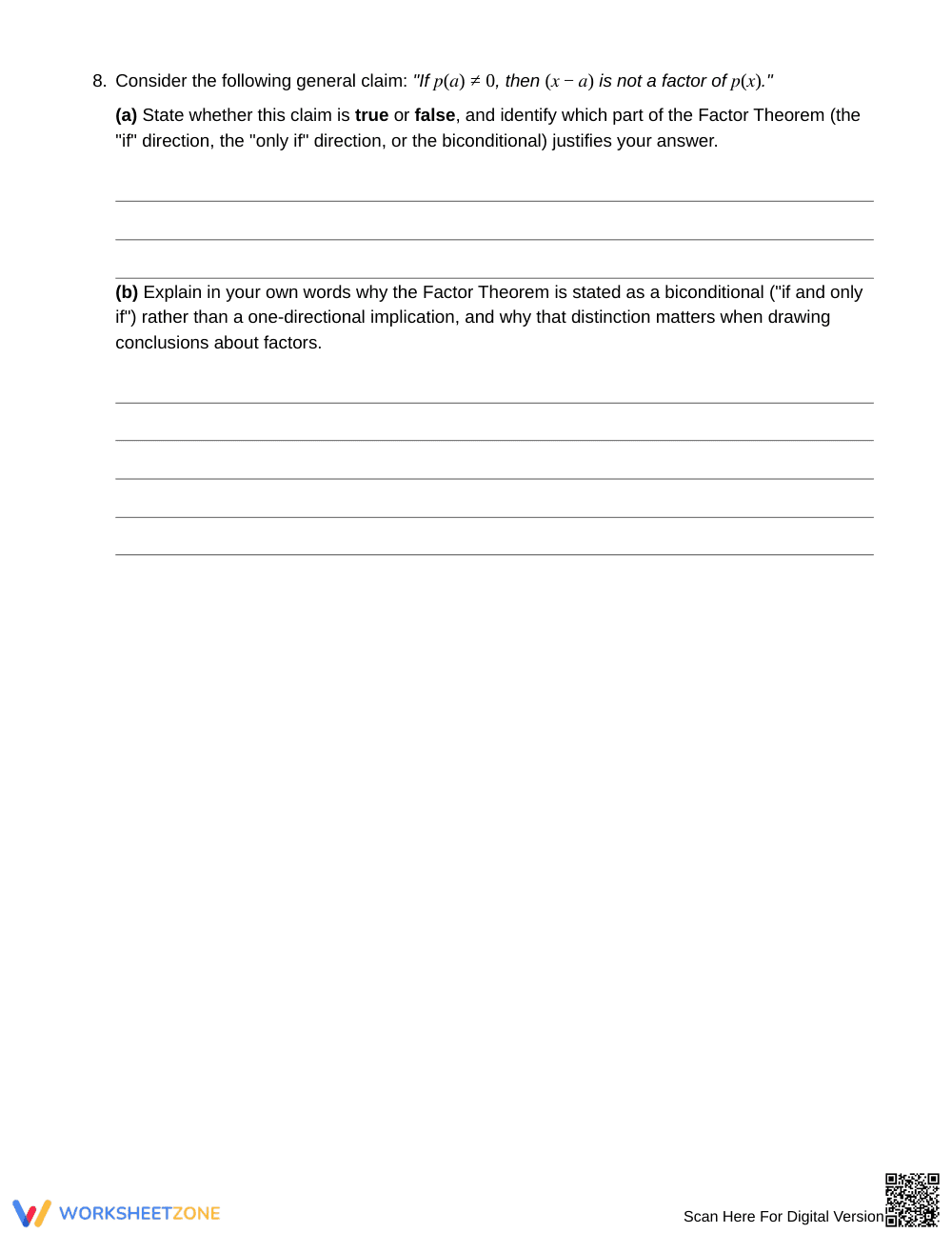
- Independent Practice (Part C, Items 7–8): Students construct polynomial counterexamples to disprove overgeneralized claims and explain why the Factor Theorem operates as a biconditional statement.
This structure reflects a gradual-release model, moving students from computational evaluation to abstract mathematical proof.
This resource aligns directly with standard HSA-APR.B.2, which requires students to know and apply the Remainder Theorem, showing that for a polynomial p(x) and a number a, the remainder upon division by (x - a) is p(a), leading to p(a) = 0 if and only if (x - a) is a factor. Both standard codes can be copied directly into lesson plans, IEP goals, or district curriculum mapping tools.
Use this worksheet after direct instruction on polynomial division to deepen conceptual understanding. During independent or paired practice, circulate to observe whether students cite both the Remainder and Factor Theorems when interpreting zero remainders from synthetic division. Completion typically requires 40 to 50 minutes of instructional time.
This worksheet serves Grade 11 Algebra II and Precalculus students developing formal proof skills. Teachers can differentiate by providing sentence frames for Part B justifications or assigning Part C as an enrichment challenge. It pairs naturally with an anchor chart detailing synthetic division and factor relationships.
According to research by Fisher & Frey (2014) on purposeful mathematics instruction, structured argumentation tasks significantly enhance student retention of complex algebraic principles. This Grade 11 instructional resource targets HSA-APR.B.2 by requiring high school learners to justify factor relationships, interpret polynomial remainders, and critique common logical fallacies in algebraic operations. Rather than relying solely on procedural synthetic division or routine mechanical calculation, students must connect concrete numerical evaluations directly to the formal biconditional structure of the Factor Theorem. The worksheet provides 8 multi-tiered problems across 5 printable pages, consistently engaging high school mathematics learners in authentic mathematical reasoning, counterexample generation, and analytical proof writing. Secondary math educators using this resource can reliably evaluate whether students truly comprehend the vital conceptual bridge connecting polynomial roots, zero remainders, and linear factors in advanced high school algebra curricula.


