


























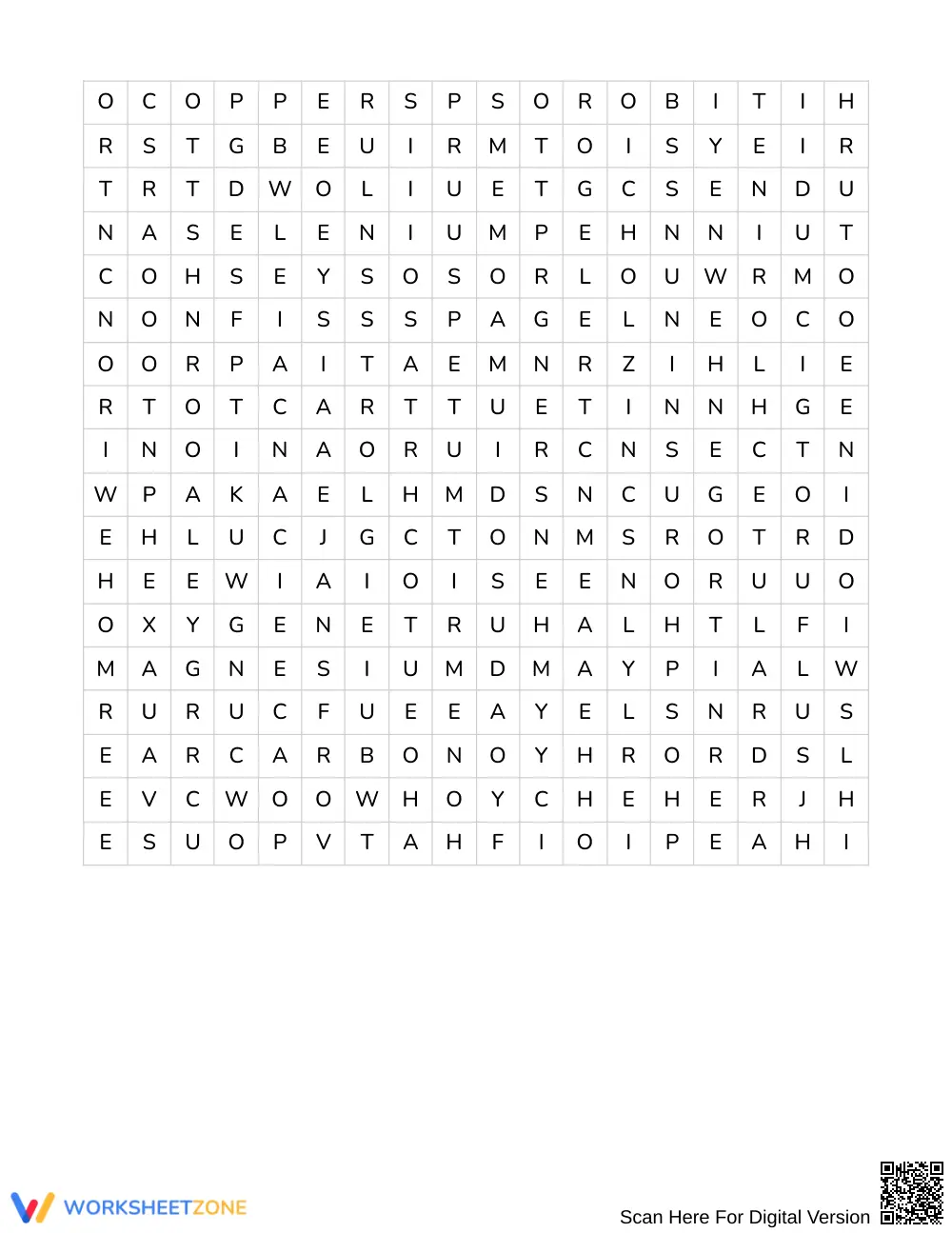

Complete Elements of Life Word Search | Grades 6–7 Science
Paste this activity's link or code into your existing LMS (Google Classroom, Canvas, Teams, Schoology, Moodle, etc.).
Students can open and work on the activity right away, with no student login required.
You'll still be able to track student progress and results from your teacher account.
This Grades 6–7 science word search reinforces essential biochemistry vocabulary by challenging students to identify and locate 16 biological elements found in living organisms. Rather than copying from a standard list, learners read descriptive scientific clues, deduce each corresponding element, and hunt for the hidden terms within an engaging, clue-driven puzzle format.
At a Glance
- Grade: Grades 6–7 · Subject: Science
- Standard: Not standards-assessed — vocabulary enrichment for cellular biology and chemical foundations of life
- Skill Focus: Elements in living things and biochemical foundations
- Format: 3 student pages · 16 words · 4-page answer key included · PDF
- Best For: Biochemistry vocabulary review, bell ringers, and independent practice
- Time: 20–35 minutes
What's Inside
This 3-page science resource centers on the chemical elements that build living matter. Students receive no word bank; instead, they analyze 16 clues covering macronutrients, structural minerals, and trace elements like carbon, phosphorus, and iron. A 4-page answer key highlights every word's path across the grid for quick grading.
Puzzle Mechanics
This word search operates as an active recall challenge to test conceptual comprehension:
- Grid Construction: The activity features an 18 x 18 letter grid, balancing search complexity and visual clarity.
- Search Directions: Words run in all 8 directions—N, NE, E, SE, S, SW, W, and NW—requiring thorough spatial tracking.
- Clue-Driven Structure: With no word bank provided, students interpret scientific clues detailing biological functions to identify the hidden terms.
Standards Alignment
This learning resource serves primarily as vocabulary enrichment and is not aligned to a formal state standard. It reinforces foundational terminology in the chemistry of life unit, strengthening students' retention of atomic components before they encounter high-stakes assessments in life science.
How to Use It
Use this puzzle after direct instruction on the chemistry of life. Students can work independently or in pairs to decode definitions and search the grid, taking 20 to 35 minutes. Alternatively, deploy it as a review station: observe whether students identify elements directly from clues or need notes, revealing which biological concepts need reteaching.
Who It's For
This word search is designed for Grades 6–7 science students learning introductory cellular chemistry or general life science. For extra support, provide an element symbol list or textbook glossary; for advanced learners, have them write chemical formulas containing each identified element. Pair this activity directly with a periodic table anchor chart or a lesson on macromolecules.
Integrating clue-based retrieval tasks into middle school science instruction significantly accelerates academic language acquisition and subject mastery. According to Fisher & Frey (2014), purposeful vocabulary instruction that requires students to actively retrieve conceptual definitions from memory rather than passively copying term lists establishes robust neural pathways for long-term retention. This word search targets elements in living things through 16 rigorous definitional clues, compelling middle school learners to bridge abstract chemical concepts with concrete biological functions such as cellular respiration, DNA synthesis, and enzymatic regulation. By combining descriptive text analysis with spatial search strategies on an 18 x 18 grid, the resource reinforces disciplinary literacy while maintaining student engagement during foundational life science units. Educators can implement this print-and-go puzzle knowing that active, context-rich retrieval practice provides the necessary cognitive scaffolding for students to master complex biochemical terminology and confidently communicate scientific understanding across future inquiry-based laboratory activities.


