

































Complete Ecological Footprint Worksheet | Grade 12 Science

Paste this activity's link or code into your existing LMS (Google Classroom, Canvas, Teams, Schoology, Moodle, etc.).
Students can open and work on the activity right away, with no student login required.
You'll still be able to track student progress and results from your teacher account.
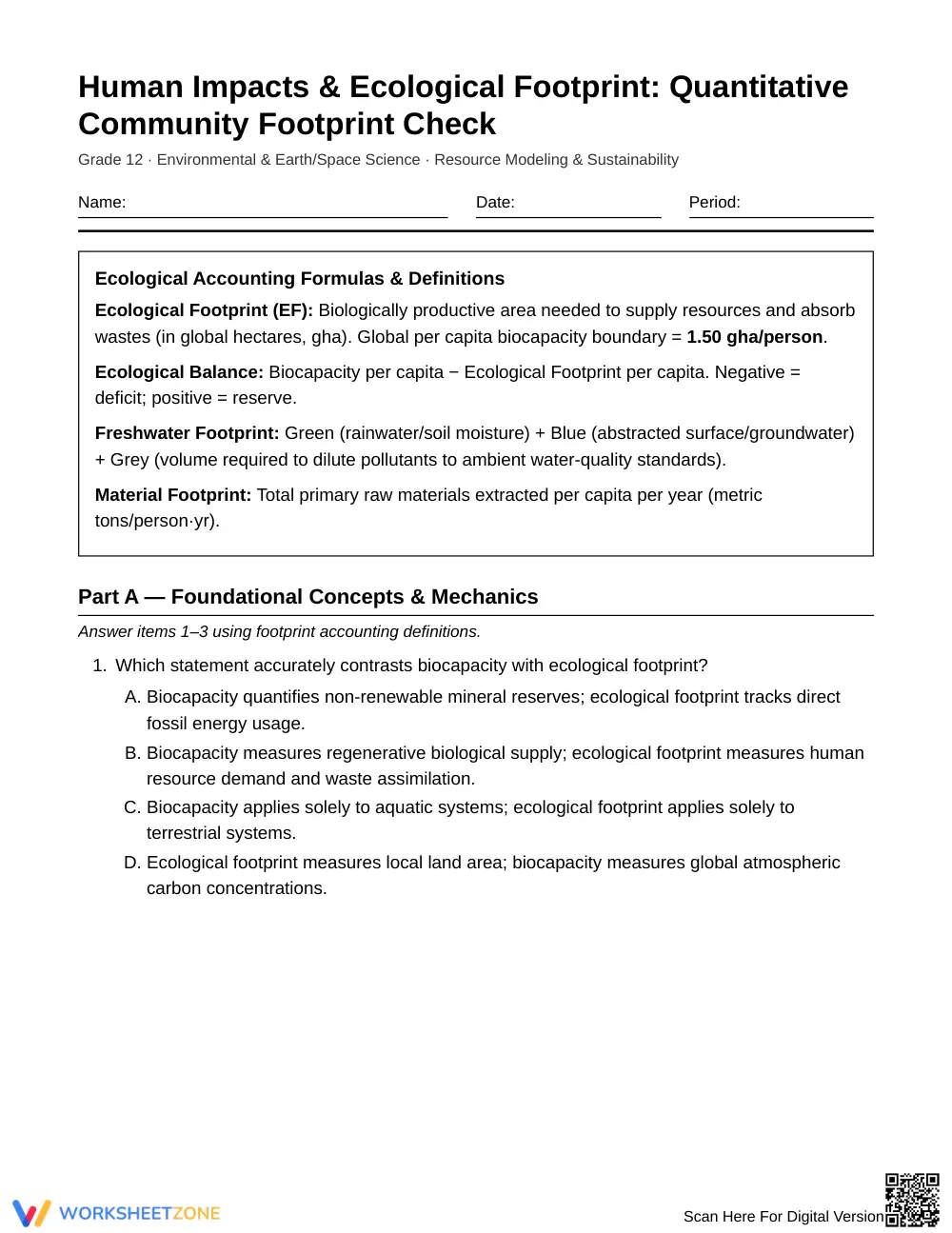
This Grade 12 environmental science worksheet equips students to master quantitative ecological accounting and sustainability modeling. Learners analyze synthetic municipal footprint datasets, calculate per capita biocapacity deficits, quantify freshwater footprints, and evaluate environmental trade-offs across twelve structured analytical tasks.
At a Glance
- Grade: 12 · Subject: Environmental Science
- Standard: Earth and Space Science — Model human resource consumption and planetary biocapacity limits
- Skill Focus: Quantitative ecological and freshwater footprint accounting
- Format: 5 pages · 12 problems · Answer key included · PDF
- Best For: High school sustainability and ecology units
- Time: 45–60 minutes
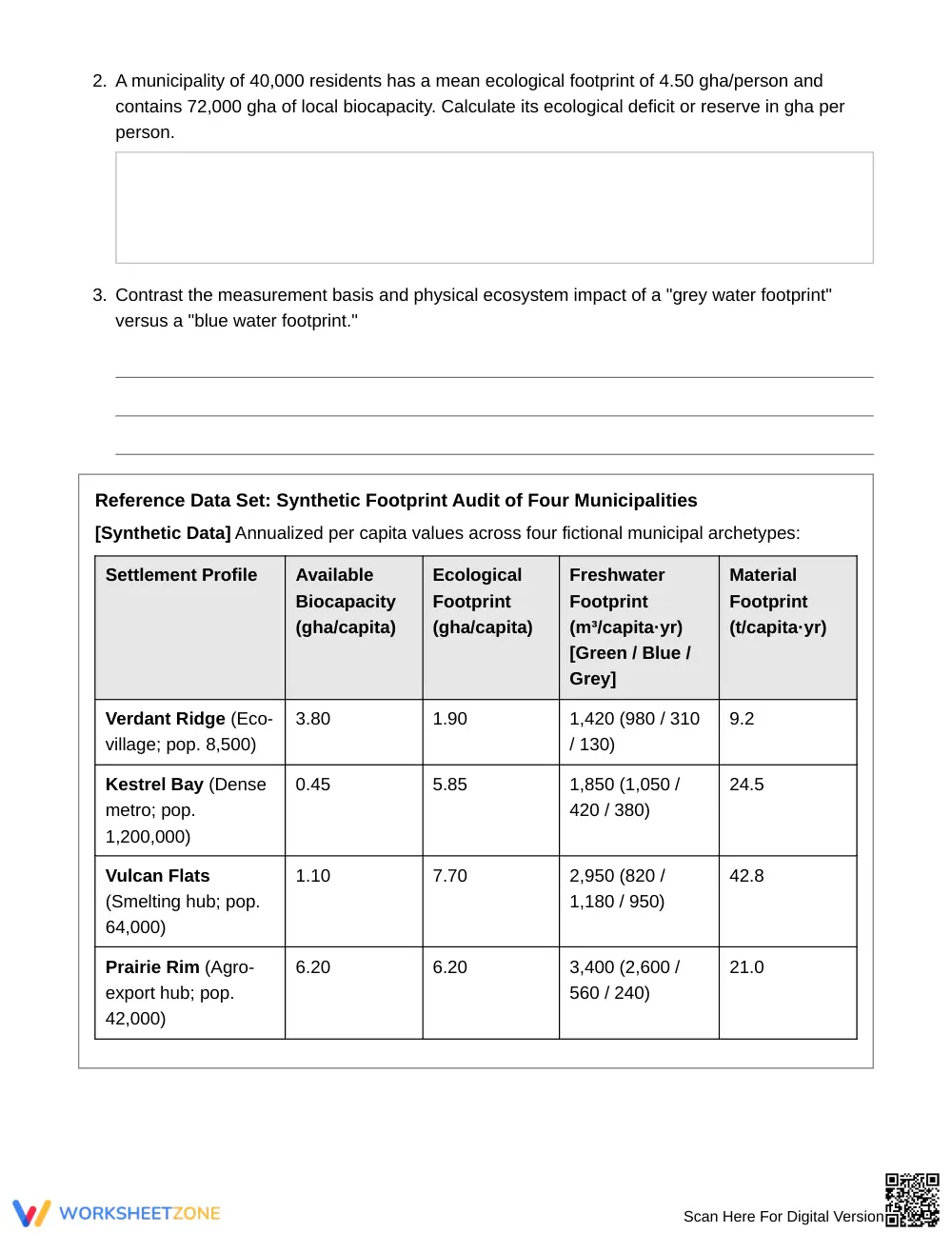
The 5-page printable resource includes foundational definitions, a complete reference data set featuring four municipal settlement profiles, and a 3-page comprehensive answer key. Students progress through twelve tiered analytical problems requiring unit conversions, ratio calculations, and environmental policy trade-off synthesis.
Skill Progression
- Guided practice (Items 1–3): Students review core accounting mechanics, contrasting biocapacity with ecological footprints and distinguishing blue, green, and grey water metrics.
- Supported practice (Items 4–9): Learners calculate per capita ecological deficits, evaluate planetary boundary consumption metrics, and analyze water footprint ratios using the municipal data table.
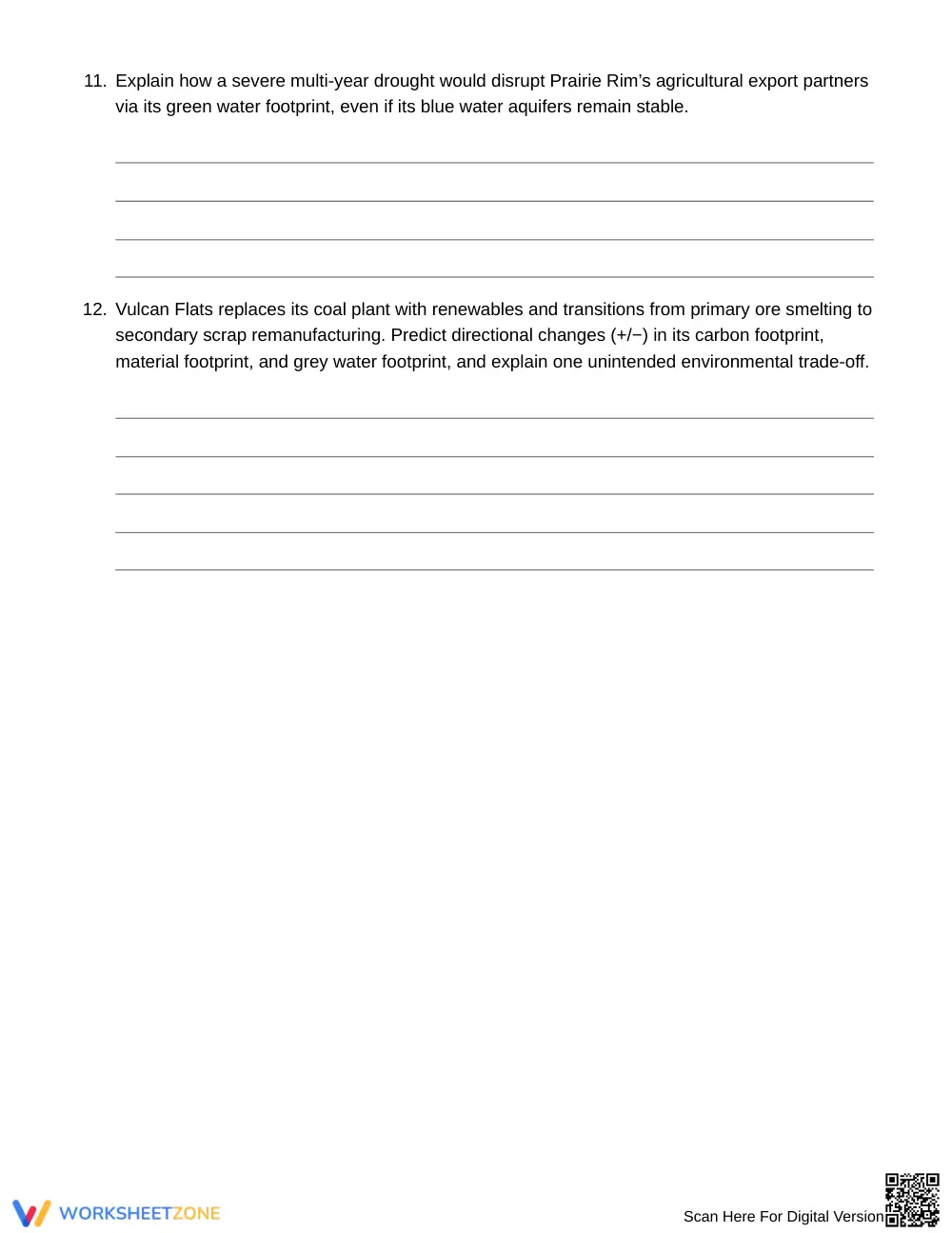
- Independent practice (Items 10–12): Students apply multi-variable systems reasoning to evaluate municipal policy interventions, drought disruptions, and industrial transition trade-offs.
This structured progression reflects the gradual release of responsibility model, guiding learners from baseline formula recall to independent environmental policy analysis.
Standards Alignment
This activity aligns with high school Environmental and Earth Systems science standards requiring students to evaluate the computational relationships between human resource consumption and planetary biocapacity. While no specific state code is assigned, the content directly addresses resource modeling. Both standard codes can be copied directly into lesson plans, IEP goals, or district curriculum mapping tools.
How to Use It
Deploy this worksheet after direct instruction on carrying capacity and planetary boundaries, or assign it as an intensive summative review before an ecology exam. For formative assessment, inspect student calculations in Part B item 5 to verify correct application of the 1.50 global hectare baseline. Expected completion time is 45 to 60 minutes.
Who It's For
Designed for Grade 12 Environmental Science, Earth and Space Science, and sustainability classrooms. For students requiring extra support, provide a physical reference sheet with metric conversions. Pair this activity with a direct instruction lesson on global resource equity and carbon cycle dynamics.
According to Fisher & Frey (2014), instructional materials that implement a structured gradual-release architecture enable high school students to master complex computational modeling tasks with greater autonomy. In secondary environmental science, analyzing multi-variable municipal footprint data requires students to synthesize quantitative ratios, evaluate biological supply limits, and critique policy trade-offs. By scaffolding the problem set from foundational formula comprehension to independent policy evaluation across twelve distinct tasks, this 5-page worksheet reinforces analytical rigor in sustainability education. Students actively calculate per capita ecological deficits and evaluate planetary boundaries, bridging mathematical computation and Earth systems science concepts. Educators can utilize the 3-page answer key to evaluate student mastery and pinpoint specific misconceptions in water footprint accounting.


