































Complete Division Crack the Code Math Worksheet

Paste this activity's link or code into your existing LMS (Google Classroom, Canvas, Teams, Schoology, Moodle, etc.).
Students can open and work on the activity right away, with no student login required.
You'll still be able to track student progress and results from your teacher account.
This Grade 3 division crack-the-code worksheet strengthens basic division fact fluency and inverse relationship reasoning through engaging puzzle decoding. Students solve structured division equations within 100, translate quotients into letters using dual-row cipher keys, and apply related multiplication facts to solve real-world word problems across two student-facing pages.
At a Glance
- Grade: 3 · Subject: Math
- Standard:
3.OA.C.7— Fluently divide within 100 using relationship between multiplication and division- Skill Focus: Division facts and code decoding
- Format: 2 pages · 54 problems · Answer key included · PDF
- Best For: Independent math stations and fluency practice
- Time: 25–35 minutes
What's Inside
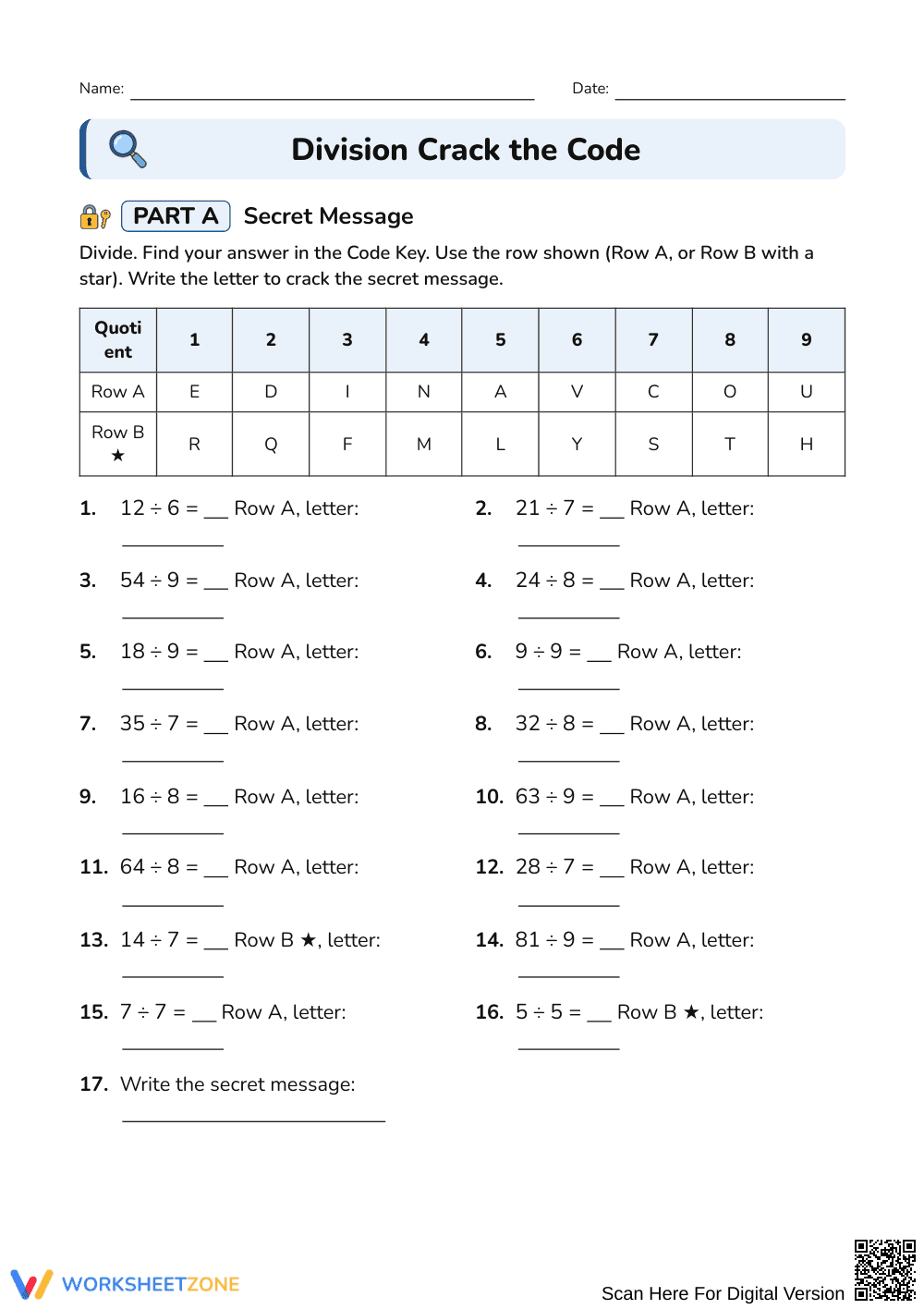
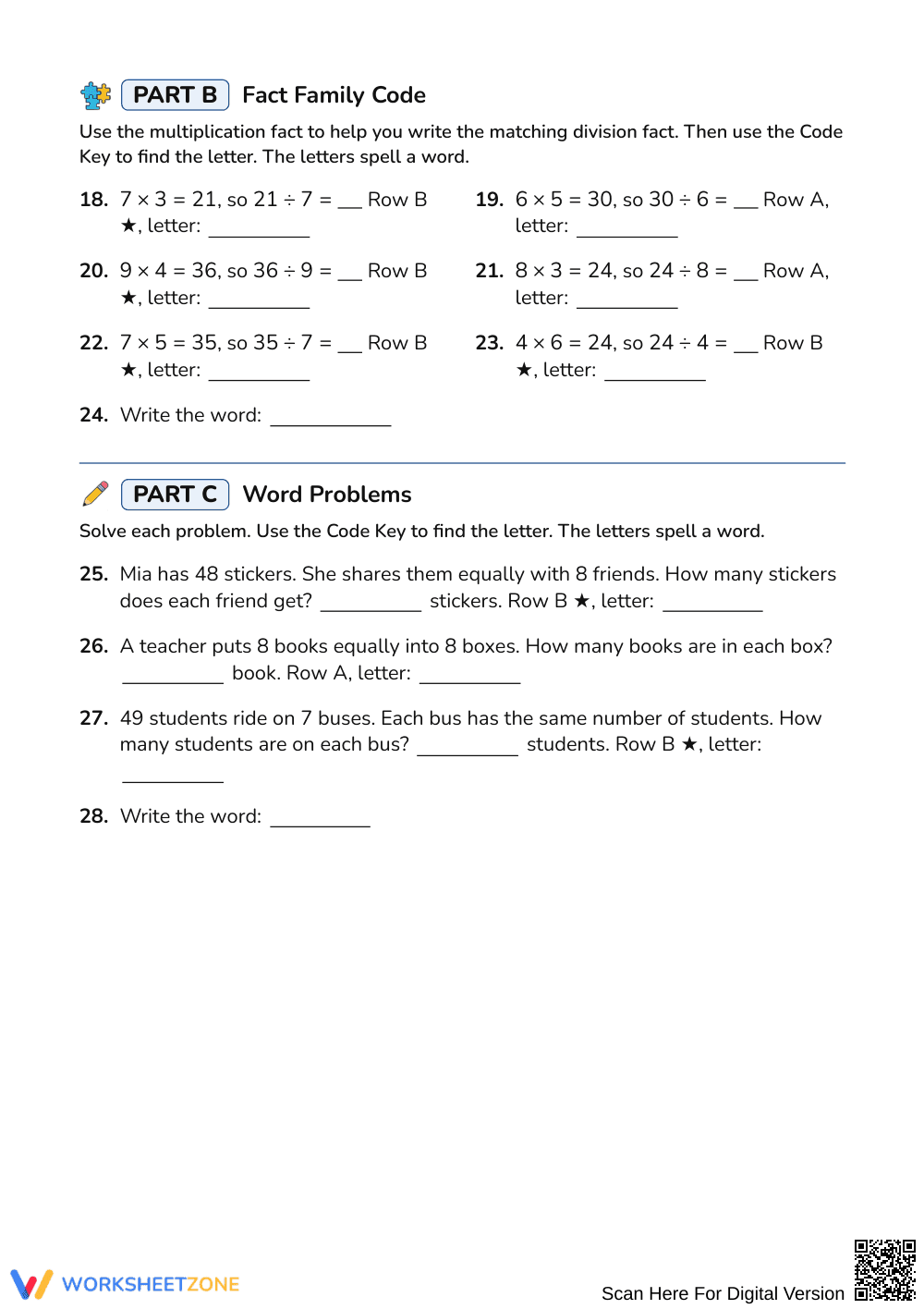
The activity spans 2 pages featuring 54 total practice items divided into three coherent sections. Part A presents single-step division equations paired with a 2-row letter cipher that reveals a secret motivational phrase. Part B prompts learners to connect known multiplication facts directly to inverse division equations to spell an target word. Part C provides one-step word problems requiring equal sharing across groups, complete with a 2-page answer key showing step-by-step solutions and decoded letters.
Skill Progression
- Guided practice: Part A supplies 16 isolated division facts with immediate row markers (Row A or Row B) to anchor code-lookup mechanics.
- Supported practice: Part B presents 6 fact-family items explicitly linking multiplication equations to their corresponding division facts before decoding.
- Independent practice: Part C challenges learners with 3 contextual word problems requiring students to identify divisors, calculate equal shares, and independently verify quotients against the cipher.
This sequence follows a gradual-release framework, moving students systematically from visual substitution to structural fact families and unprompted contextual problem-solving.
Standards Alignment
This worksheet aligns directly to primary standard `3.OA.C.7`: Fluently multiply and divide within 100, using strategies such as the relationship between multiplication and division or properties of operations. It also reinforces supporting standard `3.OA.B.6` by requiring learners to understand division as an unknown-factor problem. Both standard codes can be copied directly into lesson plans, IEP goals, or district curriculum mapping tools.
How to Use It
Deploy this worksheet during the independent practice portion of a division unit, or assign it as a self-checking station activity after direct instruction on fact families. During student work, monitor whether learners consult the multiplication prompts in Part B or attempt to count backwards, which highlights who still requires concrete arrays. Expect completion within 25 to 35 minutes depending on student recall speed.
Who It's For
This resource serves general education third-grade classrooms, math intervention groups needing structured fact reinforcement, and fourth graders reviewing operational fluency. For striving learners, provide a printed multiplication chart to bridge factor retrieval, while advanced learners can compose their own division cryptograms. Pair this worksheet naturally with a division array anchor chart during small-group review.
Mastering basic division fact fluency under standard 3.OA.C.7 represents a critical mathematical milestone that predicts long-term proficiency in multi-digit operations and algebraic readiness. According to findings from Fisher & Frey (2014), structured puzzle-based tasks and gradual-release scaffolds provide students with meaningful cognitive engagement, shifting practice from rote memorization toward pattern recognition and self-monitoring. When third-grade students calculate quotients within 100 and immediately apply those values to crack secret codes, the instant feedback loop reinforces accurate computation while lowering math anxiety. Connecting multiplication facts to inverse division operations strengthens the conceptual schema necessary for fractions and ratios in later grades. Implementing systematically scaffolded practice sets ensures that diverse learners build automaticity and procedural flexibility. Educational research demonstrates that combining contextual word problems with targeted computational fluency produces measurable improvements in elementary math achievement and conceptual retention across diverse student populations.


