




























Complete Dinosaur Groups Word Search | Grades 7–8 Science
Paste this activity's link or code into your existing LMS (Google Classroom, Canvas, Teams, Schoology, Moodle, etc.).
Students can open and work on the activity right away, with no student login required.
You'll still be able to track student progress and results from your teacher account.
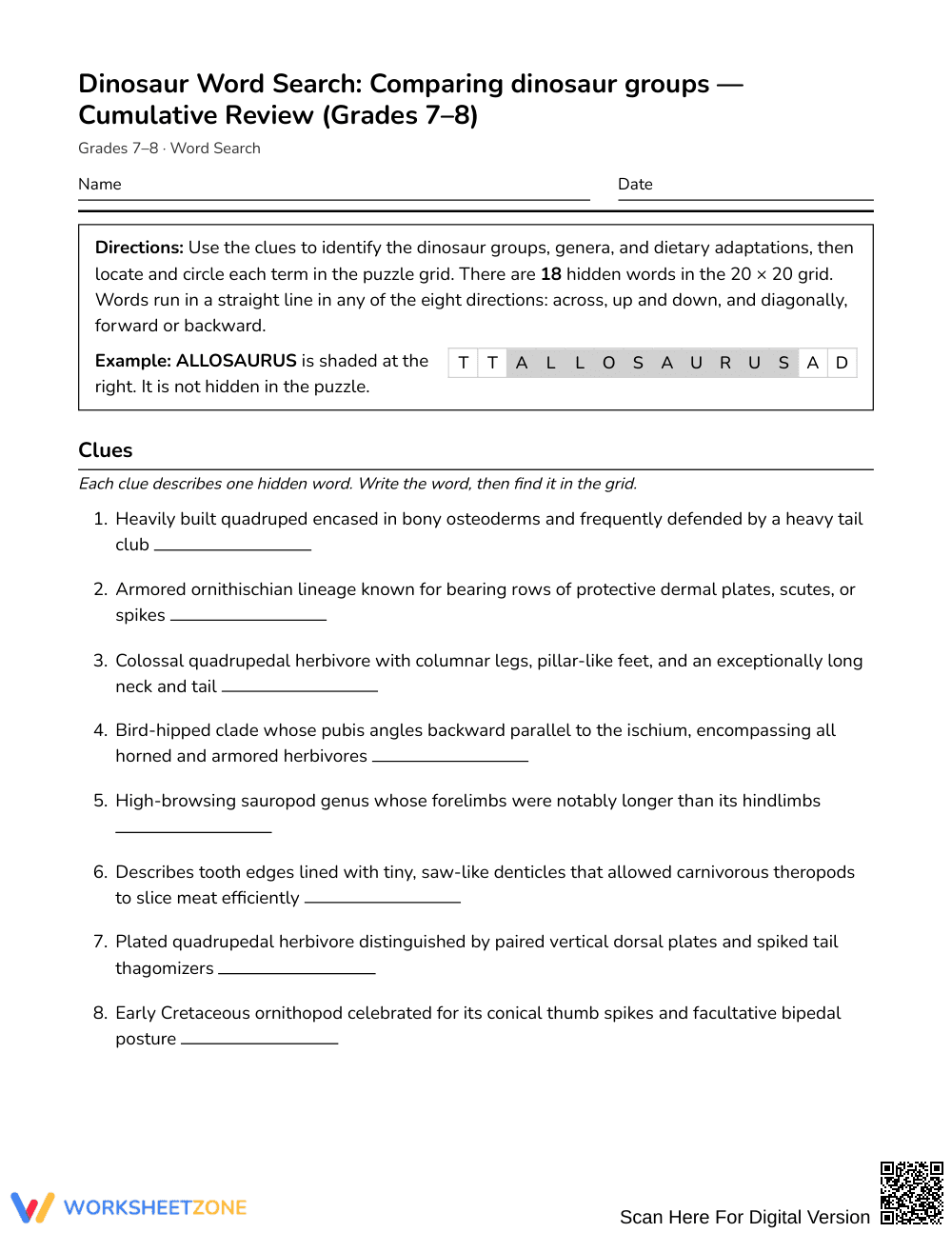
This dinosaur groups word search reinforces essential paleontology and classification vocabulary for middle school life science students. Learners identify key anatomical traits, evolutionary clades, and representative genera by matching detailed clues to hidden terms. The activity strengthens terminology retention and conceptual connections across major reptilian lineages without requiring teacher prep.
At a Glance
- Grade: Grades 7–8 · Subject: Science
- Standard: Not standards-assessed — vocabulary enrichment
- Skill Focus: Comparing dinosaur groups
- Format: 3 pages · 18 words · Answer key included · PDF
- Best For: Vocabulary review and unit wrap-up
- Time: 25–35 minutes
What's Inside
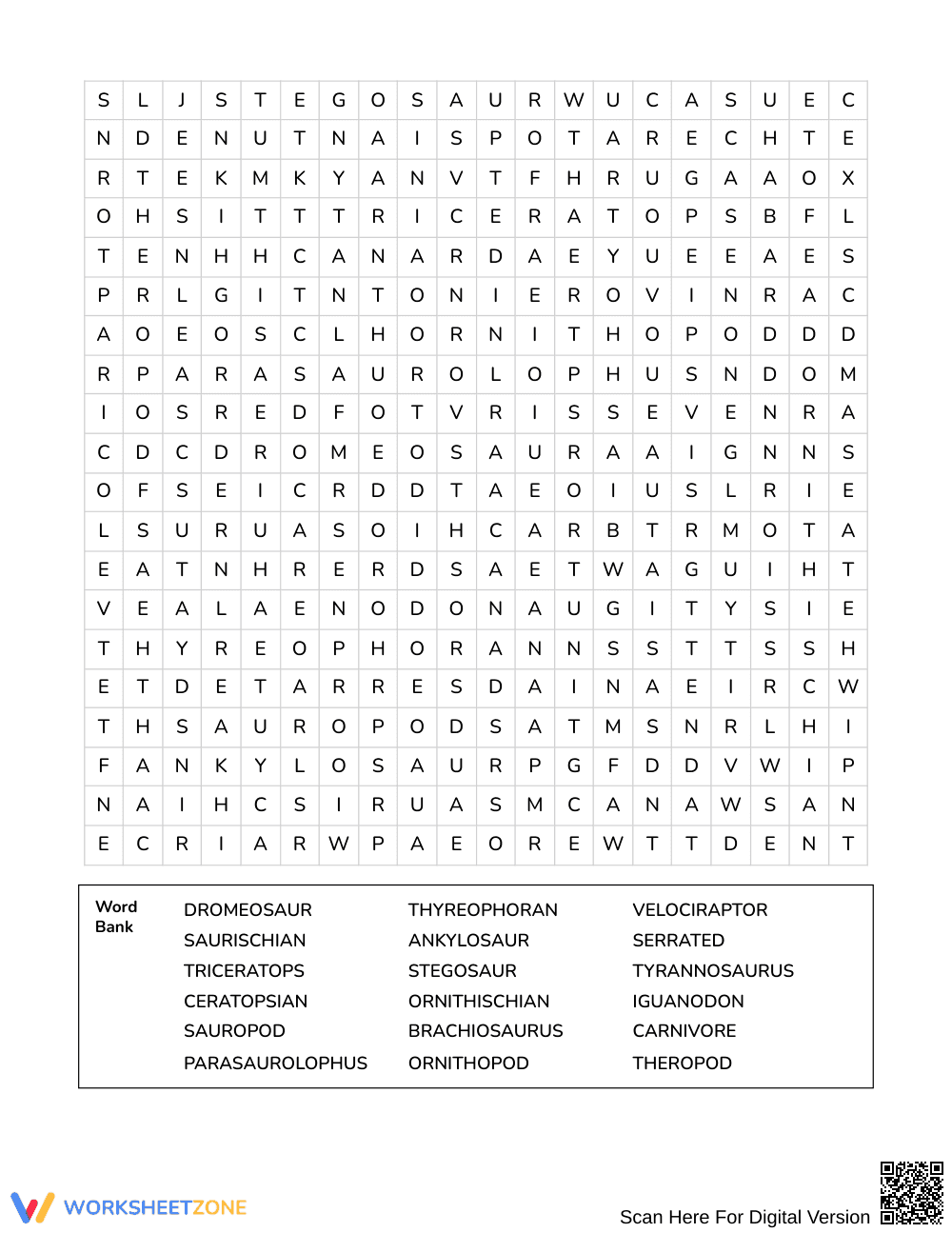
This 3-page printable science resource contains an 18-word puzzle accompanied by content-rich anatomical clues and a complete 4-page answer key. Rather than simply copying words from a list, students read descriptive definitions addressing pelvic structure, skull ornamentation, and locomotion to determine each target word before searching the letter grid.
Puzzle Mechanics and Structure
The activity is built on a dense 20 x 20 letter grid designed to challenge middle school students. The 18 hidden words run in all eight possible directions: north, northeast, east, southeast, south, southwest, west, and northwest. A shuffled word bank provides reference support, while the rigorous clues require students to distinguish between major ornithischian and saurischian clades, specific genera like Triceratops and Brachiosaurus, and specialized dietary adaptations.
Standards Alignment
This activity serves as focused vocabulary enrichment and is not aligned to a specific state or national content standard. It supports broader middle school life science units covering biological classification, comparative anatomy, and prehistoric life by cementing scientific terminology through contextual definitions.
How to Use It
Deploy this puzzle as an engaging mid-unit checkpoint after direct instruction on vertebrate anatomy or as a quiet review station during animal classification units. During work time, circulate to verify that students deduce terms from the anatomical clues rather than scanning the grid randomly. Most middle school learners will complete the search within 25 to 35 minutes.
Who It's For
This activity is designed for Grades 7–8 general science, life science, and paleontology electives. It provides accessible reinforcement for visual learners and can be paired effectively with a comparative skeletal diagram or cladogram analysis lesson.
Vocabulary acquisition in secondary science requires deliberate interaction with domain-specific terms rather than passive memorization. According to Fisher & Frey (2014), structured word study that pairs precise conceptual definitions with active orthographic processing deepens lexical storage and aids reading comprehension in informational texts. This word search activity operationalizes that principle by requiring middle school learners to process complex morphological and phylogenetic terminology—including clades such as Thyreophora and Ornithischia—through clue-based identification across an 18-word set. The multi-directional 20 x 20 puzzle framework demands sustained visual scanning and pattern recognition, reinforcing correct scientific spelling and structural definitions. As an enrichment tool within comparative anatomy and animal classification curricula, this targeted task provides meaningful vocabulary exposure that supports long-term scientific literacy.


