




























Views
Downloads




Complete Coterminal Angles Worksheet | Grade 12 Precalculus

Paste this activity's link or code into your existing LMS (Google Classroom, Canvas, Teams, Schoology, Moodle, etc.).
Students can open and work on the activity right away, with no student login required.
You'll still be able to track student progress and results from your teacher account.
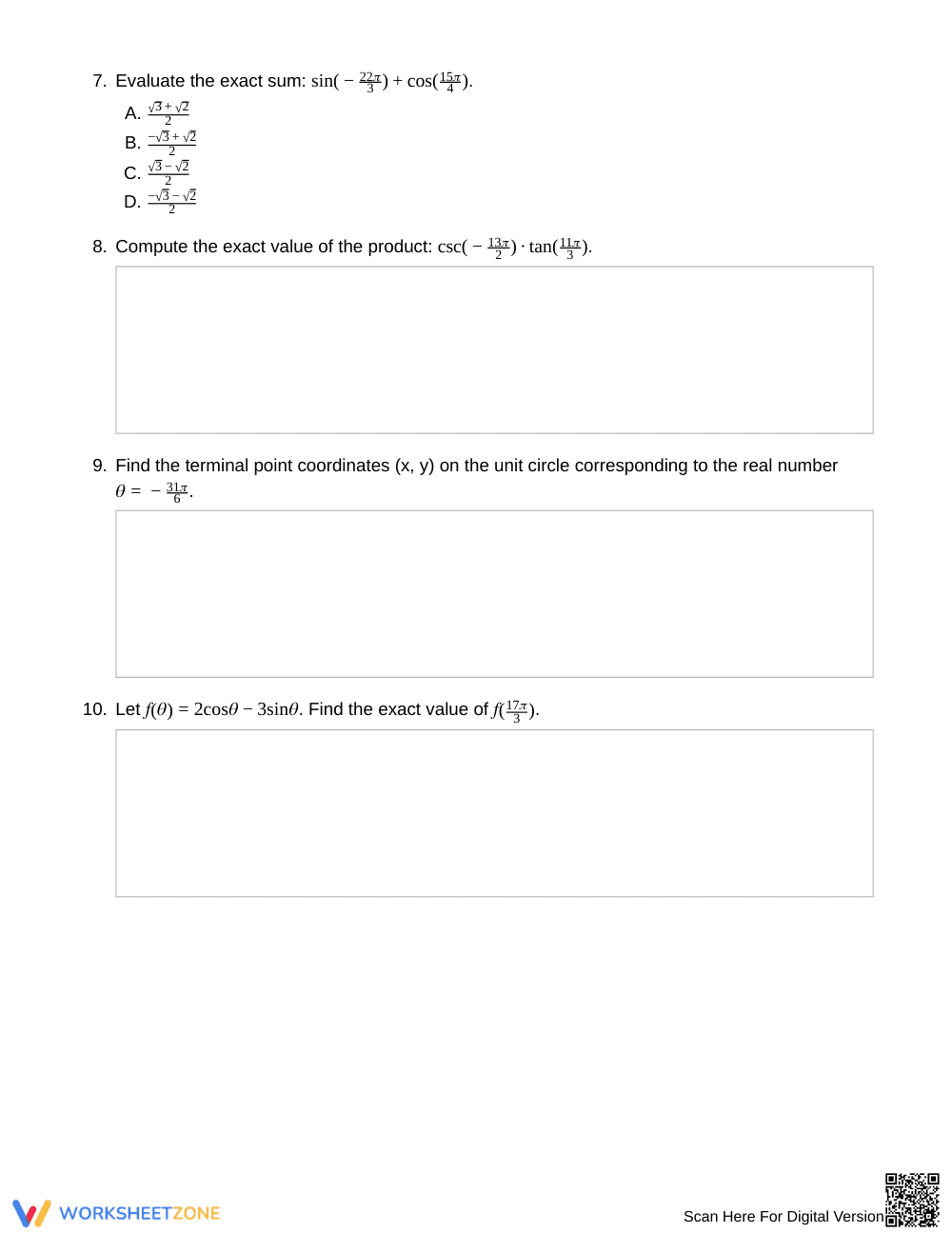
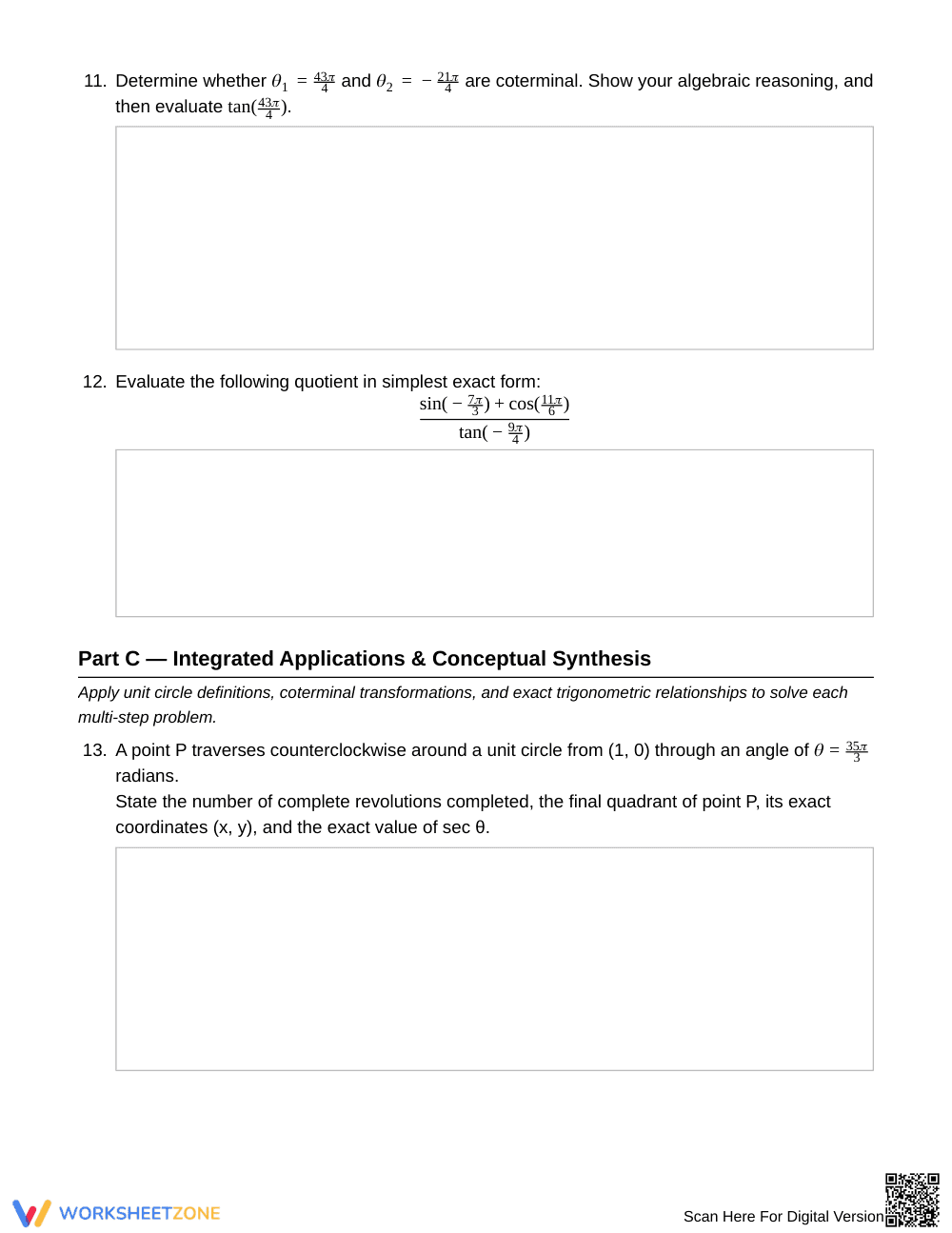
This Precalculus worksheet equips high school seniors to master coterminal angles and exact trigonometric evaluations on the unit circle. Students calculate principal coterminal values across negative and multi-revolution angles, compute exact radical ratios, and solve contextual circular motion problems with precision across sixteen comprehensive exercises.
At a Glance
- Grade: 12 · Subject: Mathematics (Precalculus)
- Standard:
HSF-TF.A.2— Use the unit circle to explain symmetry and calculate exact trigonometric values- Skill Focus: Coterminal Angles and Exact Trigonometric Values
- Format: 5 pages · 16 problems · 3-page answer key included · PDF
- Best For: Independent practice and exam preparation
- Time: 45–60 minutes
What's Inside
This 5-page worksheet opens with a Core Concepts box reviewing coterminal equations and terminal point coordinates. Across 16 exercises, students complete foundational unit circle evaluations, algebraic coterminal proofs, function evaluations, and circular motion applications. A thorough 3-page answer key provides step-by-step reductions and exact radical answers.
Skill Progression
- Guided practice (Problems 1–4): Students find coterminal angles within [0, 2π) and identify coordinates using the formula box.
- Supported practice (Problems 5–12): Learners evaluate complex products, quotients, and functions by selecting reduction strategies.
- Independent practice (Problems 13–16): Students solve multi-step circular motion applications and construct algebraic proofs.
This sequence follows a gradual-release model transitioning students from guided identification to autonomous problem-solving.
Standards Alignment
This resource aligns to HSF-TF.A.2: Explain how the unit circle in the coordinate plane enables the extension of trigonometric functions to all real numbers, interpreted as radian measures of angles traversed counterclockwise around the unit circle. It also reinforces HSF-TF.A.1 by applying radian measures as unit-circle arc lengths. Both standard codes can be copied directly into lesson plans, IEP goals, or district curriculum mapping tools.
How to Use It
Assign this worksheet following direct instruction on unit circle radian measures or as an intensive unit exam review. During practice, check whether students properly reduce negative angles by adding 2π rather than confusing reference angle rules. Students typically finish all 16 tasks within 45 to 60 minutes.
Who It's For
This material is designed for Grade 12 Precalculus students advancing toward AP Calculus. Support struggling learners by providing an initial unit circle diagram, while advanced students can complete the analytic proofs without reference sheets.
Mastery of standard HSF-TF.A.2 requires students to extend circular functions across real numbers through coterminal angle reductions and exact trigonometric evaluations on the unit circle. Educational research synthesized by Fisher & Frey (2014) highlights that structured gradual-release instructional frameworks significantly improve student retention in advanced mathematical reasoning by systematically transferring cognitive responsibility. When Grade 12 precalculus learners progress methodically from scaffolded quadrantal evaluations to independent multi-step circular motion modeling, their procedural fluency and deep structural understanding reinforce one another effectively. This 16-problem Precalculus worksheet implements targeted method selection, coordinate sign verification, and radical exactness, ensuring students develop robust conceptual schemata before tackling college-level calculus topics such as related rates or periodic derivatives. Educators can confidently deploy these structured exercises to diagnose persistent rotational misconceptions and verify that secondary mathematics students attain complete standards-based trigonometric mastery.


