































Complete Construction Proofs Worksheet | Grade 10 Geometry

Paste this activity's link or code into your existing LMS (Google Classroom, Canvas, Teams, Schoology, Moodle, etc.).
Students can open and work on the activity right away, with no student login required.
You'll still be able to track student progress and results from your teacher account.
This Grade 10 Geometry worksheet equips students to justify geometric constructions using deductive proofs, triangle congruence criteria, and circle locus theorems. Connecting physical compass methods to formal geometric principles, learners advance from drafting to rigorous mathematical explanation across eight scaffolded analytical tasks.
At a Glance
- Grade: 10 · Subject: Geometry
- Standard:
HSG-CO.D.12— Construct geometric figures and justify why each construction works using formal proofs- Skill Focus: Justify Why a Construction Works
- Format: 5 pages · 8 problems · Answer key included · PDF
- Best For: Geometry proof and construction mastery
- Time: 45–60 minutes
Inside this 5-page printable resource, students encounter eight multi-part proof and evaluation problems with clear geometric diagrams. A reference box reviews circle equidistance, the Perpendicular Bisector Theorem, and triangle congruence criteria. Students construct formal deductive arguments, assess student claims for geometric fallacies, and determine exact algebraic restrictions. A complete 2-page answer key provides step-by-step solutions.
Skill Progression
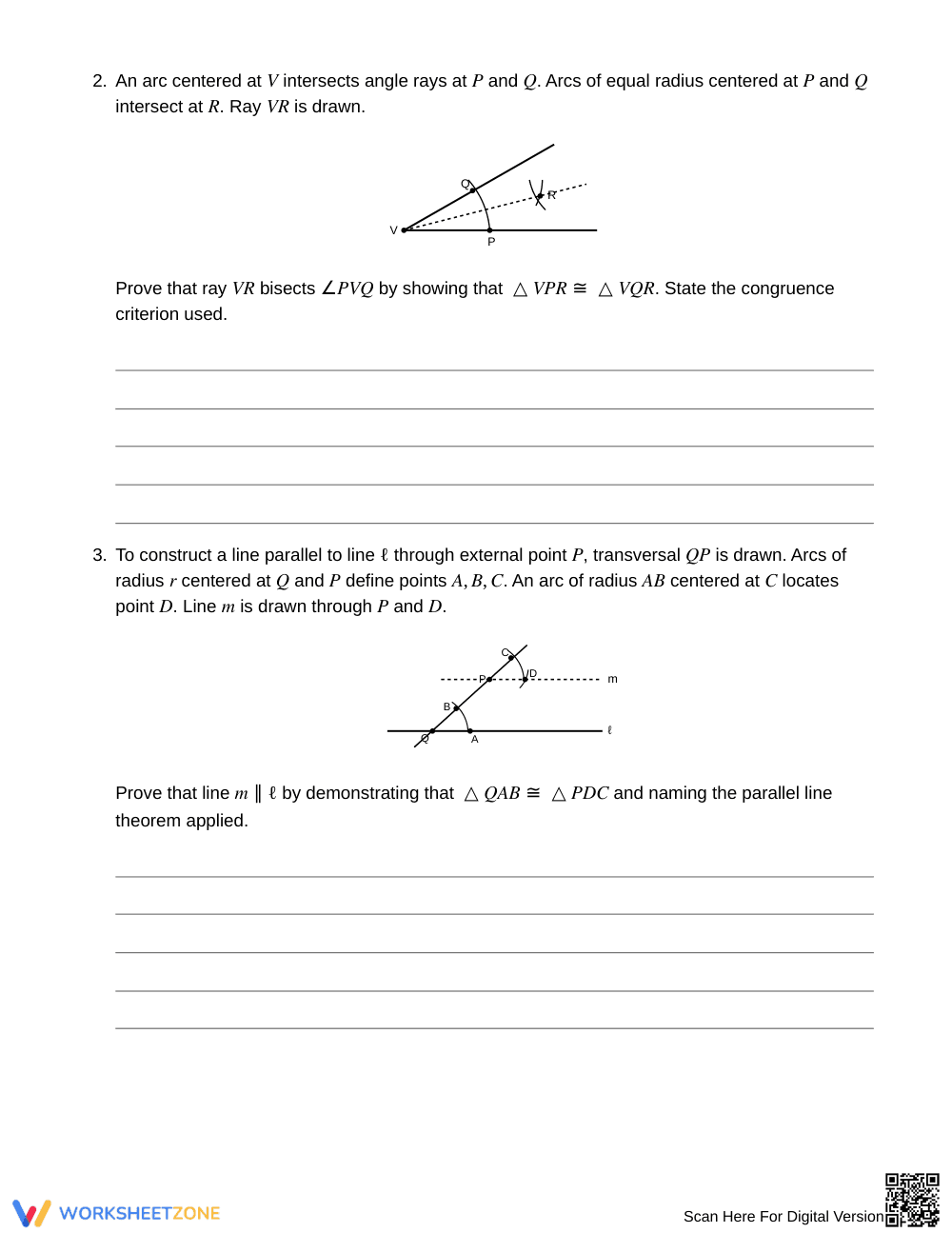
- Guided Practice (Part A, Problems 1–4): Students write deductive proofs for four classical constructions—perpendicular bisectors, angle bisectors, parallel lines, and perpendiculars—using triangle congruence and circle radii.
- Supported Practice (Part B, Problems 5–6): Students evaluate claims, applying the Triangle Inequality and similarity theorems to detect flawed assumptions.
- Independent Practice (Part C, Problems 7–8): Students determine necessary boundary conditions, deriving inequalities and analyzing counterexamples.
This gradual-release sequence guides students from applying proven theorems to independently diagnosing geometric errors.
Standards Alignment
This worksheet aligns to HSG-CO.D.12: Make formal geometric constructions and justify the mathematical reasons why each construction works. It also supports HSG-CO.C.9 by proving geometric theorems regarding lines, angles, and bisectors. Both standard codes can be copied directly into lesson plans, IEP goals, or district curriculum mapping tools.
How to Use It
Assign this resource after direct instruction on triangle congruence and compass constructions. During partner work, have students discuss Part A proofs before writing. For formative assessment, check whether students recognize equal radii as congruent sides during Part B error analysis. Expected completion time is 45 to 60 minutes.
Who It's For
This worksheet targets Grade 10 Geometry students learning formal deductive proof. For intervention, provide an anchor chart summarizing CPCTC and locus definitions; for extension, have learners verify results using coordinate geometry. Pair this activity with compass drafting labs or dynamic geometry software.
According to research on scaffolded proof instruction by Fisher & Frey (2014), gradual release structures significantly improve adolescent learners' ability to construct rigorous deductive arguments in secondary mathematics. When students transition systematically from proving classical procedures to critiquing flawed claims and identifying counterexamples, their conceptual retention of Euclidean theorems increases substantially. The instructional progression in this Grade 10 geometry resource operationalizes this evidence base for standard HSG-CO.D.12, requiring pupils to explain why compass constructions produce perpendicular lines, angle bisectors, and parallel segments rather than merely executing physical drafting steps. By challenging students to coordinate circle equidistance properties with triangle congruence criteria, the eight analytical tasks foster the precise mathematical reasoning emphasized in modern standards, ensuring that high school pupils develop verifiable deductive proof fluency alongside essential procedural geometric drafting competencies across all instructional settings.


