































Complete Construction Errors Worksheet | Grade 10 Geometry

Paste this activity's link or code into your existing LMS (Google Classroom, Canvas, Teams, Schoology, Moodle, etc.).
Students can open and work on the activity right away, with no student login required.
You'll still be able to track student progress and results from your teacher account.
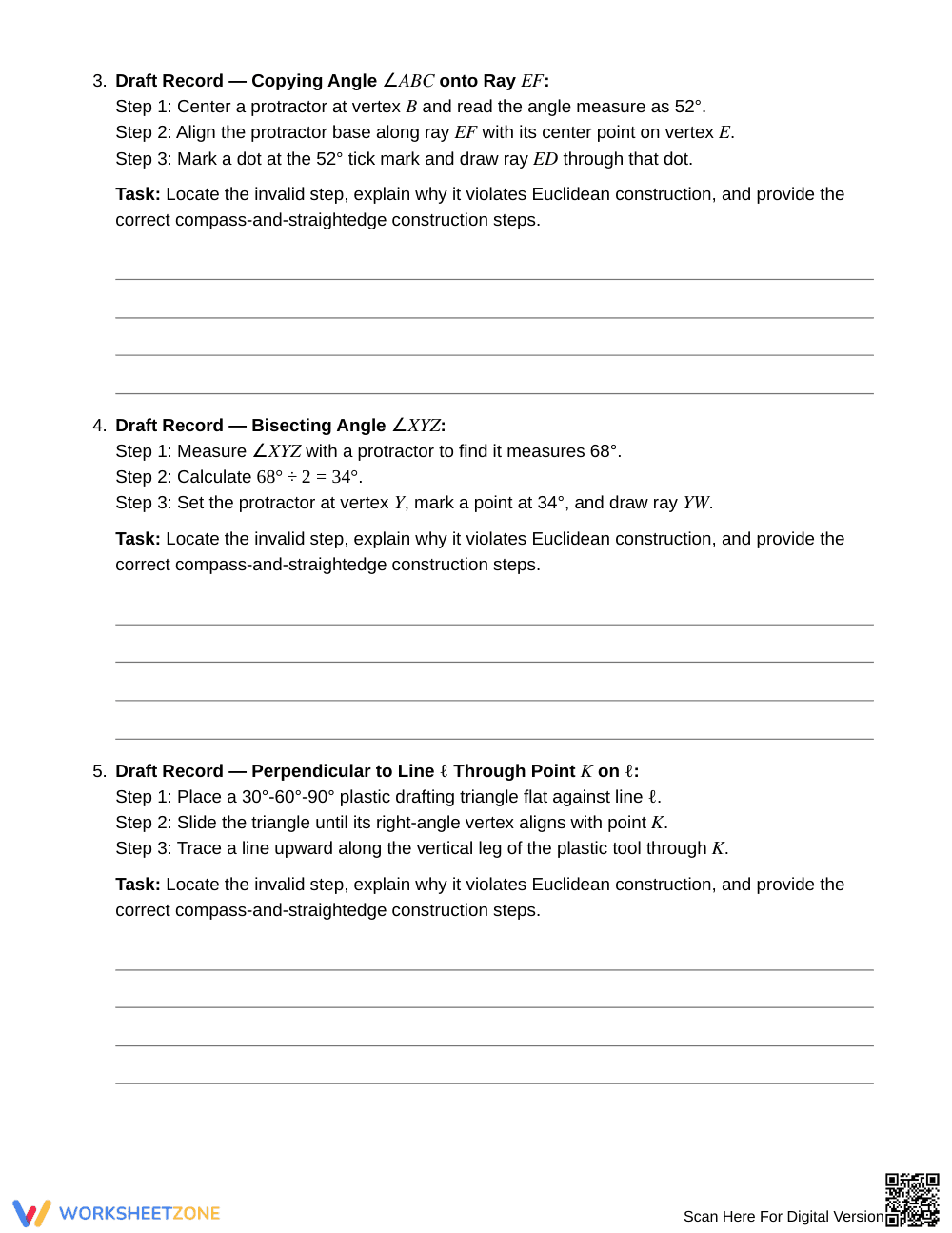
This 5-page geometry worksheet helps high school students identify, explain, and correct invalid measurement steps in formal geometric constructions. Students replace empirical ruler and protractor procedures with rigorous compass-and-straightedge methods, reinforcing Euclidean principles across 10 multi-part analytical tasks to build lasting geometric reasoning.
At a Glance
- Grade: 10 · Subject: Geometry
- Standard:
HSG-CO.D.12— Construct geometric figures using formal compass and straightedge methods- Skill Focus: Correcting invalid measurement steps
- Format: 5 pages · 10 problems · Answer key included · PDF
- Best For: Error analysis and conceptual mastery
- Time: 40–50 minutes
What's Inside
The resource begins with a reference box defining Euclidean axioms versus measurement tools, followed by a modeled repair. Across 5 student pages, learners analyze 10 drafting records divided into foundational and advanced constructions, supported by a full 5-page explanatory answer key.
Skill Progression
- Guided practice: A modeled repair shows how to detect measurement errors, explain theoretical flaws, and write valid compass-and-straightedge steps for constructing a square.
- Supported practice: Part A features 5 foundational problems on segment copies, bisectors, and perpendiculars, providing clear structure for error identification.
- Independent practice: Part B challenges students with 5 complex tasks involving external points, parallel lines, midpoints, triangles, and angle constructions.
This progression uses the gradual-release model to transition students from guided analysis to autonomous geometric justification.
Standards Alignment
This worksheet aligns with HSG-CO.D.12: Make formal geometric constructions with a variety of tools and methods. It supports HSG-CO.D.13 by applying construction logic to polygons and segments. Both standard codes can be copied directly into lesson plans, IEP goals, or district curriculum mapping tools.
How to Use It
Use this worksheet after direct instruction on constructions as a formative diagnostic or collaborative error-analysis activity. As students work, check whether they explain underlying geometric loci rather than just naming tools. Expected completion time is 40 to 50 minutes.
Who It's For
Designed for Grade 10 Geometry students learning formal proofs and construction axioms. It supports emerging learners through structured error prompts and challenges advanced students to write rigorous step-by-step proofs. Pair with an interactive compass demonstration lesson.
According to research in Fisher & Frey (2014) on error analysis and instructional scaffolding, having high school mathematics students analyze flawed work significantly strengthens conceptual understanding and procedural fluency. This worksheet targets standard HSG-CO.D.12 by requiring 10th-grade learners to replace empirical measurement shortcuts with valid compass-and-straightedge constructions. Rather than simply executing mechanical steps, students evaluate incorrect draft records involving rulers, protractors, and drafting triangles, diagnose why physical measurement violates Euclidean axioms, and formulate mathematically sound construction proofs. This dual focus on error identification and deductive justification builds the metacognitive skills necessary for advanced geometric proof writing and spatial reasoning. By explicitly distinguishing between approximate empirical measurements and exact locus-based intersections, the resource ensures students achieve rigorous mastery of formal geometric constructions across 10 targeted tasks, supporting long-term retention and standards-aligned geometry achievement.


