


























Views
Downloads


Complete Conditional Events Worksheet | Grade 12 Statistics
Paste this activity's link or code into your existing LMS (Google Classroom, Canvas, Teams, Schoology, Moodle, etc.).
Students can open and work on the activity right away, with no student login required.
You'll still be able to track student progress and results from your teacher account.
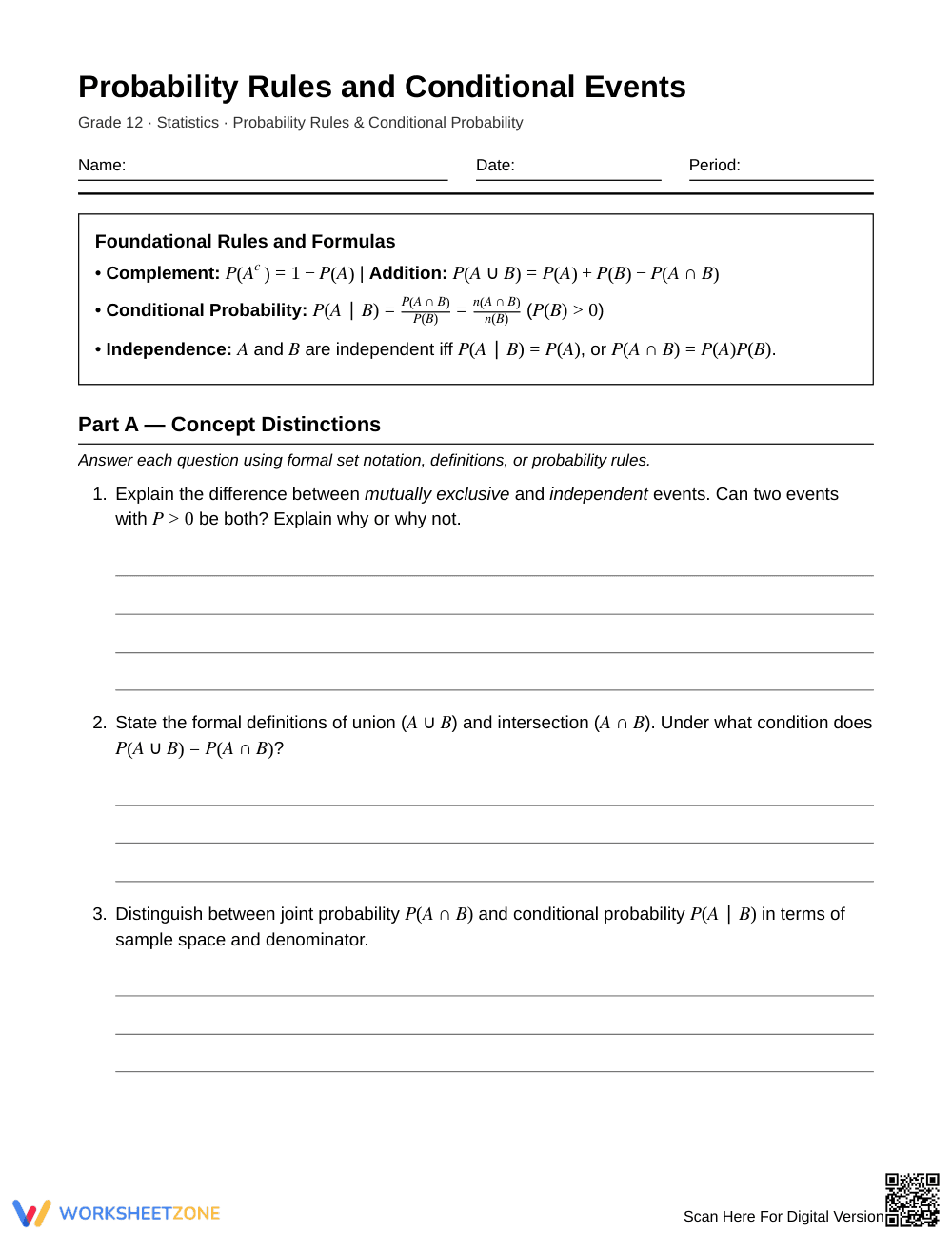
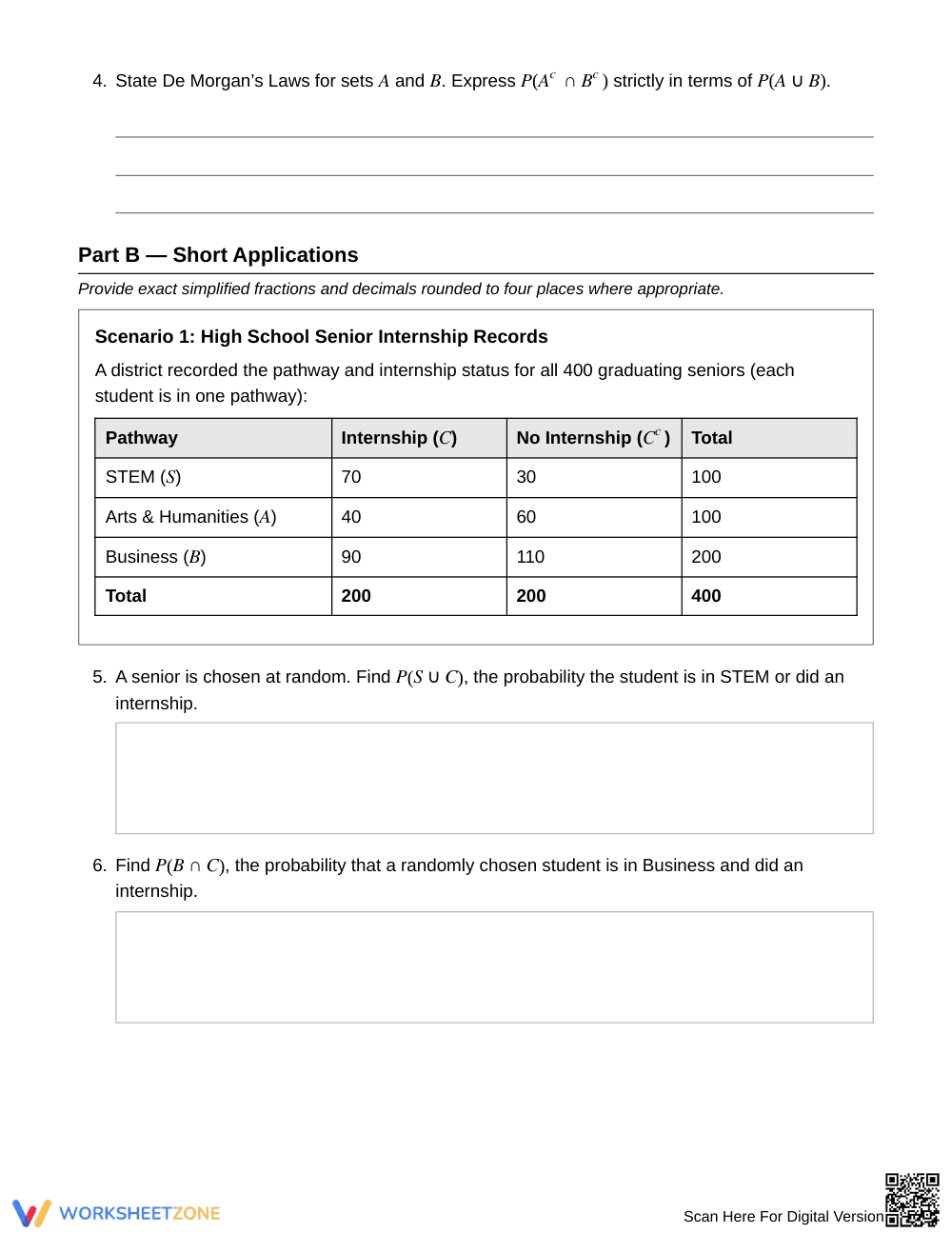
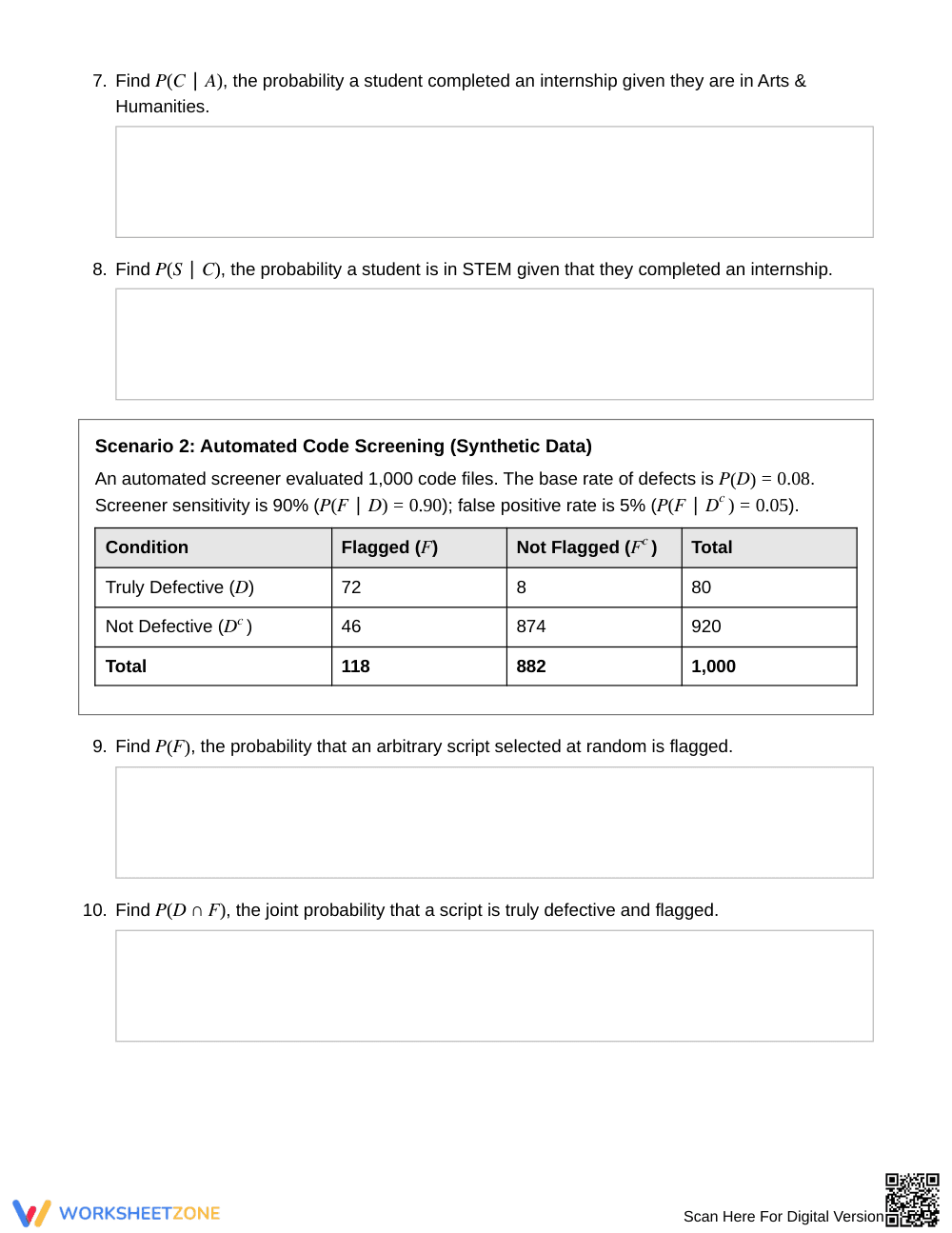
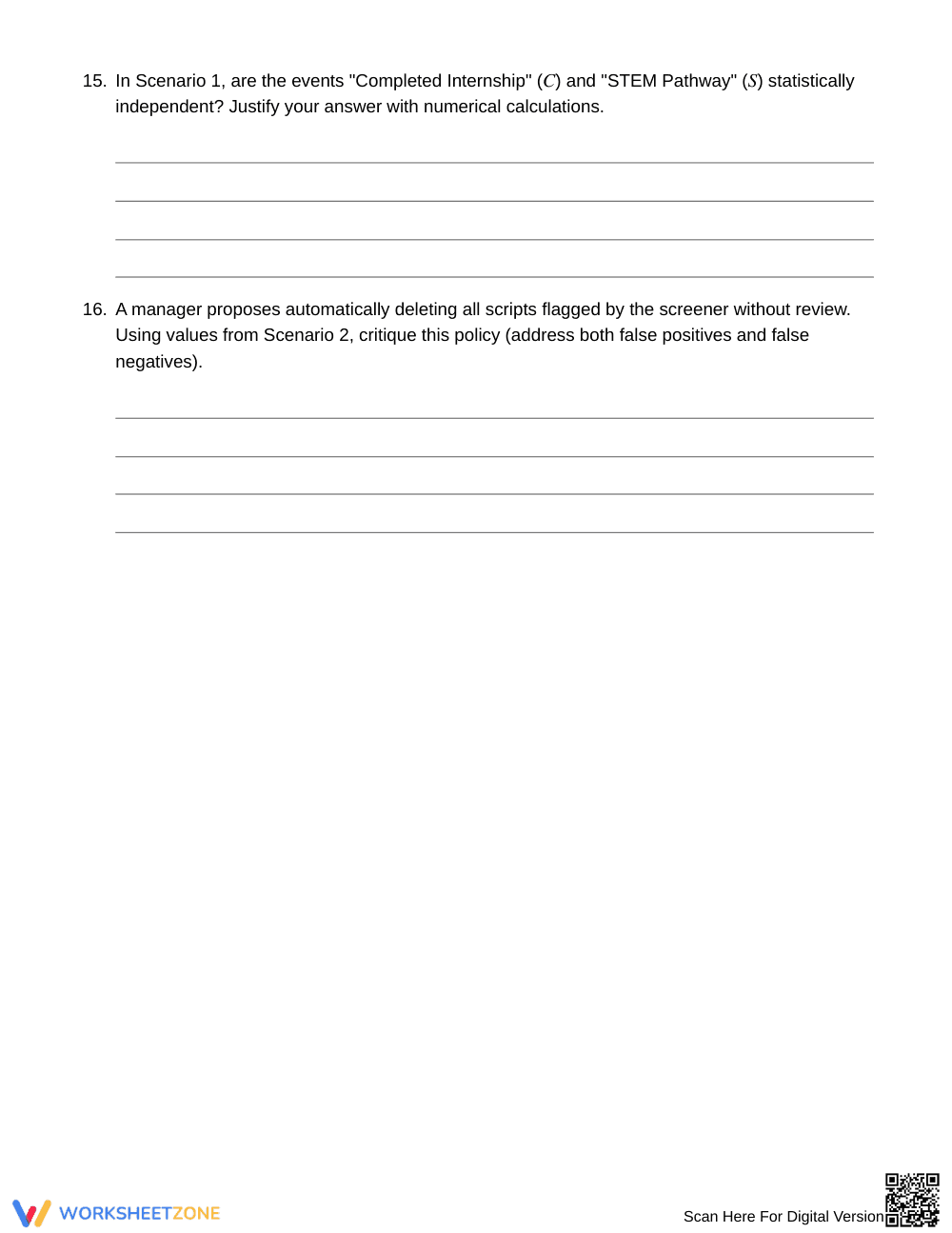
This Grade 12 Statistics worksheet equips students to master unions, intersections, and conditional probabilities through structured data analysis. High school seniors calculate joint and conditional rates from two-way tables, state set theory rules, and evaluate statistical independence across multi-step technical scenarios to build rigorous mathematical reasoning.
At a Glance
- Grade: 12 · Subject: Statistics
- Standard: Calculate conditional probabilities and assess independence from two-way contingency tables
- Skill Focus: Union, Intersection, and Conditional Events
- Format: 5 pages · 16 analytical problems · Full answer key included · Printable PDF
- Best For: Advanced probability review and AP exam preparation
- Time: 45–60 instructional class minutes
What's Inside
This 5-page student packet includes a foundational probability formula box, 16 analytical exercises, and a 2-page answer key with complete step-by-step solutions. Students engage with set notation definitions, calculate exact fractional and decimal probabilities from two realistic contingency tables, and justify mathematical proofs involving base rates and set partitions.
Skill Progression
- Guided practice: Part A offers 4 conceptual questions reviewing set notation, joint versus conditional definitions, and De Morgan’s Laws using formula box cues.
- Supported practice: Part B provides 8 tabular items across two scenarios where students compute compound probabilities, conditional rates, and predictive values.
- Independent practice: Part C challenges learners with 4 justification problems requiring proofs of addition rules, numerical tests of independence, and policy critiques.
This structured progression reflects the gradual-release framework, guiding learners from definitional recall to independent statistical justification.
Standards Alignment
This resource aligns with high school statistics standards focusing on conditional probability and rules of probability. Students understand independence and conditional probability, interpret empirical data, and compute compound probabilities. Both standard codes can be copied directly into lesson plans, IEP goals, or district curriculum mapping tools.
How to Use It
Use this worksheet directly after lecture instruction on conditional probability or as comprehensive review before an exam. During seatwork, check whether students erroneously divide by the overall sample size rather than the conditioned subset in Part B. The 16 problems require approximately 45 to 60 minutes.
Who It's For
This material serves Grade 12 Statistics, AP Statistics, and advanced mathematics students mastering probability rules. To differentiate for struggling learners, pair this worksheet with a visual Venn diagram reference sheet. Advanced students can extend Part C by constructing complete probability trees to compute inverse probabilities.
Structured problem sets that systematically develop union, intersection, and conditional probability analysis reinforce higher-level statistical reasoning in secondary mathematics. According to Fisher & Frey (2014), the gradual release of responsibility framework accelerates conceptual mastery by pairing explicit initial structural support with progressively complex independent transfer tasks. This 16-problem Grade 12 Statistics worksheet operationalizes that instructional architecture by guiding high school learners through foundational set notation, structured two-way contingency table evaluations, and rigorous open-ended probability justifications. Students consistently practice defining sample space restrictions, identifying statistical independence, and evaluating false positive rates in empirical contexts without procedural ambiguity. Research demonstrates that moving purposefully from guided formula recall to authentic analytical evaluation builds durable procedural fluency and conceptual schema. Consequently, this comprehensive resource provides an evidence-based instructional pathway for high school seniors preparing for collegiate data analysis and advanced probability coursework.


