





























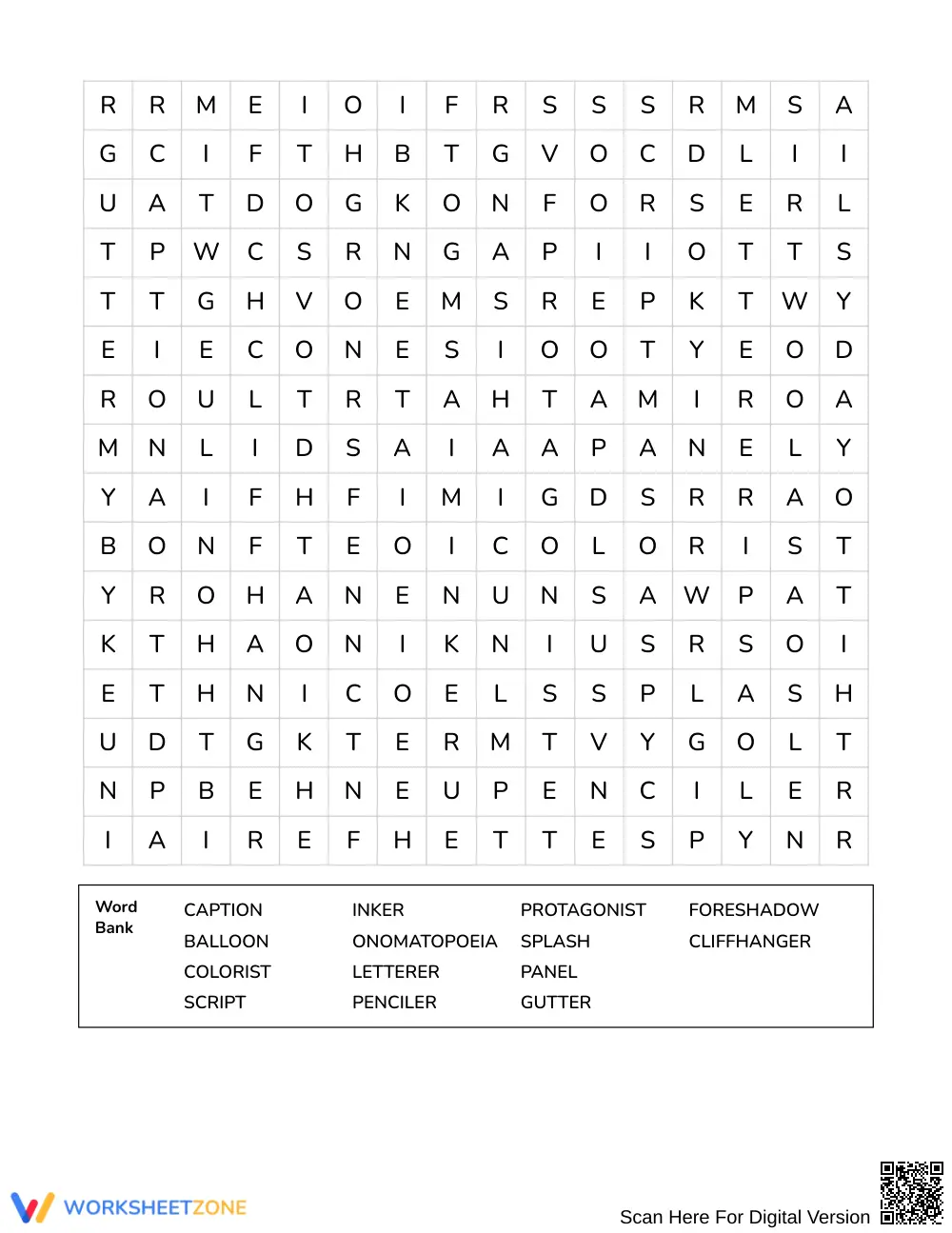


Complete Comic Storytelling Word Search | Grades 4–5 ELA

Paste this activity's link or code into your existing LMS (Google Classroom, Canvas, Teams, Schoology, Moodle, etc.).
Students can open and work on the activity right away, with no student login required.
You'll still be able to track student progress and results from your teacher account.
This Grades 4–5 English Language Arts word search builds foundational literacy with comic panel and storytelling terms. Students read contextual definitions to identify 14 key narrative concepts—including panel, gutter, caption, and protagonist—before locating them within the grid. The activity reinforces visual storytelling vocabulary and supports graphic novel comprehension.
At a Glance
- Grade: Grades 4–5 elementary learners · Subject: English Language Arts (ELA)
- Standard: Not standards-assessed — vocabulary enrichment
- Skill Focus: Comic panel mechanics and visual storytelling terms
- Format: 3 resource pages · 14 target words · Full answer key included · PDF format
- Best For: Graphic novel units and vocabulary stations
- Time: 20–30 total minutes
What's Inside
This 3-page instructional resource combines vocabulary acquisition with an interactive word puzzle. The student handout features 14 clue-based definitions that require learners to determine each storytelling term before locating it in the puzzle grid. Structural elements and creative production roles—such as penciler, inker, colorist, and letterer—are integrated. The package includes a shuffled word bank and a 3-page answer key showing exact letter coordinates for simple verification.
Puzzle Mechanics and Structure
The puzzle features a 16 x 16 letter grid built for vocabulary reinforcement and spatial scanning. The 14 hidden words run across four distinct directions: northeast (NE), east (E), southeast (SE), and south (S). Using a clue detective format, students read descriptive definitions to determine words such as splash or onomatopoeia, using a shuffled word bank before searching the grid.
Standards Alignment
This activity serves as vocabulary enrichment and is not aligned to a specific academic standard code. It enriches domain-specific vocabulary for graphic novels, visual media, and story structure. By examining concepts like foreshadowing and cliffhangers in an exploratory puzzle, students strengthen contextual knowledge that supports general reading comprehension across multimodal texts.
How to Use It
Use this word search during graphic novel units to introduce visual storytelling vocabulary before reading, or assign it afterward as an engaging literacy station. Formatively observe whether students deduce words from definition clues or rely primarily on the word bank, identifying terms that require reteaching. Students typically complete the activity within 20 to 30 minutes.
Who It's For
This puzzle is designed for Grades 4–5 ELA students studying comic conventions and narrative structure. To differentiate, support emerging readers by reading definition clues collaboratively in small groups, or extend learning by having advanced students create a comic panel using three target terms. Pair this resource with a graphic novel mentor text or visual literacy anchor chart.
Comic panel and storytelling vocabulary provides elementary learners with the foundational structural language required to comprehend multimodal narratives and visual texts. While this word search functions as standalone vocabulary enrichment rather than a standards-assessed measurement, mastering specialized terms such as gutter, panel, and caption directly reinforces text structure analysis and narrative comprehension. Research by Fisher & Frey (2014) demonstrates that intentional, clue-based vocabulary practice coupled with contextual word retrieval substantially accelerates domain-specific language retention compared to isolated memorization. By challenging fourth and fifth grade students to decipher 14 descriptive narrative clues before locating terms within a 16 x 16 letter grid across multiple directional vectors, this instructional puzzle actively promotes morphological awareness, spatial reasoning, and visual literacy. Consequently, educators can utilize this structured puzzle activity to bridge creative storytelling mechanics with rigorous literacy acquisition across diverse upper-elementary reading environments.


