





























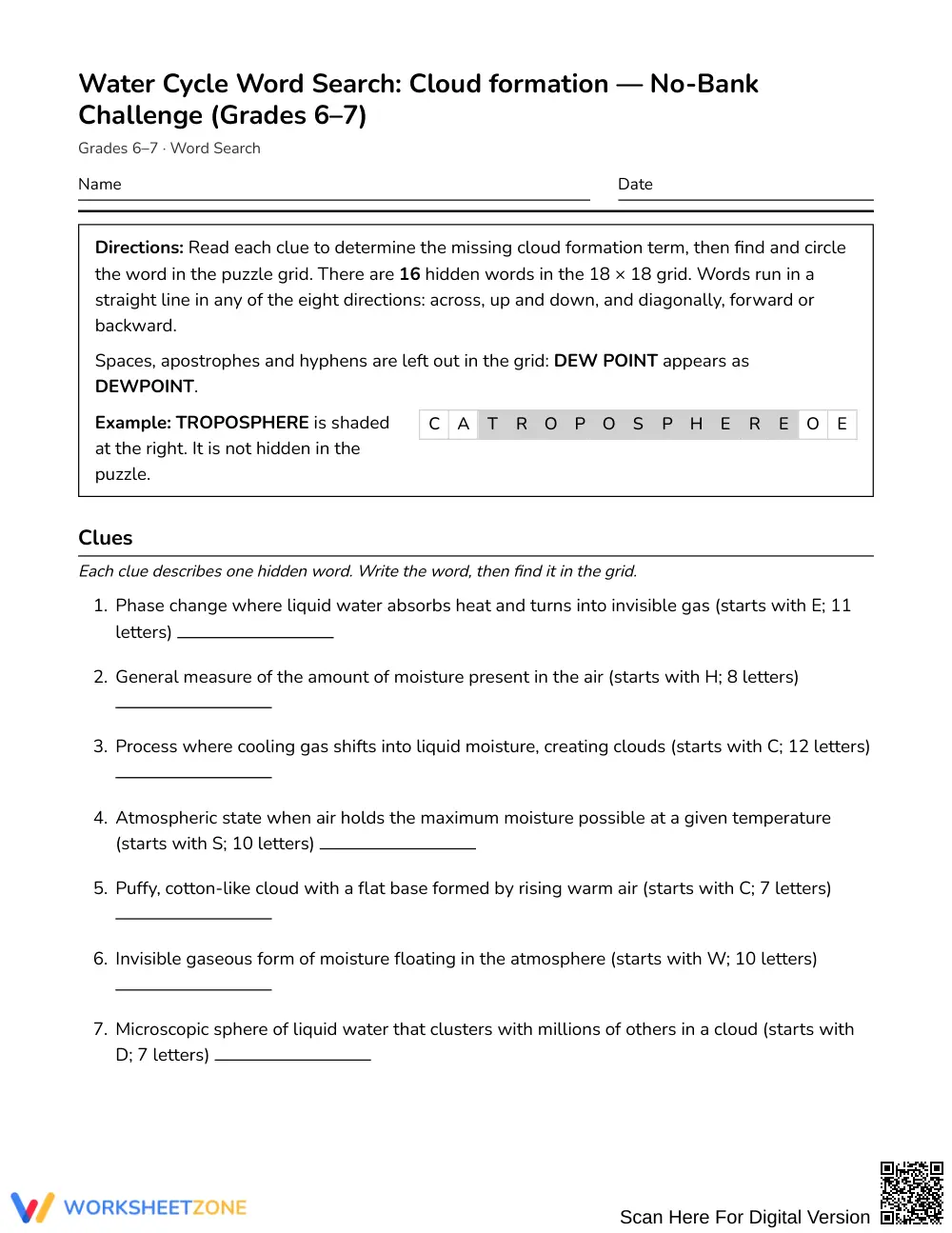


Complete Cloud Formation Word Search | Grades 6–7 Science

Paste this activity's link or code into your existing LMS (Google Classroom, Canvas, Teams, Schoology, Moodle, etc.).
Students can open and work on the activity right away, with no student login required.
You'll still be able to track student progress and results from your teacher account.
This cloud formation science word search strengthens middle school Earth science vocabulary through an active clue-solving format. Students decode descriptive meteorological definitions before locating target terms, solidifying comprehension of key atmospheric processes including condensation, saturation, adiabatic cooling, and cloud classification across a challenging letter grid.
At a Glance
- Grade: Grades 6–7 · Subject: Science
- Standard: Not standards-assessed — vocabulary enrichment
- Skill Focus: Cloud formation and atmospheric processes
- Format: 3 pages · 16 words · Answer key included · PDF
- Best For: Science warm-ups, review, or emergency sub plans
- Time: 25–35 minutes
What's Inside
This 3-page printable science resource contains a complete 18-by-18 letter puzzle, a comprehensive definition-based clue sheet, and a 3-page full-size answer key. Instead of scanning from a traditional word bank, learners read 16 content-rich scientific clues to deduce the target vocabulary words before searching the puzzle.
Puzzle Mechanics
This no-bank challenge requires active vocabulary recall rather than passive letter matching:
- Grid Layout: An 18 × 18 uppercase letter grid containing 16 hidden Earth science terms.
- Word Placement: Terms are placed across all 8 possible compass directions: North, Northeast, East, Southeast, South, Southwest, West, and Northwest.
- Clue-Based Retrieval: Rather than providing a list of answers, students read 16 rigorous definitions covering concepts like dew point, nuclei, updrafts, and precipitation to identify each hidden word.
Standards Alignment
This activity provides targeted vocabulary enrichment and is not aligned to a specific assessed state standard. It reinforces essential Earth science and water cycle terminology supporting general middle school weather and climate units.
How to Use It
Deploy this puzzle as an engaging mid-unit formative check during your weather unit or as an independent task during emergency substitute days. For optimal instructional flow, distribute the puzzle after direct instruction on the water cycle so students can apply definitions they have already encountered. As a formative assessment check, circulate while students read the clues to verify whether they can identify words like adiabatic or transpiration without consulting reference notes. Most learners finish within 25 to 35 minutes.
Who It's For
This resource serves general education science students in Grades 6–7 learning atmospheric science and hydrologic cycles. For English language learners or students needing additional support, teachers may highlight key syllables in the clues or provide the first letter of each hidden term. It pairs naturally with cloud identification diagrams, hands-on cloud-in-a-jar laboratory demonstrations, and weather unit anchor charts.
According to Fisher & Frey (2014), intentional disciplinary vocabulary instruction substantially improves content-area comprehension when students actively retrieve terminology through contextual definitions rather than rote memorization. This word search engages middle school learners by requiring them to analyze 16 atmospheric science clues, identifying precise concepts such as condensation, dew point, and adiabatic cooling before locating words within an 18-by-18 grid. By removing the traditional word bank, the activity shifts student effort from passive visual scanning to active semantic retrieval, cementing critical hydrologic terminology into long-term memory across 25 to 35 minutes of focused independent work.


