




























Complete Climate Systems Word Search | Grades 10–12 Science
Paste this activity's link or code into your existing LMS (Google Classroom, Canvas, Teams, Schoology, Moodle, etc.).
Students can open and work on the activity right away, with no student login required.
You'll still be able to track student progress and results from your teacher account.
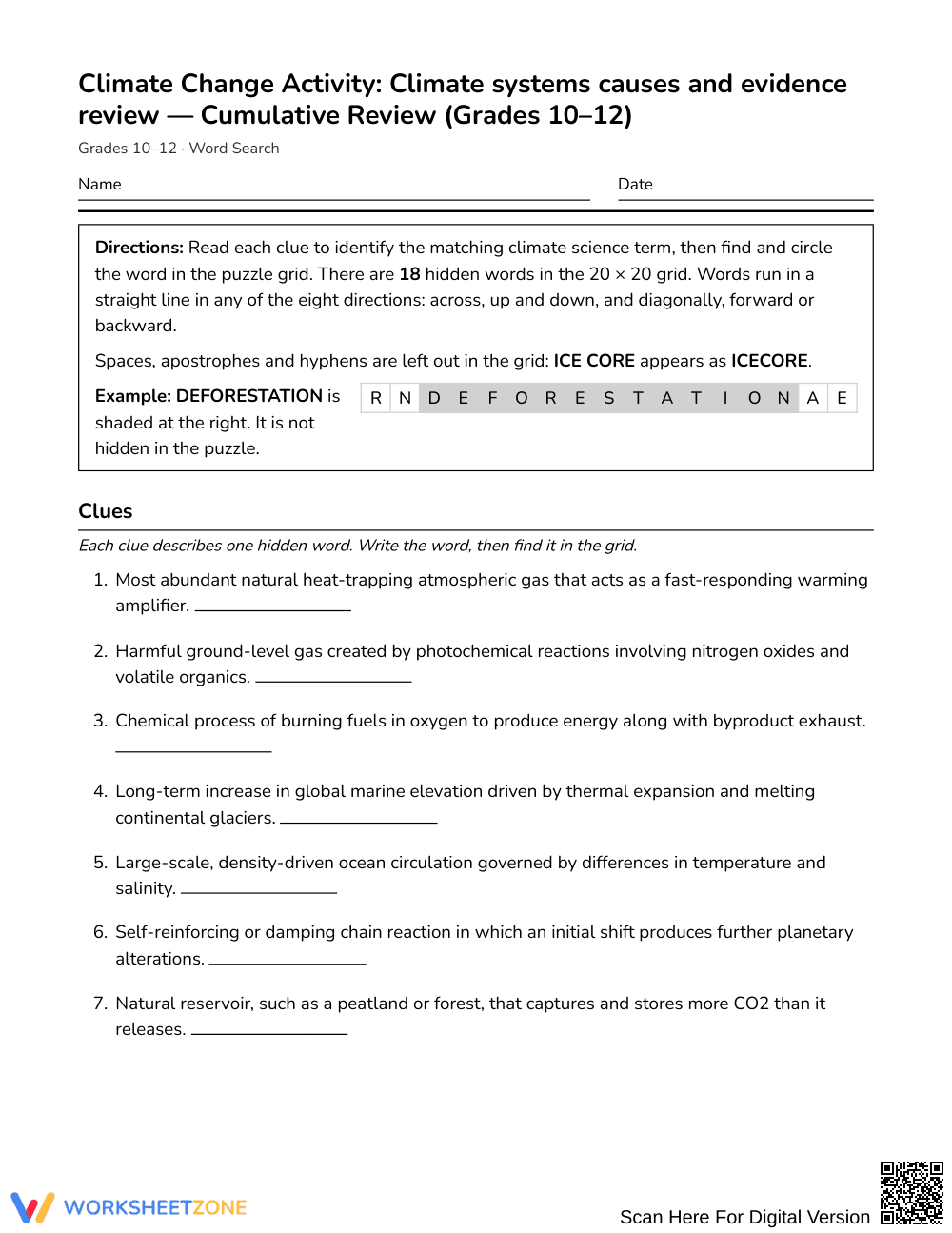
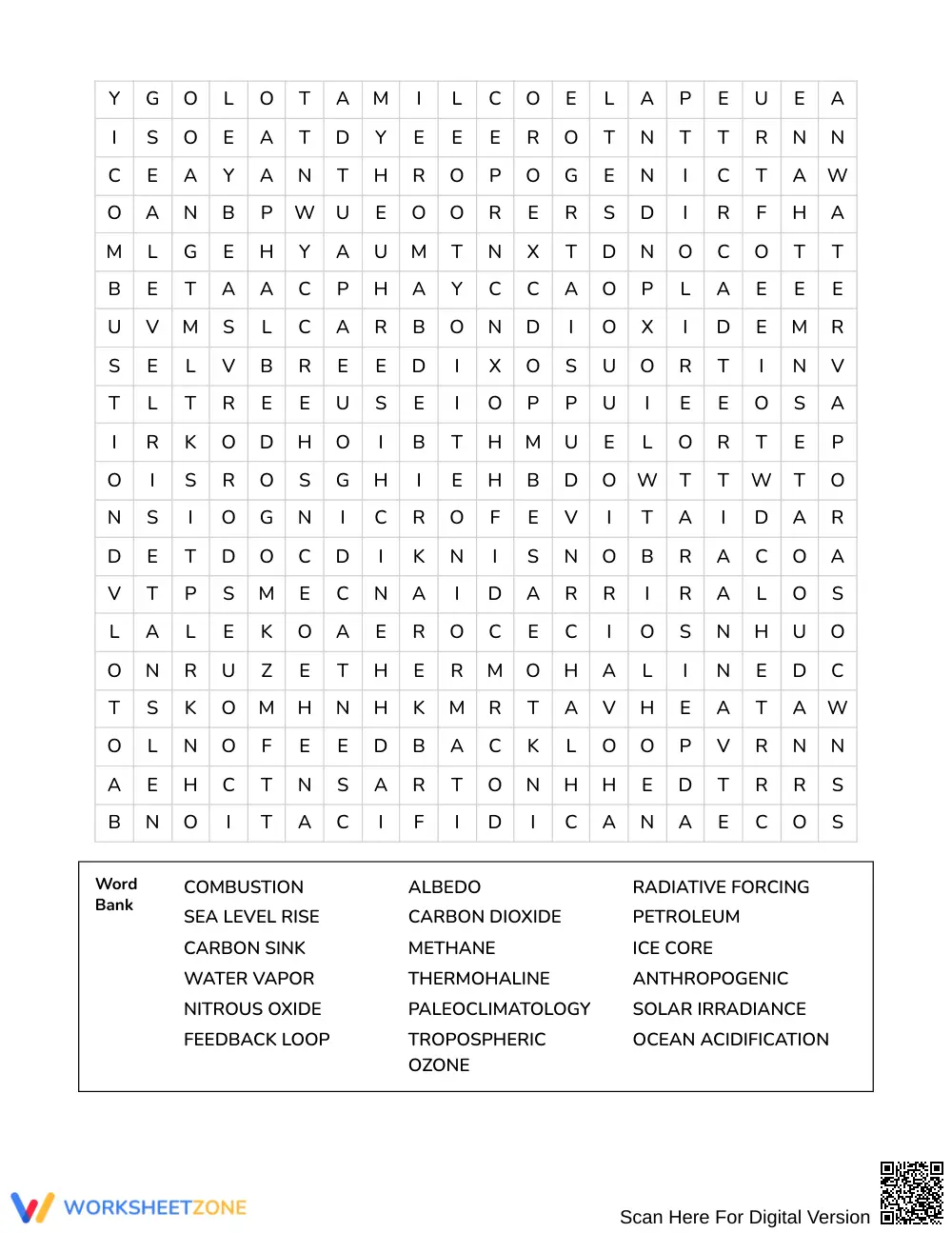
This Grades 10–12 climate change word search reinforces essential environmental science terminology through clue-based retrieval. Students define and locate 18 specialized terms covering global energy balance, greenhouse gases, paleoclimate records, and anthropogenic drivers. The puzzle strengthens scientific literacy by requiring learners to connect rigorous definitions to key concepts before searching the grid.
At a Glance
- Grade: Grades 10–12 · Subject: Science
- Standard: Not standards-assessed — vocabulary enrichment
- Skill Focus: Climate systems causes and evidence review
- Format: 3 pages · 18 words · Answer key included · PDF
- Best For: Unit vocabulary review or sub plan
- Time: 25–40 minutes
What's Inside: A 3-page student activity featuring 18 clues paired with high-frequency climate science terms. Rather than simply scanning for letter clusters, students first read technical definitions to identify target terms like ocean acidification, radiative forcing, and paleoclimatology. The resource includes a full 4-page answer key highlighting all letter coordinates for immediate verification.
Puzzle Structure and Mechanics
This puzzle challenges high school science students using an authentic, clue-driven format:
- Grid Layout: A dense 20 x 20 letter grid containing 18 hidden climate science terms.
- Word Placement: Target vocabulary words run in all eight possible orientations: north, northeast, east, southeast, south, southwest, west, and northwest.
- Clue-Based Retrieval: Rather than consulting an alphabetized list, students read rigorous descriptive clues for each term, prompting active memory recall prior to grid identification.
Standards Alignment
This activity provides targeted vocabulary enrichment and is not aligned to a specific academic standard. It supports foundational literacy in secondary Earth science, environmental systems, and AP Environmental Science courses by reinforcing terminology used in climate data analysis and biogeochemical cycle units.
How to Use It
Deploy this word search at the conclusion of a climate change unit to consolidate academic language before a summative exam, or provide it as a focused independent task during station rotations. For formative assessment, inspect student clue responses before they begin searching the grid to verify that students correctly match each definition to its target term. Most secondary learners complete the full search in 25 to 40 minutes.
Who It's For
Designed for Grades 10–12 Earth Science, Biology, and Environmental Science classrooms. It serves as an accessible review for general education students and provides targeted language support for emerging bilingual learners needing structured exposure to multisyllabic scientific vocabulary. Pair this puzzle with an introductory ice core data analysis lab or a radiative balance lecture.
According to Fisher & Frey (2014), intentional disciplinary vocabulary instruction requires students to engage in both definitional understanding and word recognition across multiple contexts. Secondary science students frequently struggle with dense, multisyllabic terminology such as thermohaline circulation and radiative forcing, which represent complex physical processes rather than concrete objects. Providing structured clue-based word puzzles bridges the gap between passive recognition and active conceptual retrieval. When learners identify a climate term from its functional scientific definition, they reinforce neural pathways associated with academic language comprehension. Integrating vocabulary review into Earth and space science curricula supports long-term retention of environmental mechanisms, allowing high school learners to interpret climate evidence and anthropogenic factors with greater conceptual accuracy.


