





























Complete Climate Patterns Worksheet | Grade 12 Science
Paste this activity's link or code into your existing LMS (Google Classroom, Canvas, Teams, Schoology, Moodle, etc.).
Students can open and work on the activity right away, with no student login required.
You'll still be able to track student progress and results from your teacher account.
This advanced atmospheric science worksheet equips Grade 12 students to evaluate planetary energy balance, radiative forcings, and climate variability through rigorous quantitative analysis. High schoolers calculate blackbody equilibrium temperatures, assess coupled ocean-atmosphere feedback mechanisms like ENSO, and interpret statistical signal-to-noise ratios across complex multi-decadal climatological datasets.
At a Glance
- Grade: 12 · Subject: Environmental & Earth/Space Science
- Standard: Advanced Earth Science — Analyze energy balance, radiative forcings, and ocean-atmosphere climate patterns
- Skill Focus: Weather Variability and Climate Patterns
- Format: 5 pages · 12 problems · Answer key included · PDF
- Best For: Advanced high school Earth science practice
- Time: 45–60 minutes
What's Inside
This 5-page worksheet features 12 multi-part analytical exercises accompanied by a comprehensive 3-page answer key detailing thermodynamic derivations and physical justifications. Students work with planetary energy balance equations, thermal infrared flux relations, synoptic atmospheric circulation tables, and empirical climate feedback scenarios without generic multiple-choice simplifications.
Skill Progression
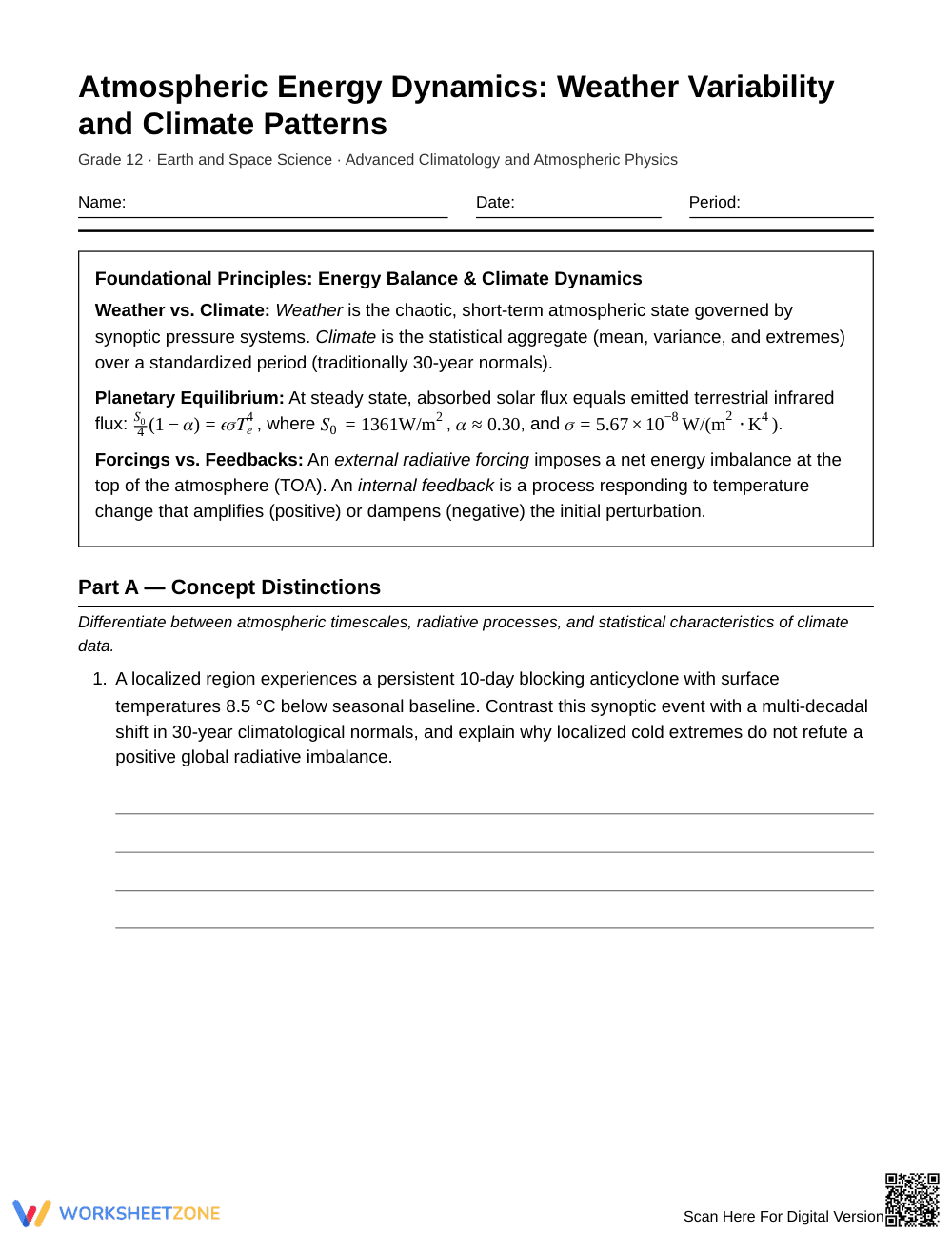
- Guided Practice (Part A, Problems 1–4): Students establish foundational distinctions by classifying radiative forcings versus internal feedbacks, contrasting synoptic weather blocking against 30-year normals, and examining shifts in Gaussian temperature distributions.
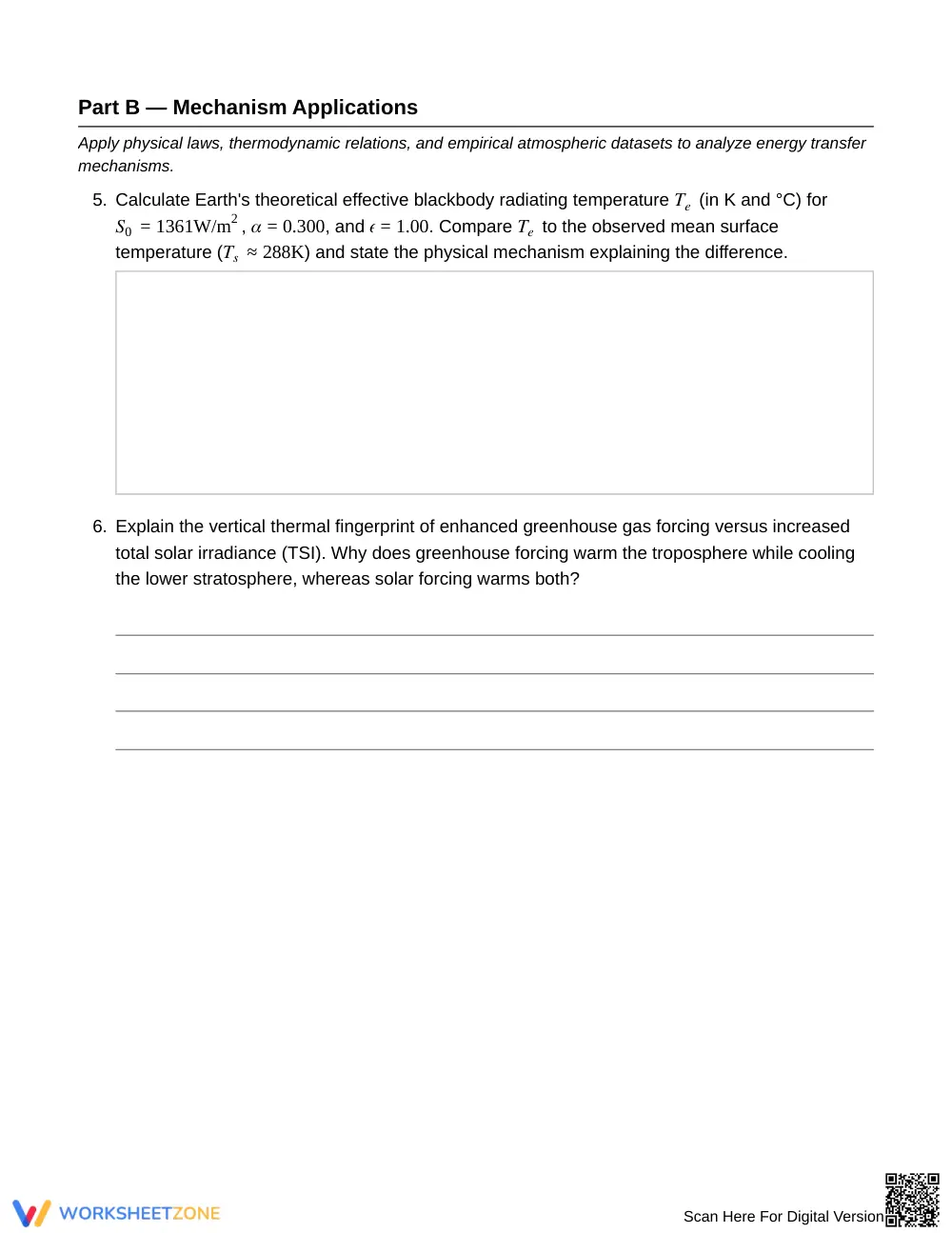
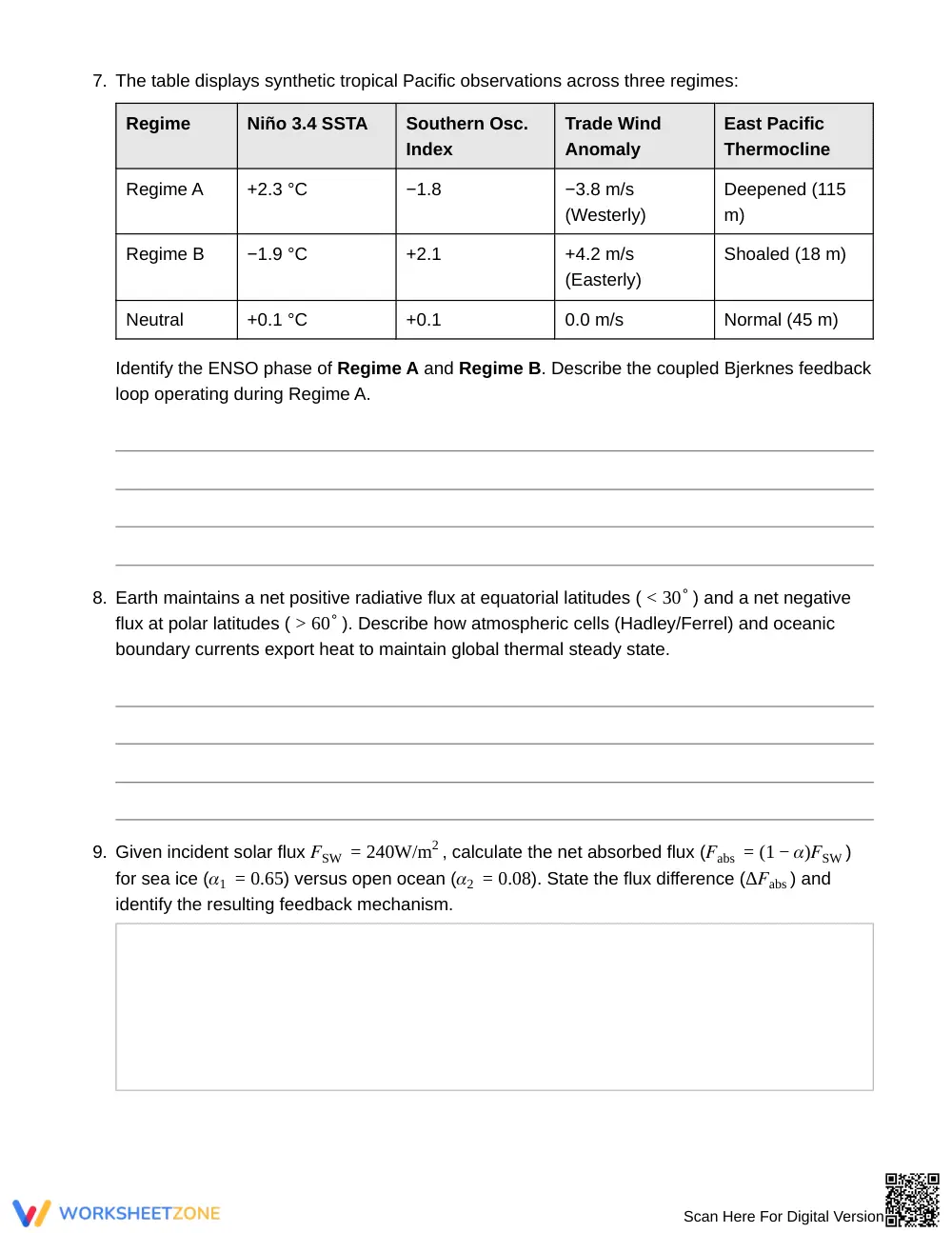
- Supported Practice (Part B, Problems 5–10): Students calculate Earth's effective radiating temperature with the Stefan-Boltzmann law, compute ice-albedo feedback flux differentials, and diagnose El Niño-Southern Oscillation regimes from tabular Pacific observational anomalies.
- Independent Practice (Part C, Problems 11–12): Students synthesize multi-variable atmospheric perturbations independently, calculating forced decadal anomalies against annual stochastic noise and modeling convective rainfall responses under competing radiative forcings.
This structured progression reflects the gradual release of responsibility model, guiding senior students from core concepts to autonomous quantitative modeling.
Standards Alignment
This resource aligns with high school Earth and Space Science standards requiring students to analyze geoscience data and climate models to forecast rates of atmospheric change. Curriculum frameworks emphasize calculating energy flow through Earth systems and interpreting coupled feedbacks across oceans, land cover, and the atmosphere. Standard learning goals can be copied directly into lesson plans, IEP goals, or district curriculum mapping tools.
How to Use It
Deploy this worksheet after direct instruction on planetary radiative equilibrium and global atmospheric circulation cells. Use Part A as a collaborative checkpoint where partner pairs debate forcing-versus-feedback mechanisms, checking for misconceptions regarding synoptic weather versus multi-decadal trends. Dedicate 45 to 60 minutes for student completion, followed by peer review using the included step-by-step mathematical solutions.
Who It's For
This material is engineered for Grade 12 students in Earth and Space Science, AP Environmental Science, or Advanced Climatology. It provides quantitative challenge for college-bound science students, while structured data tables support learners needing organized computational scaffolds. Pair this activity directly with planetary energy budget diagrams or real-time NOAA climate data dashboards.
According to Fisher & Frey (2014), intentional scaffolding within the gradual release of responsibility framework significantly improves student autonomy when interpreting complex scientific phenomena. This Grade 12 Earth and Space Science worksheet puts that pedagogy into practice across 12 rigorous tasks, guiding learners to analyze weather variability and long-term climate patterns. Students begin by clarifying distinctions between short-term synoptic extremes and multi-decadal trends, advance to calculating blackbody equilibrium temperatures via the Stefan-Boltzmann equation, and conclude by evaluating stochastic noise against forced climate signals. By integrating explicit physical laws, oceanic-atmospheric coupling tables, and thermodynamic relationships, the activity ensures high school seniors build robust conceptual and quantitative mastery. The scaffolded progression bridges direct instruction and independent scientific inquiry, enabling students to construct evidence-based predictions regarding radiative imbalances and global thermal steady states with measurable academic success.


