





























Complete Chemistry of Life Worksheet | Grades 9-12 Science
Paste this activity's link or code into your existing LMS (Google Classroom, Canvas, Teams, Schoology, Moodle, etc.).
Students can open and work on the activity right away, with no student login required.
You'll still be able to track student progress and results from your teacher account.
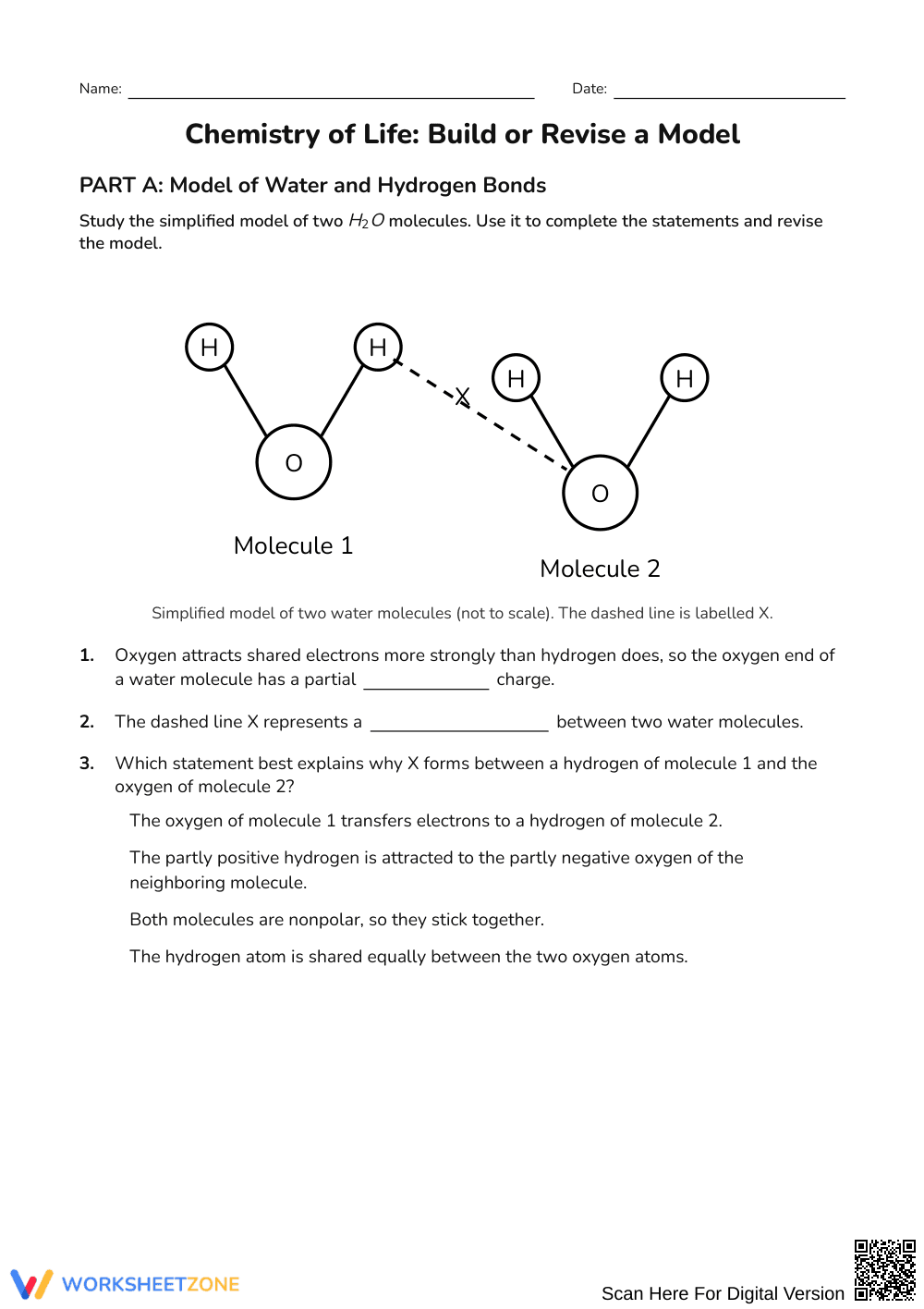
This high school science worksheet equips students to construct, analyze, and revise models illustrating the chemistry of life. Across four structured pages, students examine hydrogen bonding in water, map macromolecule synthesis and hydrolysis, and investigate enzyme kinetics, translating abstract biochemical principles into clear visual models of cellular function.
At a Glance
- Grade: Grades 9–12 · Subject: Science
- Standard:
Life Science— Construct and revise models explaining macromolecules, water properties, and enzymes- Skill Focus: Construct, complete, and revise biochemical models
- Format: 4 pages · 19 problems · Answer key included · PDF
- Best For: Biochemistry unit review
- Time: 45–60 minutes
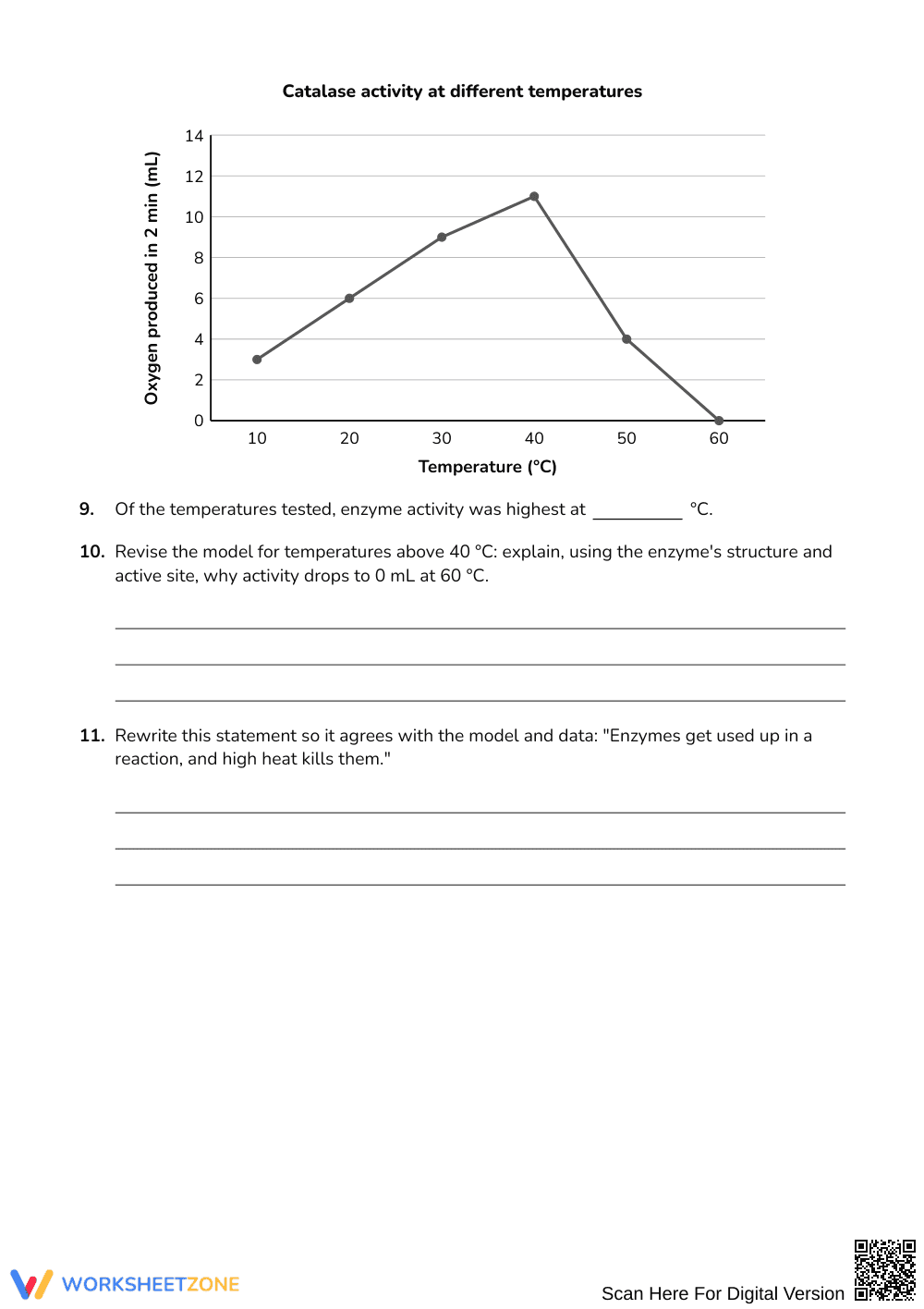
Inside, students complete 19 targeted tasks across three sections. The resource features visual diagrams of polar water molecules, a comparative macromolecule chart, reaction pathways for polymerization, and experimental catalase graphs. Tasks include fill-in explanations, charge labeling, and misconception revisions. A four-page answer key provides complete model annotations.
Skill Progression
- Guided practice (Part A, 4 tasks): Students examine labeled water molecules, identifying polarity before adding partial charge annotations.
- Supported practice (Part B, 7 tasks): Students complete a macromolecule table, then model dehydration synthesis and hydrolysis reactions.
- Independent practice (Part C, 8 tasks): Students analyze enzyme diagrams, interpret catalase rate data, and revise flawed scientific claims.
This sequence mirrors a gradual-release instructional model, moving from scaffolded diagram interpretation to independent scientific revision.
Standards Alignment
This worksheet aligns with high school science standards requiring students to construct and revise models illustrating relationships and chemical changes in biological systems. Students demonstrate mastery by modeling water polarity, macromolecule structures, and enzyme denaturation. These standard expectations can be copied directly into lesson plans, IEP goals, or district curriculum mapping tools.
How to Use It
Deploy this worksheet after direct instruction on biochemistry as an active class consolidation activity, or assign individual sections as station tasks. During Part C, check student explanations of thermal denaturation to ensure they attribute rate loss to active site deformation rather than cell death. Expected completion time is 45 to 60 minutes.
Who It's For
This resource serves general biology and introductory biochemistry students in grades 9 through 12. Visual diagrams support English learners and students requiring structural scaffolds, while open-ended revision prompts challenge advanced learners. Pair this worksheet directly with a hands-on macromolecule modeling kit or an enzyme laboratory investigation.
According to Fisher & Frey (2014), modeling complex scientific phenomena requires structured visual representations paired with opportunities for students to revise conceptual frameworks based on evidence. This Grades 9–12 Chemistry of Life worksheet operationalizes that research through 19 targeted tasks across 4 instructional pages. Learners examine molecular interactions, distinguish dehydration synthesis from hydrolysis, and analyze catalytic denaturation using empirical data. By requiring students to identify partial electrical charges, diagram macromolecule assemblies, and correct common misconceptions regarding enzyme kinetics, the resource bridges discrete factual recall and explanatory systems thinking. The scaffolded progression from guided structural analysis to independent model revision ensures that students articulate causal relationships governing cellular chemistry. Teachers obtain clear diagnostic data regarding student grasp of biochemical processes, while learners develop the metacognitive discipline needed to refine scientific models when presented with new structural and experimental evidence.


