




























Complete Chemistry of Life Worksheet | Grade 9-12 Science
Paste this activity's link or code into your existing LMS (Google Classroom, Canvas, Teams, Schoology, Moodle, etc.).
Students can open and work on the activity right away, with no student login required.
You'll still be able to track student progress and results from your teacher account.
This cumulative chemistry of life assessment evaluates high school science students on fundamental biochemical principles across 20 tasks. Students demonstrate mastery of macromolecule structures, water properties, enzyme reaction kinetics, and laboratory food testing. By analyzing visual models and interpreting experimental data, learners synthesize core molecular concepts and articulate scientific explanations.
At a Glance
- Grade: Grades 9–12 · Subject: Science
- Standard:
High School Life Science— Construct explanations based on evidence for how carbon-based macromolecules form biomass- Skill Focus: Chemistry of Life Cumulative Review
- Format: 4 pages · 20 problems · Answer key included · PDF
- Best For: Summative assessment and unit exam review
- Time: 45–60 minutes
What's Inside
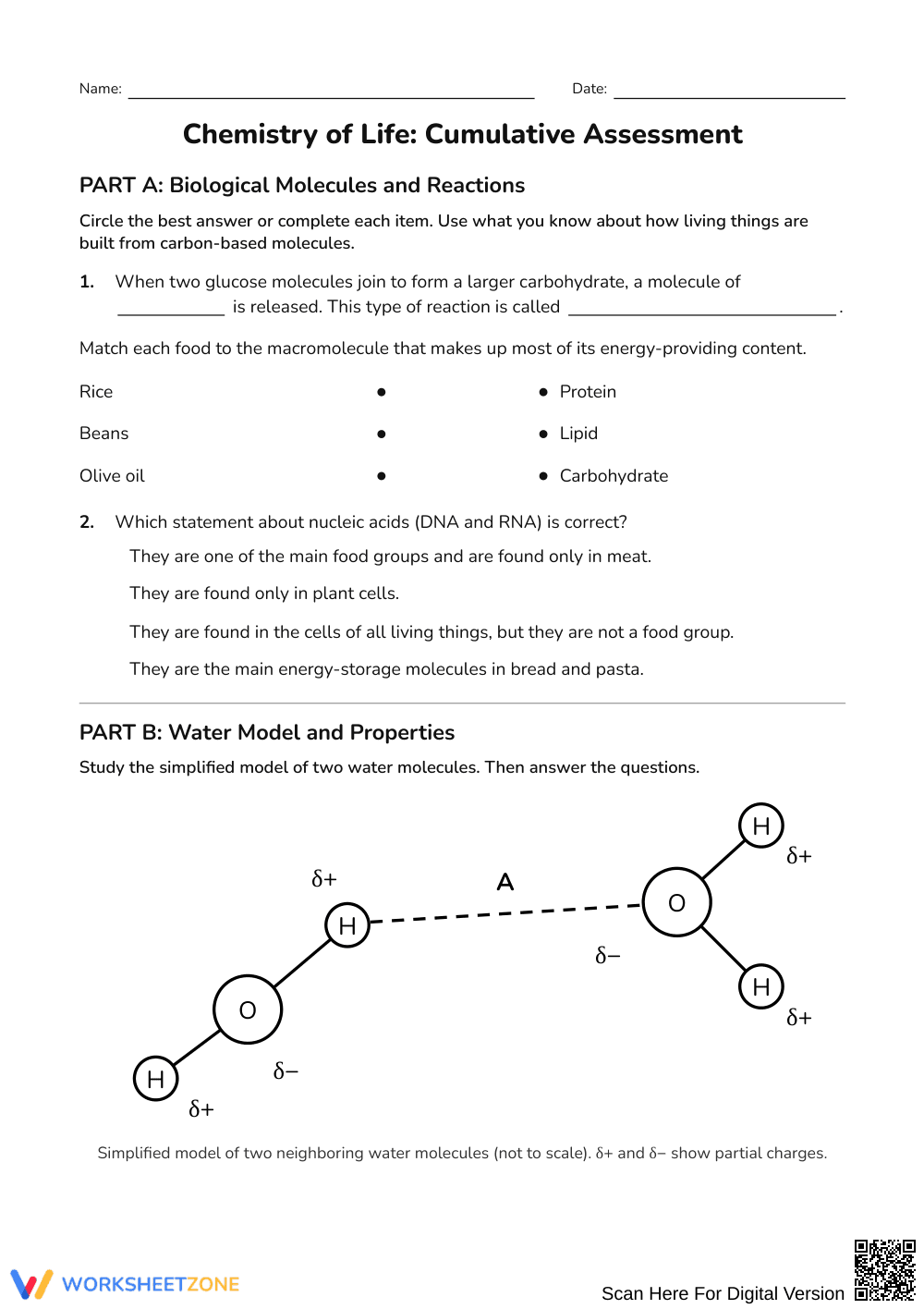
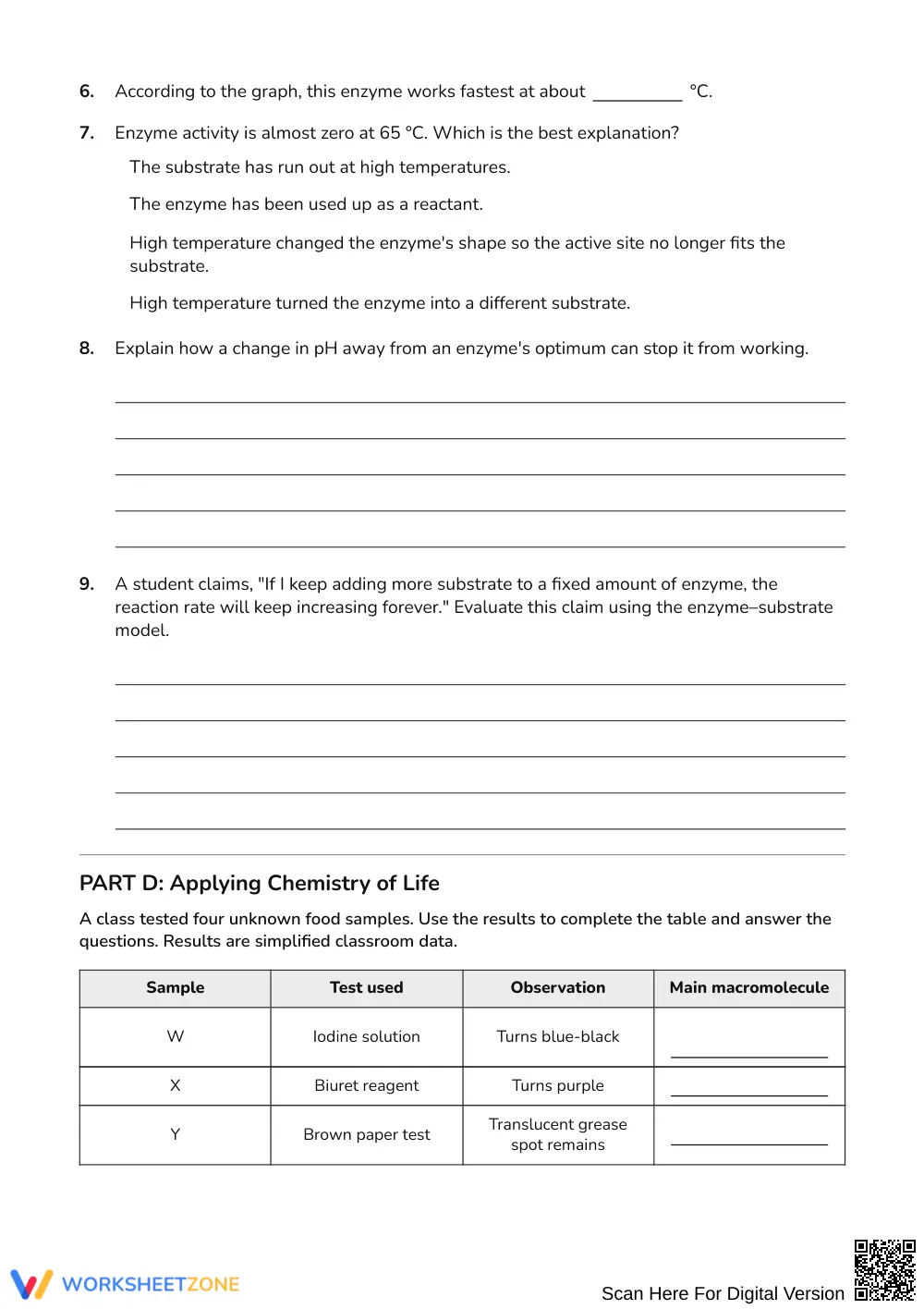
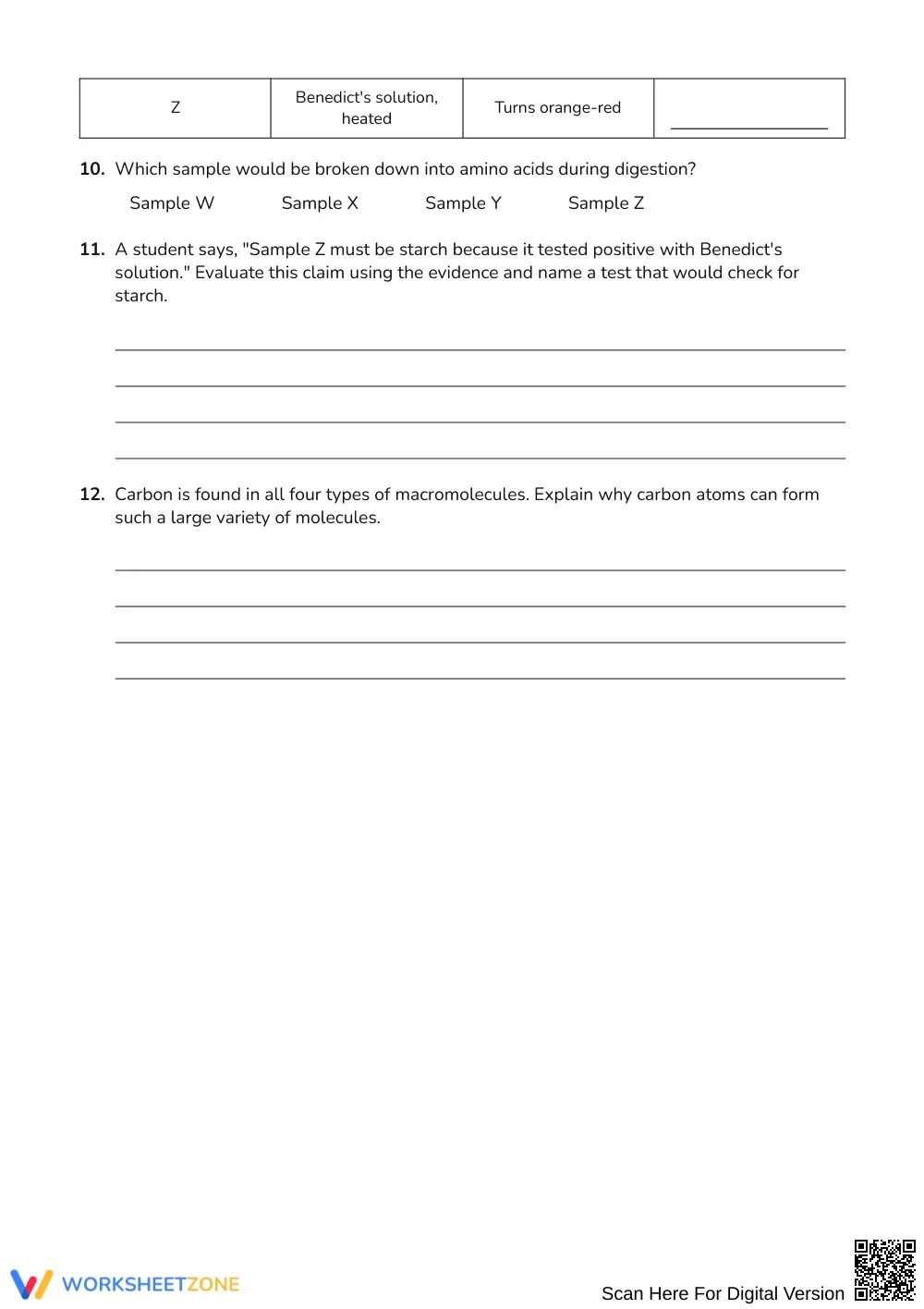
Spanning four student pages, this printable assessment organizes 20 tiered tasks into four distinct parts. Part A assesses biological macromolecules and dehydration synthesis. Part B examines water polarity and hydrogen bonding through a molecular diagram. Part C provides an enzyme temperature graph requiring curve interpretation and denaturation analysis. Part D features a four-sample food nutrient testing table and questions on carbon tetravalence. A complete four-page answer key provides full model explanations.
Skill Progression
- Guided practice (Parts A & B, 6 tasks): Students identify reaction mechanisms, classify nucleic acids, match nutrients, and use water models to define polarity and hydrogen bonding.
- Supported practice (Part C, 4 tasks): Students read temperature graphs to identify enzyme optimums, explain thermal and pH denaturation, and evaluate substrate saturation claims.
- Independent practice (Part D, 10 tasks): Students evaluate multi-variable indicator data tables, diagnose unknown macromolecules, correct student misconceptions, and explain carbon bonding versatility.
This sequence follows a gradual-release framework, moving learners from foundational recall to rigorous scientific evaluation.
Standards Alignment
This assessment aligns with high school molecular biology curriculum standards. Students construct explanations for how carbon, hydrogen, and oxygen form essential macromolecules. A supporting standard addresses how water polarity and enzyme structure maintain life-sustaining biochemical systems. Both standard codes can be copied directly into lesson plans, IEP goals, or district curriculum mapping tools.
How to Use It
Administer this four-page assessment after direct instruction on macromolecules or during mid-term review. Formatively check Part C responses; confusion regarding active sites signals a need to reteach protein folding before testing cellular energetics. Students typically complete the 20 problems in 45 to 60 minutes.
Who It's For
This cumulative resource is tailored for general high school biology students, Honors biology sections, and introductory biochemistry learners. Accommodate students by providing a macromolecule formula reference chart or extend learning by having advanced students sketch enzyme denaturation. It pairs directly with laboratory macromolecule testing investigations.
According to Fisher & Frey (2014), structured cumulative assessments that scaffold scientific tasks from model observation to independent data analysis significantly reinforce long-term conceptual retention in secondary science education. This 20-problem chemistry of life worksheet applies these evidence-based principles by engaging high school biology students in systematic evaluation of carbon-based biomolecules, water polarity, and enzyme reaction kinetics. Rather than relying on simple rote memorization, the four-page progression challenges learners to interpret laboratory evidence from nutrient indicators, analyze enzyme activity curves across temperature gradients, and articulate causal relationships governing molecular structure and function. Integrating comprehensive answer explanations directly supports teacher feedback cycles, ensuring that students bridge the gap between microscopic biochemical properties and macroscopic biological phenomena. As research on guided release confirms, combining data interpretation with claim evaluation accelerates student mastery of fundamental life science mechanisms across diverse high school learning environments.


