




























Views
Downloads


Complete Changes in Motion Word Search | Grades 7–8 Science

Paste this activity's link or code into your existing LMS (Google Classroom, Canvas, Teams, Schoology, Moodle, etc.).
Students can open and work on the activity right away, with no student login required.
You'll still be able to track student progress and results from your teacher account.
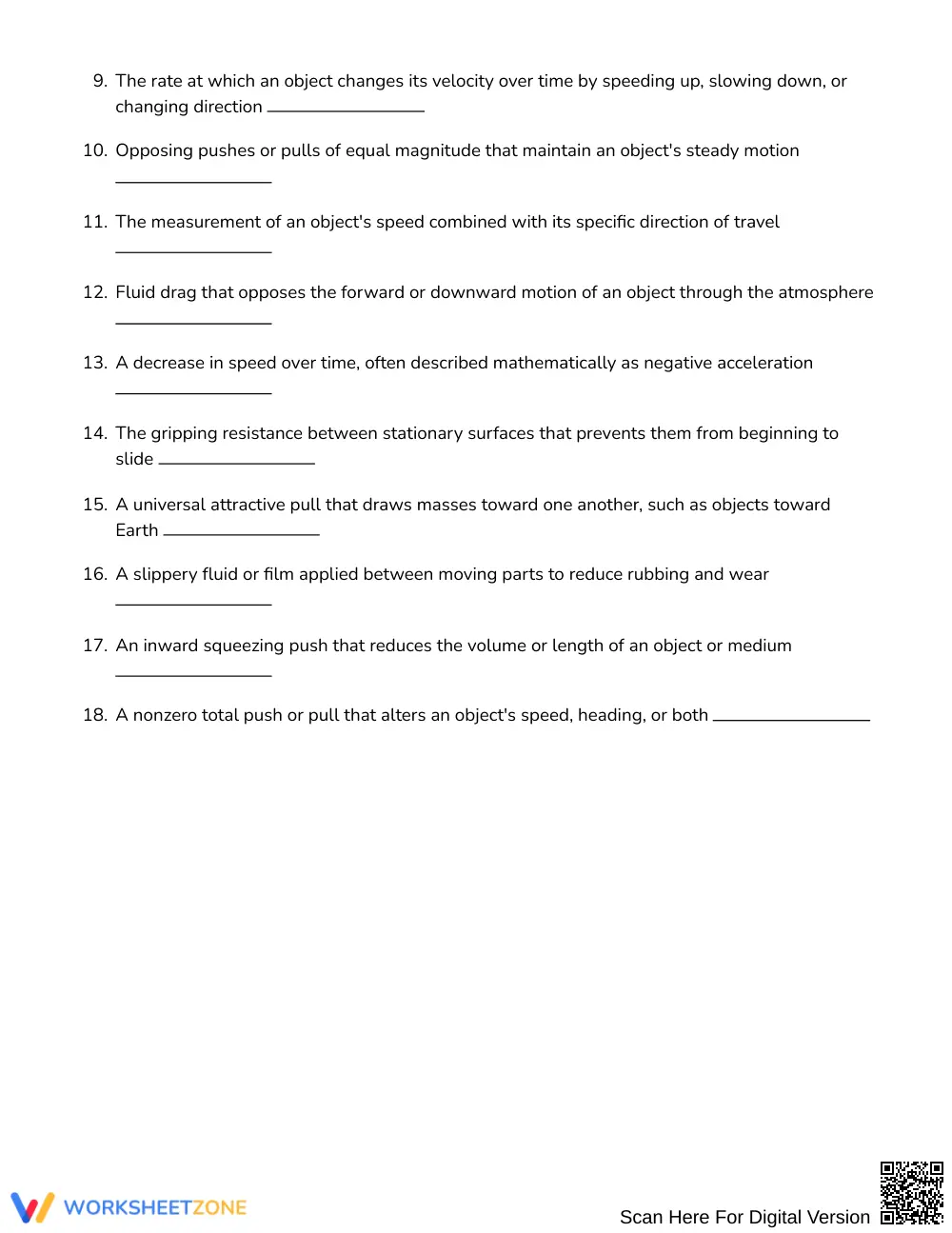
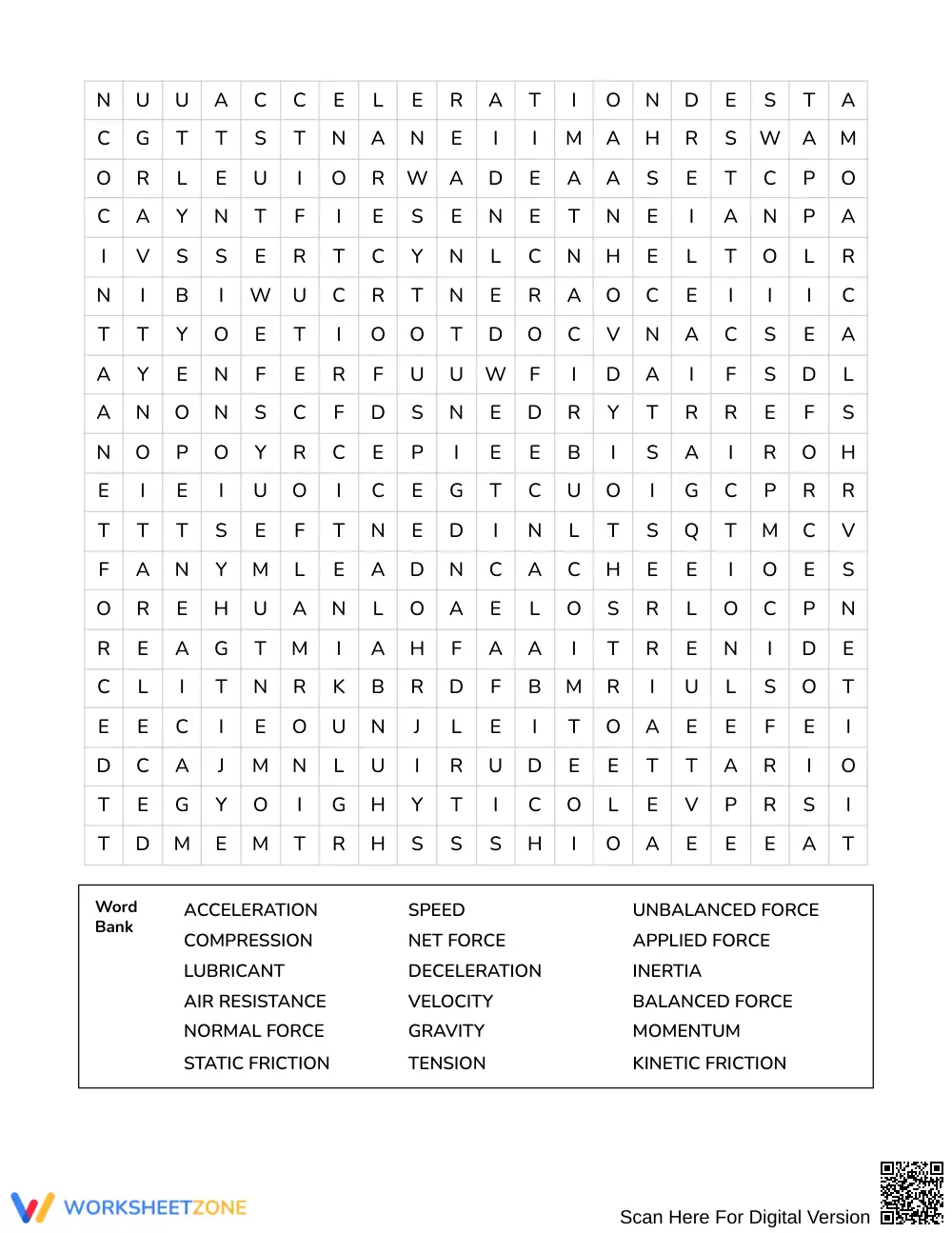
This physical science word search reinforces foundational vocabulary for comparing changes in motion across middle school classrooms. Students analyze definitions of core mechanical concepts, identify corresponding science terms, and locate them within the grid. The activity consolidates scientific terminology, strengthening student comprehension of forces, speed, velocity, and acceleration during unit review or independent practice.
At a Glance
- Grade: Grades 7–8 · Subject: Science
- Standard: Not standards-assessed — vocabulary enrichment
- Skill Focus: Comparing changes in motion
- Format: 3 pages · 18 words · Answer key included · PDF
- Best For: Vocabulary review and sub plans
- Time: 20–35 minutes
What's Inside
The activity package features a clear 3-page printable layout containing 18 hidden vocabulary terms paired with descriptive concept clues. Rather than presenting a simple word list, the resource provides rigorous definitions for every term, requiring students to demonstrate concept recall before searching the grid. A complete 4-page answer key provides clear solution paths for efficient teacher grading or student self-checking.
Puzzle Structure and Mechanics
The puzzle is built on a dense 20 x 20 letter grid containing 18 hidden science terms. Words run in all 8 possible directions: north, northeast, east, southeast, south, southwest, west, and northwest. A shuffled word bank provides reference support alongside comprehensive scientific clues that challenge students to connect definitions to specific motion principles, including net force, inertia, friction types, and acceleration.
Standards Alignment
This supplementary science resource is designed specifically for vocabulary enrichment and is not aligned to a formal performance standard. It builds essential domain-specific literacy that underpins middle school physics and physical science units on motion, forces, and mechanical systems.
How to Use It
Deploy this puzzle as an engaging warm-up during a cumulative unit review or as an independent task after direct instruction on Newton's laws. During seatwork, circulate to ensure students read the definition clues to deduce terms rather than scanning solely for familiar letter sequences. Most learners complete the full search within 20 to 35 minutes.
Who It's For
This review resource supports general education students in Grades 7–8 science classes, providing targeted vocabulary reinforcement for English language learners and students benefiting from visual word identification. Pair this puzzle with an introductory motion lab or force diagram anchor chart to bridge physical demonstrations with technical science terms.
Research from Fisher & Frey (2014) emphasizes that intentional exposure to domain-specific vocabulary within content-area instruction accelerates student reading comprehension and conceptual retention. When secondary science students interact with technical terms in diverse contexts, such as matching precise scientific definitions to terms in an 18-word search, they construct robust mental models of abstract physical phenomena like velocity, friction, and net force. Studies highlighted in Fisher & Frey (2014) indicate that systematic vocabulary reinforcement before and during cumulative assessments significantly improves academic achievement for diverse learners by reducing cognitive load during complex problem solving. Providing structured opportunities for middle school students to rehearse physical science terminology bridges the gap between everyday language and rigorous scientific discourse, supporting long-term mastery of mechanics concepts across Grades 7–8 curricula.


