




























Complete Central Dogma Worksheet | Grades 9-12 Science
Paste this activity's link or code into your existing LMS (Google Classroom, Canvas, Teams, Schoology, Moodle, etc.).
Students can open and work on the activity right away, with no student login required.
You'll still be able to track student progress and results from your teacher account.
This comprehensive Central Dogma assessment evaluates high school biology students on molecular genetics mechanisms. Students demonstrate mastery by tracking information flow from DNA to polypeptides, interpreting a eukaryotic cell model, decoding nucleotide sequences with a codon chart, and analyzing mutation data from sickle cell hemoglobin variants.
At a Glance
- Grade: Grades 9–12 · Subject: High School Science
- Standard: Construct an explanation based on evidence for how DNA sequences determine protein structure
- Skill Focus: Central Dogma mechanisms, codon decoding, and mutation effects
- Format: 4 pages · 39 problems · 4-page answer key included · PDF
- Best For: High school biology end-of-unit cumulative assessment
- Time: 45–60 minutes
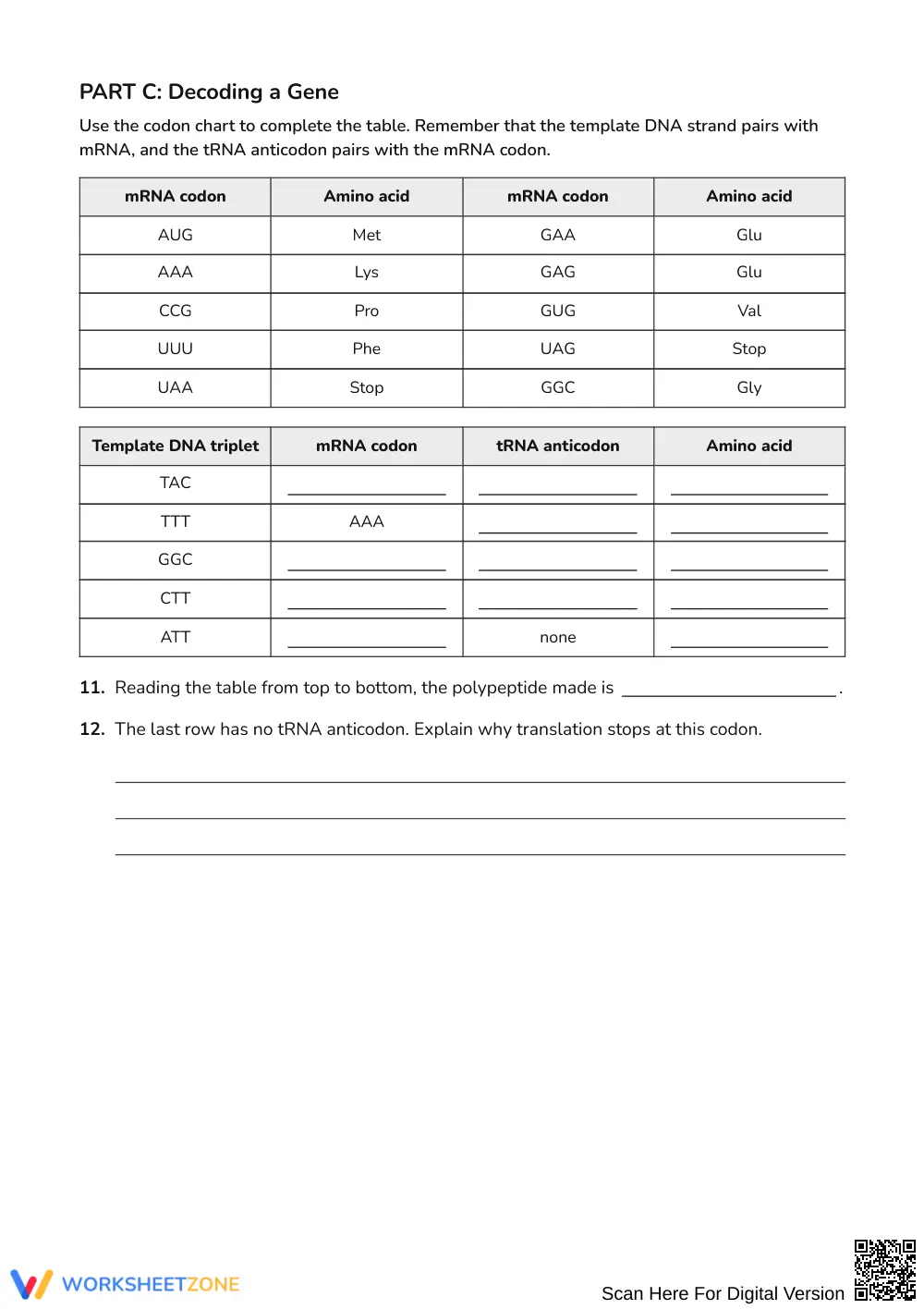
This 4-page assessment delivers 39 structured tasks organized into four focused parts. Part A assesses foundational knowledge of genetic flow and nuclear transport through selected-response questions. Part B utilizes an anatomical eukaryotic cell model for diagram labeling and short-answer mechanistic explanations. Part C provides a complete codon chart for decoding DNA triplets into mRNA, tRNA anticodons, and amino acids. Part D presents clinical hemoglobin variant data to analyze missense, nonsense, and silent mutations. A complete 4-page answer key provides full explanations.
- Guided practice: Multiple-choice questions and cell diagram labeling guide learners to identify molecular structures and nuclear transport pathways.
- Supported practice: Reference-supported codon decoding tasks prompt students to translate DNA template strands into complementary mRNA, tRNA, and polypeptide chains.
- Independent practice: Analytical data prompts require students to evaluate sickle cell hemoglobin mutations and explain how altered codons disrupt protein function.
This progression mirrors the gradual-release framework, moving students from basic structural recognition to independent genetic data analysis.
This assessment aligns with high school life science standards for gene expression: construct an explanation based on evidence for how the structure of DNA determines the structure of proteins, which carry out the essential functions of life. Supporting standards address evaluating the functional effects of genetic mutations. Both standard statements can be copied directly into lesson plans, IEP goals, or district curriculum mapping tools.
Administer this assessment immediately after instruction on transcription and translation as a summative exam or comprehensive review. Formatively check Part C during work time to confirm students pair uracil with adenine rather than thymine. Expected completion time is 45 to 60 minutes.
This resource serves Grades 9–12 biology and life science students preparing for unit exams. Embedded reference charts and cell models support diverse learners without lowering cognitive expectations. Pair this worksheet with a protein synthesis lecture or interactive translation anchor chart.
According to research by Fisher & Frey (2014) on purposeful instructional design, multi-tiered assessments that bridge visual modeling, sequence decoding, and analytical explanations significantly reinforce complex biological concepts. This Grades 9–12 science worksheet provides 39 rigorous tasks evaluating core Central Dogma principles under high school life science standards. Students trace genetic information flow from DNA to RNA to functional polypeptides, demonstrate transcription and translation using eukaryotic cell models, decode nucleotide sequences with reference codon charts, and analyze clinical hemoglobin variant data to assess mutation outcomes. The accompanying 4-page teacher answer key supports rapid scoring and precise diagnostic tracking across both multiple-choice and constructed-response formats. By systematically shifting cognitive demand from basic structural recall to evidence-based cause-and-effect reasoning, this curriculum resource delivers rigorous data on student mastery for classroom evaluation, progress monitoring, and standards-aligned gradebook reporting.


