































Complete Central Dogma Worksheet | Grade 9-12 Science

Paste this activity's link or code into your existing LMS (Google Classroom, Canvas, Teams, Schoology, Moodle, etc.).
Students can open and work on the activity right away, with no student login required.
You'll still be able to track student progress and results from your teacher account.
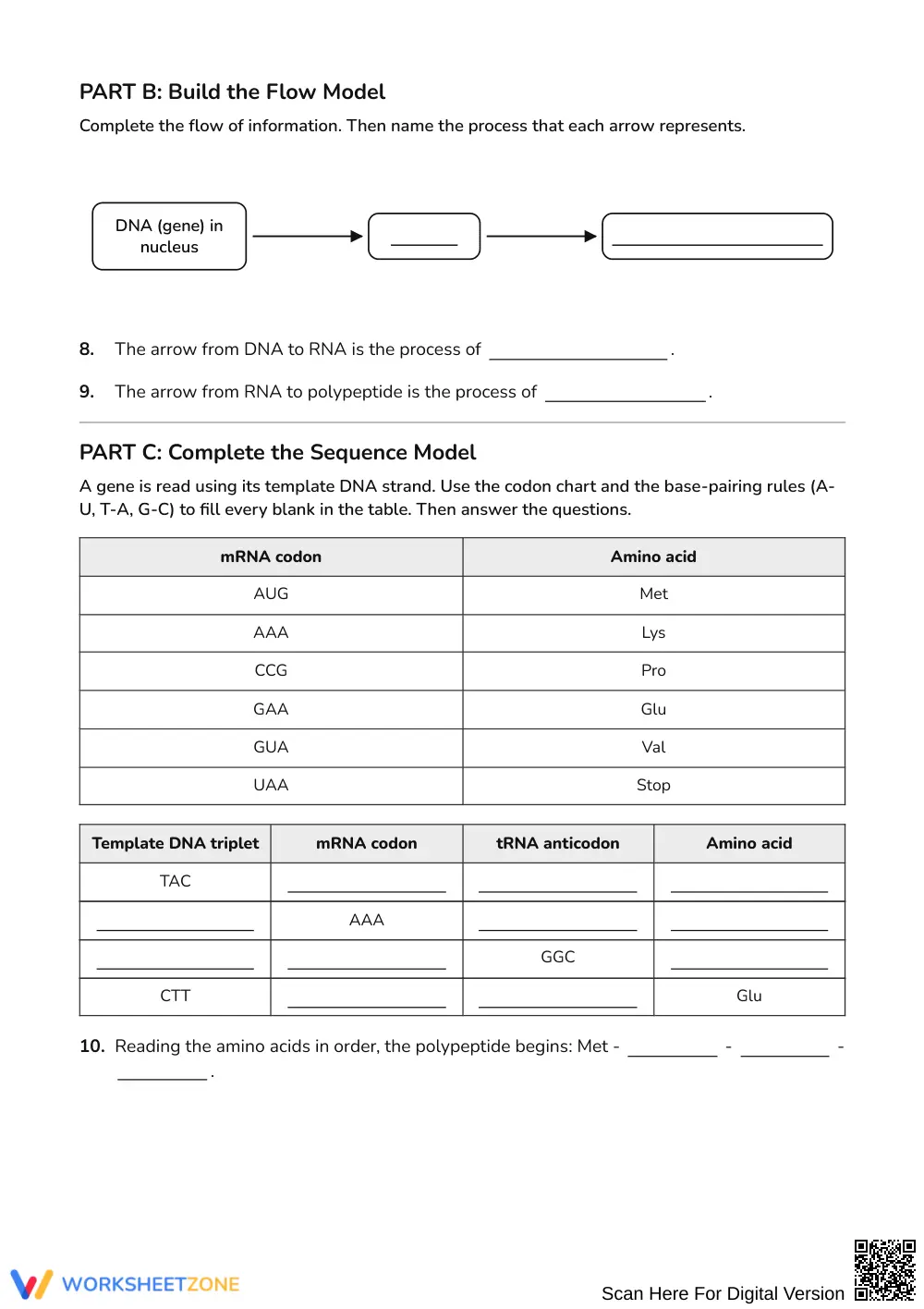
This comprehensive high school science worksheet guides biology students through constructing, completing, and revising models of the Central Dogma. Learners trace genetic information from nuclear DNA through transcription to mRNA, and through translation into functional polypeptides at ribosomes, ensuring conceptual mastery of cellular protein synthesis.
At a Glance
- Grade: Grades 9–12 · Subject: Science
- Standard: Construct and revise models illustrating how DNA codes for proteins
- Skill Focus: Central Dogma: construct, complete, or revise a model
- Format: 4 pages · 37 problems · Answer key included · PDF
- Best For: High school molecular genetics unit review
- Time: 45–60 minutes
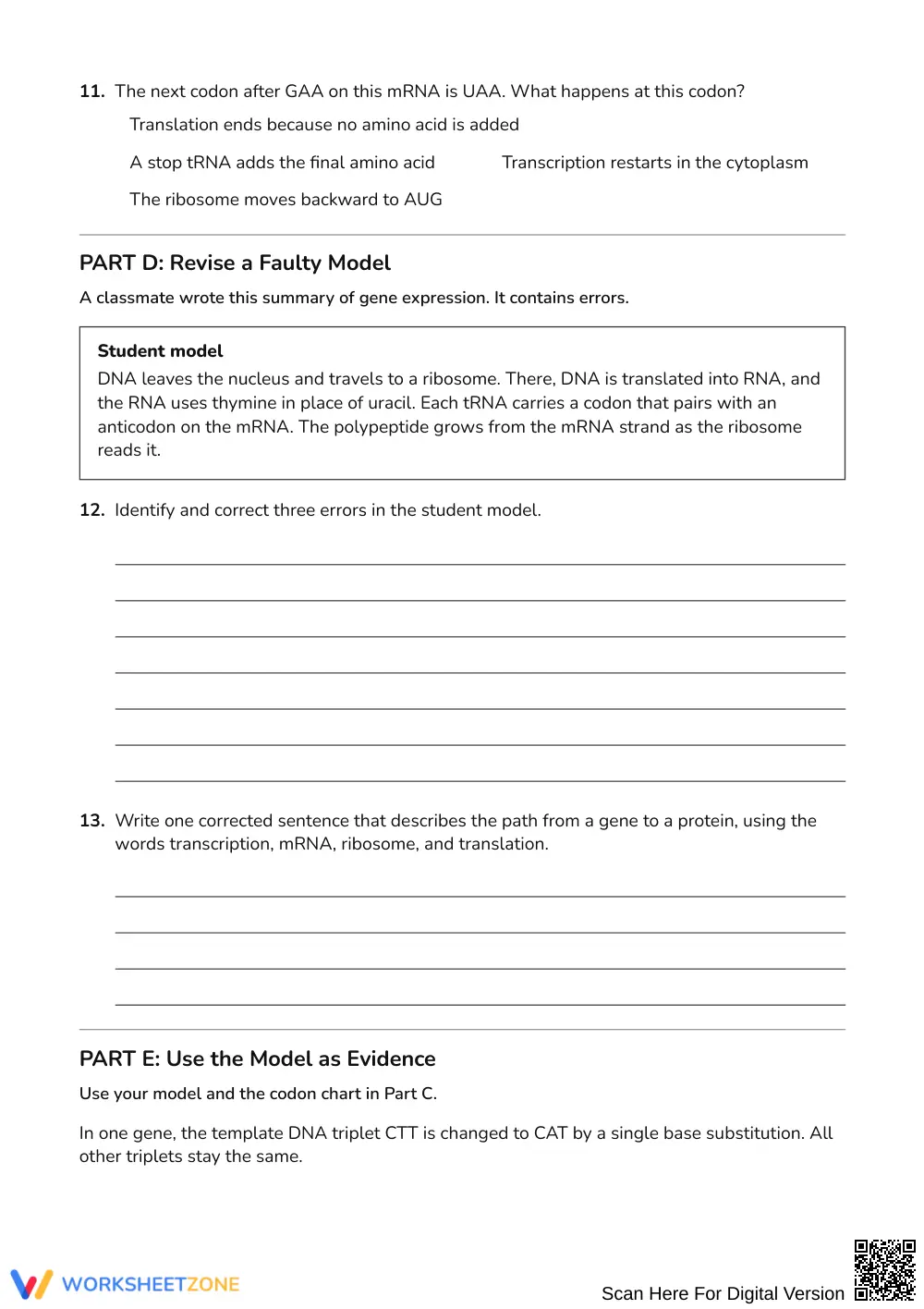
The 4-page activity contains 37 structured tasks divided into five progressive parts. Students label cellular diagrams using an integrated word bank, complete directional flow diagrams, decode nucleotide triplets using a standard genetic code codon chart, diagnose misconceptions in peer explanations, and predict mutation outcomes. A complete 4-page answer key provides full model keys and written explanations.
Skill Progression
- Guided Practice: Parts A and B provide 11 visual identification and pathway problems scaffolded by word banks and directional cues to ground foundational terminology.
- Supported Practice: Part C features 18 sequence-conversion tasks using a codon chart where students practice base-pairing mechanics across DNA, mRNA, and tRNA.
- Independent Practice: Parts D and E present 8 rigorous analytical tasks requiring students to debug flawed scientific claims and predict phenotypic impacts of base substitutions.
This structured sequence follows a gradual-release instructional model that transitions learners smoothly from diagrammatic recall to sophisticated scientific modeling.
Standards Alignment
This resource directly aligns with high school life science standards requiring students to construct and revise an explanation based on evidence for how the structure of DNA determines the structure of proteins, which carry out the essential functions of life through systems of specialized cells. Both standard objectives and modeling criteria can be copied directly into lesson plans, IEP goals, or district curriculum mapping tools.
How to Use It
Deploy this worksheet after direct instruction on protein synthesis as an interactive paired review or post-lecture formative assessment. During class, circulate during Part D to check whether students identify that tRNA contains anticodons rather than codons, offering quick feedback on persistent conceptual errors. Expected completion time spans 45 to 60 minutes.
Who It's For
Designed for on-level biology, honors life science, and introductory genetics classes. Built-in word banks and reference tables support developing readers, while error-analysis tasks challenge advanced thinkers. Pair this activity naturally with a hands-on transcription and translation simulation or an interactive codon bingo lesson.
According to Fisher & Frey (2014), the gradual release of responsibility framework accelerates scientific literacy by anchoring conceptual acquisition before expecting students to troubleshoot non-examples. This Central Dogma worksheet puts that methodology into practice across 37 sequentially arranged items on 4 reproducible pages. By guiding high school biology students from concrete diagram labeling and sequence decoding through the analytical critique of faulty peer explanations, the task structure directly reflects research-backed strategies for deep conceptual modeling. Students actively investigate how informational flow regulates cellular functions and explain how single-nucleotide substitutions alter polypeptide assembly and structural folding. Because the resource includes fully articulated model keys and step-by-step transcription tables, educators can reliably capture diagnostic data on student mechanistic reasoning without requiring supplemental instructional aids.


