




























Complete Central Dogma Worksheet | Grade 9-12 Science
Paste this activity's link or code into your existing LMS (Google Classroom, Canvas, Teams, Schoology, Moodle, etc.).
Students can open and work on the activity right away, with no student login required.
You'll still be able to track student progress and results from your teacher account.
This comprehensive Central Dogma worksheet equips high school biology students to trace genetic information from DNA to functional polypeptides. Through structured classification, diagram labeling, codon translation, and mutation analysis, learners articulate how transcription and translation coordinate to produce proteins and analyze how sequence changes alter final cellular products.
At a Glance
- Grade: 9–12 · Subject: Science
- Standard: High School Life Science — Model the flow of genetic information from DNA to RNA to proteins
- Skill Focus: Central Dogma stages, cellular structures, and sequence analysis
- Format: 4 pages · 39 problems · Answer key included · PDF
- Best For: Formative practice and review unit
- Time: 45–60 minutes
What's Inside: The 4-page student activity features matching tables, cellular diagram labeling supported by a word bank, sequence translation using a provided genetic code chart, and short-answer analytical prompts. A complete 4-page answer key provides expected responses and explanatory rationales for straightforward grading and self-assessment.
Skill Progression
- Guided practice (Part A & Part B, 18 tasks): High scaffold level. Students classify molecular events into replication, transcription, or translation, pair functional terms with their roles, and label eukaryotic cellular structures using a targeted word bank.
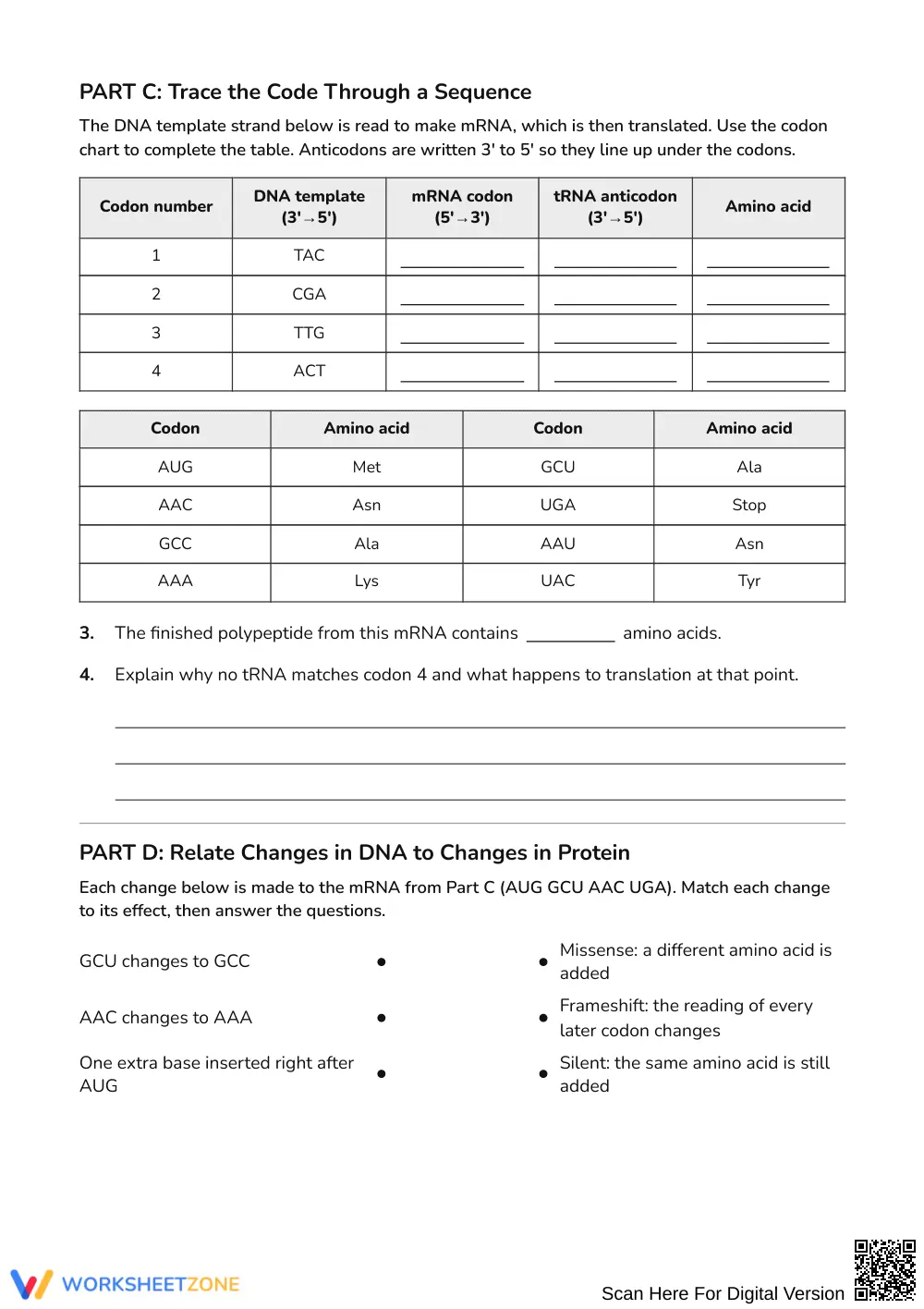
- Supported practice (Part C, 14 tasks): Moderate scaffold level. Students apply base-pairing rules to transcribe DNA into mRNA codons, write complementary tRNA anticodons, and decode amino acid chains using an embedded codon table.
- Independent practice (Part D, 7 tasks): Low scaffold level. Learners independently evaluate silent, missense, and frameshift mutations, predict phenotypic impact, and explain molecular cascades when transcription enzymes are inhibited.
This sequence follows a gradual-release instructional model that transitions students from structural identification to predictive biochemical reasoning.
Standards Alignment
This resource aligns with high school life science standards requiring students to construct explanations and develop models illustrating how the structure of DNA determines the structure of proteins carrying out essential life functions. Both standard concepts and process skills can be copied directly into lesson plans, IEP goals, or district curriculum mapping tools.
How to Use It
Deploy this worksheet after direct instruction on protein synthesis as an in-class consolidation activity, or assign it across two class periods during unit review. During independent sequence decoding in Part C, circulate to verify whether students correctly recognize that stop codons do not code for transfer RNA molecules or amino acids. Expected student completion time is 45 to 60 minutes.
Who It's For
Designed for general biology and honors high school science classrooms, this printable provides clear conceptual stepping stones for diverse learners. Pair this assignment with a 3D ribosome animation or a large-format transcription diagram to reinforce cellular compartmentalization.
According to Fisher & Frey (2014), purposeful instructional architecture that transitions systematically from guided classification to independent evaluation solidifies conceptual retention in secondary science. High school life science benchmarks require learners to understand the precise biochemical mechanisms that govern the expression of genetic traits. This 39-task resource delivers intentional scaffolding across eukaryotic gene expression, requiring students to link structural mechanics with genetic coding principles. By requiring learners to analyze how nucleotide insertions alter translation reading frames and downstream polypeptides, the activity bridges mechanical base-pairing rules with foundational evolutionary concepts. The complete 4-page teacher key supports precise error correction and evidence-based progress monitoring, establishing an accountable classroom resource that verifies student mastery of molecular biology standards.


