




























Views
Downloads



Complete Calculation Plans Worksheet | Grade 6 Math

Paste this activity's link or code into your existing LMS (Google Classroom, Canvas, Teams, Schoology, Moodle, etc.).
Students can open and work on the activity right away, with no student login required.
You'll still be able to track student progress and results from your teacher account.
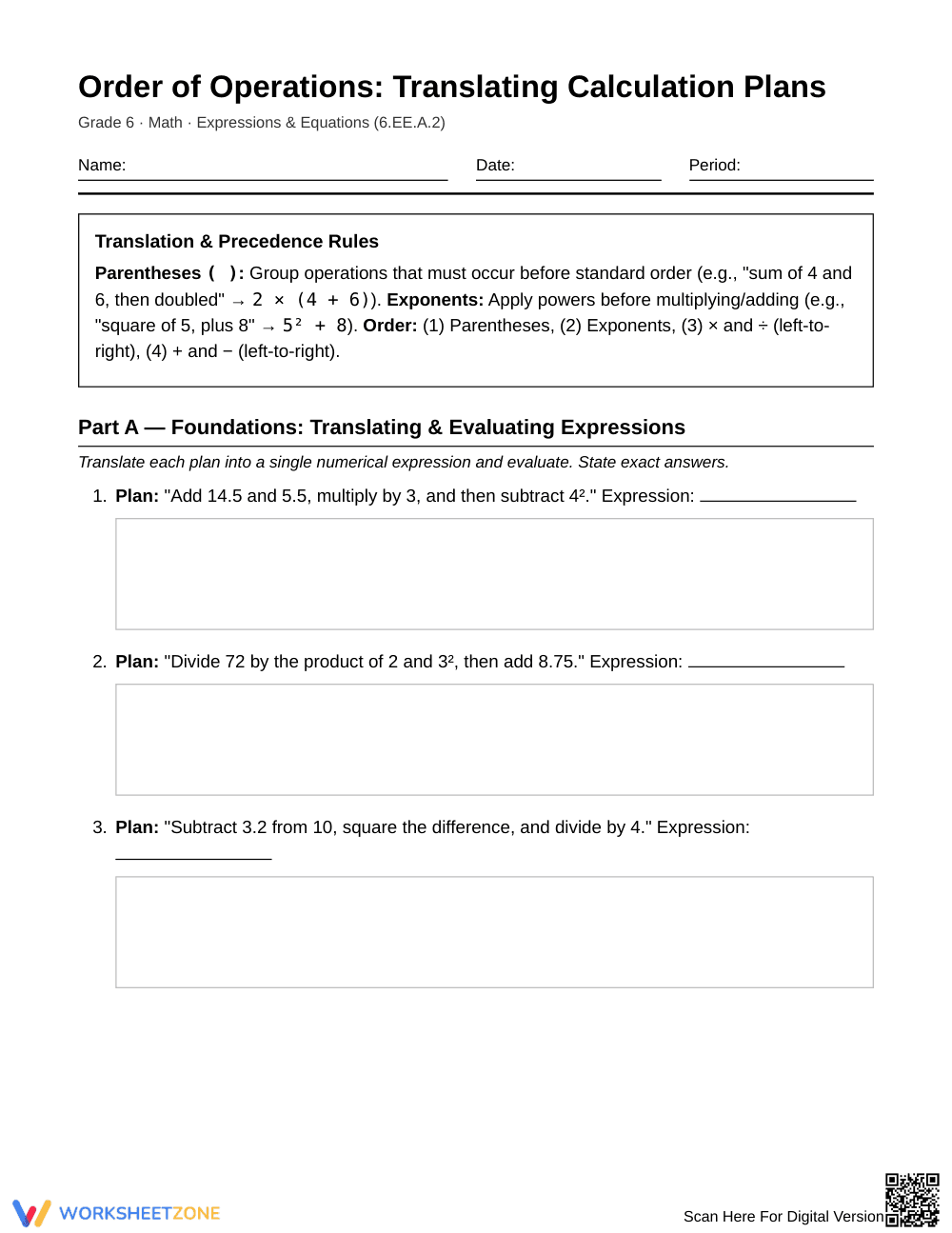
This Grade 6 order of operations worksheet provides structured practice translating written calculation plans and multi-step real-world scenarios into precise numerical expressions. Students build procedural fluency by applying parentheses, evaluating whole-number exponents, and executing the correct order of operations across 15 targeted problems to achieve accurate numerical results.
At a Glance
- Grade: 6 · Subject: Math
- Standard:
6.EE.A.1— Write and evaluate numerical expressions involving whole-number exponents- Skill Focus: Translating calculation plans into expressions
- Format: 4 pages · 15 problems · Answer key included · PDF
- Best For: Guided practice and independent review
- Time: 35–45 minutes
What's Inside
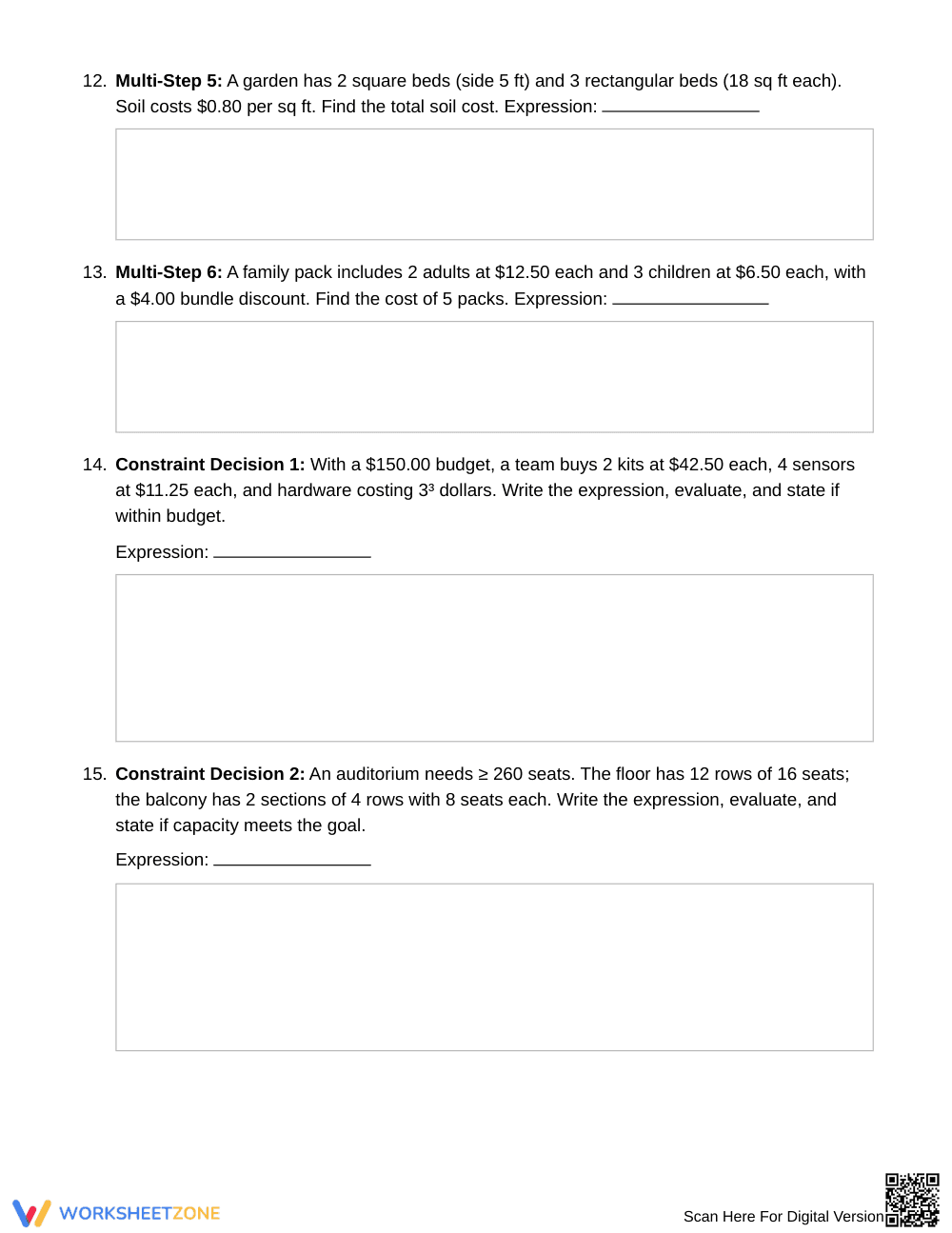
This 4-page printable activity features 15 distinct problems arranged by complexity, complete with an explicit translation and precedence reference box, a modeled financial example, error analysis, and multiple-choice items. A complete 2-page answer key provides step-by-step numerical evaluations and clear explanatory notes for rapid checking.
Skill Progression
- Guided Practice (Part A, Problems 1–5): Students translate direct verbal calculation plans into numerical expressions, identify equivalent expressions involving grouped sums and cubes, and diagnose order-of-precedence errors in worked student samples.
- Supported Practice (Part B, Problems 6–13): Learners analyze multi-step contextual word problems involving itemized purchases, area models with squared terms, and inventory counts, translating each scenario into an unsimplified single expression before evaluating.
- Independent Practice (Part B, Problems 14–15): Students construct multi-term expressions to evaluate real-world constraint decisions, determining whether total expenditures remain within a 150-dollar budget and if auditorium seating arrangements satisfy minimum capacity thresholds.
This structured sequence follows a gradual-release instructional model, transitioning students from foundational verbal translation rules to independent mathematical modeling and decision-making.
Standards Alignment
Primary Standard: `6.EE.A.1` — Write and evaluate numerical expressions involving whole-number exponents. Supporting Standard: `6.EE.A.2` — Write, read, and evaluate expressions in which letters and numbers stand for numbers. Both standard codes can be copied directly into lesson plans, IEP goals, or district curriculum mapping tools.
How to Use It
Use this resource after introducing exponent rules and grouping symbols during direct instruction. Assign Part A during paired classwork to observe whether students correctly prioritize parentheses over multiplication when translating terms like "sum doubled." Reserve Part B for independent seatwork or small-group intervention. Expected completion time is 35 to 45 minutes.
Who It's For
This worksheet serves sixth-grade general education students, introductory pre-algebra learners, and students receiving Tier 2 math intervention on order of operations. Pair this resource with a visual order of operations anchor chart or hands-on expression-building cards.
According to Fisher & Frey (2014), structured gradual-release frameworks significantly strengthen student mastery in procedural mathematics by bridging guided rule application with authentic contextual problem-solving. This Grade 6 mathematics resource targets standard 6.EE.A.1 by requiring students to translate verbal calculation descriptions into structured numerical expressions featuring parentheses and exponents. Across 15 rigorous tasks, learners interpret operational hierarchy, correct common procedural errors, and calculate exact values within applied financial and geometric contexts. The included step-by-step answer key supports efficient formative feedback, ensuring educators can readily identify and remediate misconceptions surrounding operational grouping and exponential evaluation.


