































Complete Atomic Structure Word Search | Grades 7–8 Science

Paste this activity's link or code into your existing LMS (Google Classroom, Canvas, Teams, Schoology, Moodle, etc.).
Students can open and work on the activity right away, with no student login required.
You'll still be able to track student progress and results from your teacher account.
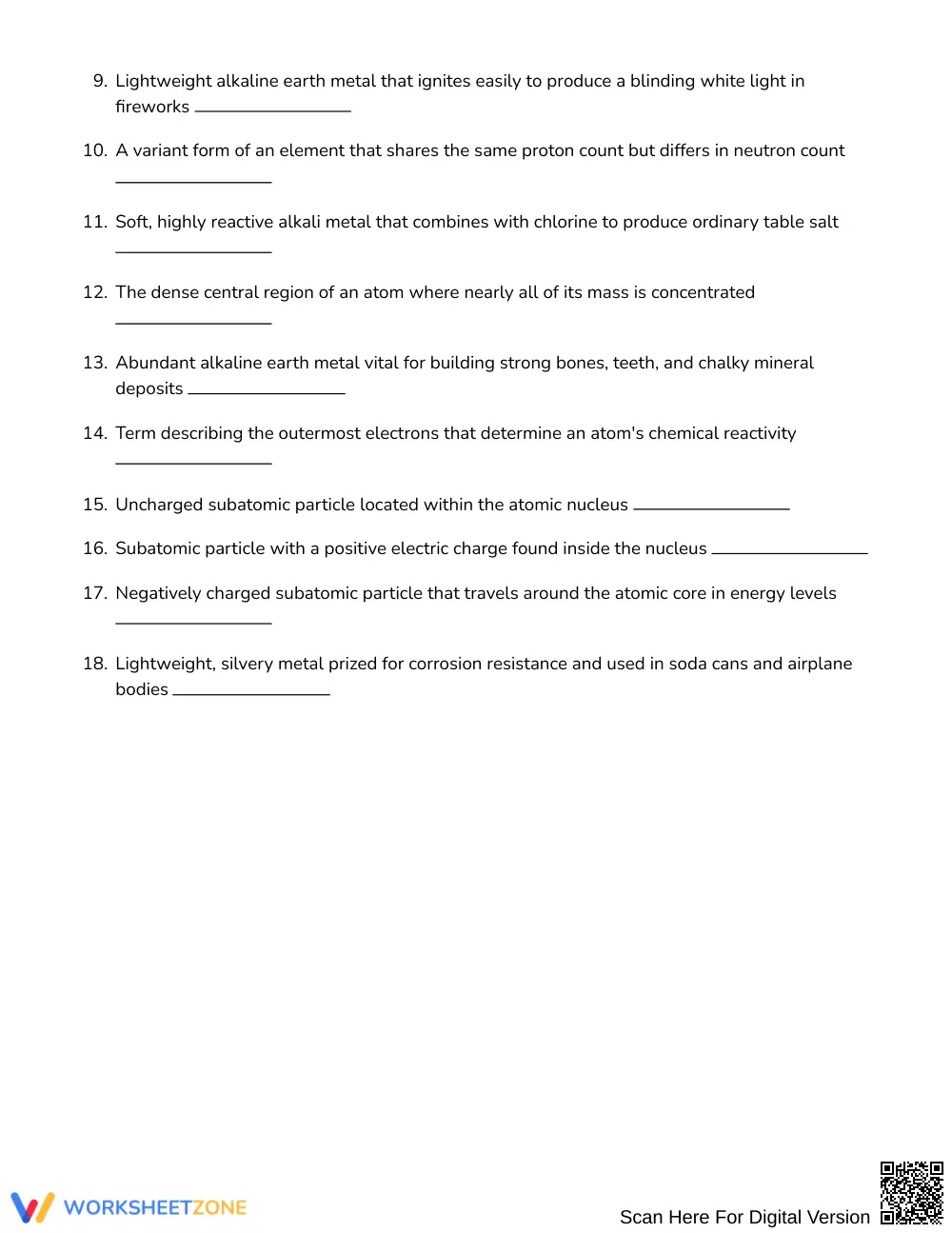
This atomic structure and periodic patterns review word search reinforces foundational chemistry concepts for middle school learners. Students read scientific clue definitions to identify 18 essential terms—including subatomic particles, periodic table trends, and representative elements—before locating them within the grid. The activity strengthens domain-specific vocabulary retention through active retrieval and contextual recognition.
At a Glance
- Grade: Grades 7–8 · Subject: Science (Middle School Physical Science)
- Standard: Not standards-assessed — vocabulary enrichment for secondary chemistry fundamentals
- Skill Focus: Atomic structure and periodic patterns cumulative review
- Format: 3 pages · 18 words · Full answer key included · Printable PDF
- Best For: Cumulative chemistry review, vocabulary reinforcement, or sub plans
- Time: 20–35 minutes of engaged independent practice
What's Inside
This 3-page printable science resource contains an 18-word puzzle paired with scientific clues and an answer key. Rather than scanning a simple word bank, students read clue descriptions to deduce target terms such as proton, valence, isotope, and calcium. The answer key displays exact word placements within the letter matrix alongside clue solutions, enabling rapid grading and self-checking.
Puzzle Mechanics and Structure
The word search is constructed on a 20 × 20 grid containing 18 hidden chemistry terms placed in all eight compass directions: forward, backward, vertically, and diagonally. Clues prompt learners to solve descriptions of subatomic components, periodic organization, and elemental metals before locating answers across the grid.
Standards Alignment
This resource serves as supplemental vocabulary enrichment and is not aligned to a specific academic standard. It supports physical science units by reinforcing essential chemical terminology, structural concepts of matter, and periodic table classification through active recall and definition matching.
How to Use It
Deploy this word search as a mid-unit vocabulary check or as a post-instruction cumulative review before an exam. Circulate to observe whether students solve the definition clues first or search blindly for letters; learners who annotate clues demonstrate stronger conceptual understanding. Completion typically requires 20 to 35 minutes of focused student work.
Who It's For
This activity is designed for middle school science students in Grades 7–8 studying introductory chemistry or physical science. For differentiated support, pair struggling readers with a periodic table anchor chart to connect clues to element symbols, while advanced learners can draw Bohr models for discovered elements. It pairs naturally with lessons on atomic anatomy or periodic table families.
Secondary science achievement depends heavily on mastering specialized scientific vocabulary, as evidenced by educational research synthesizing domain literacy. According to Fisher & Frey (2014), intentional vocabulary exposure paired with contextual definitions directly enhances academic comprehension and long-term recall in middle school science. This Grades 7–8 atomic structure and periodic patterns review word search provides structured vocabulary enrichment without standard-specific assessment constraints, engaging students in identifying 18 core chemical terms through clue-based definition retrieval. By demanding that learners analyze descriptive clues—such as differentiating isotopes by neutron count or characterizing alkali metals like sodium and potassium—before searching a 20 × 20 letter grid, the puzzle transforms routine word recognition into meaningful semantic practice. Teachers utilize this resource for cumulative physical science review, independent enrichment, and targeted reinforcement, ensuring learners build the foundational conceptual fluency required for advanced high school chemistry coursework.


