































Complete Animal Habitats Word Search | Grades 7–8 Science

Paste this activity's link or code into your existing LMS (Google Classroom, Canvas, Teams, Schoology, Moodle, etc.).
Students can open and work on the activity right away, with no student login required.
You'll still be able to track student progress and results from your teacher account.
Reinforce animal and habitat associations across life science units with this focused vocabulary activity. Students match eighteen organisms to their biomes by reading scientific definitions before locating each term in the puzzle. This activity solidifies ecological terminology, reinforces biome characteristics, and provides middle school science classes with meaningful vocabulary retention practice.
At a Glance
- Grade: Grades 7–8 · Subject: Science
- Standard: Not standards-assessed — vocabulary enrichment
- Skill Focus: Matching animals to habitats
- Format: 3 pages · 18 words · Answer key included · PDF
- Best For: Cumulative biome review and vocabulary reinforcement
- Time: 20–30 minutes
What's Inside
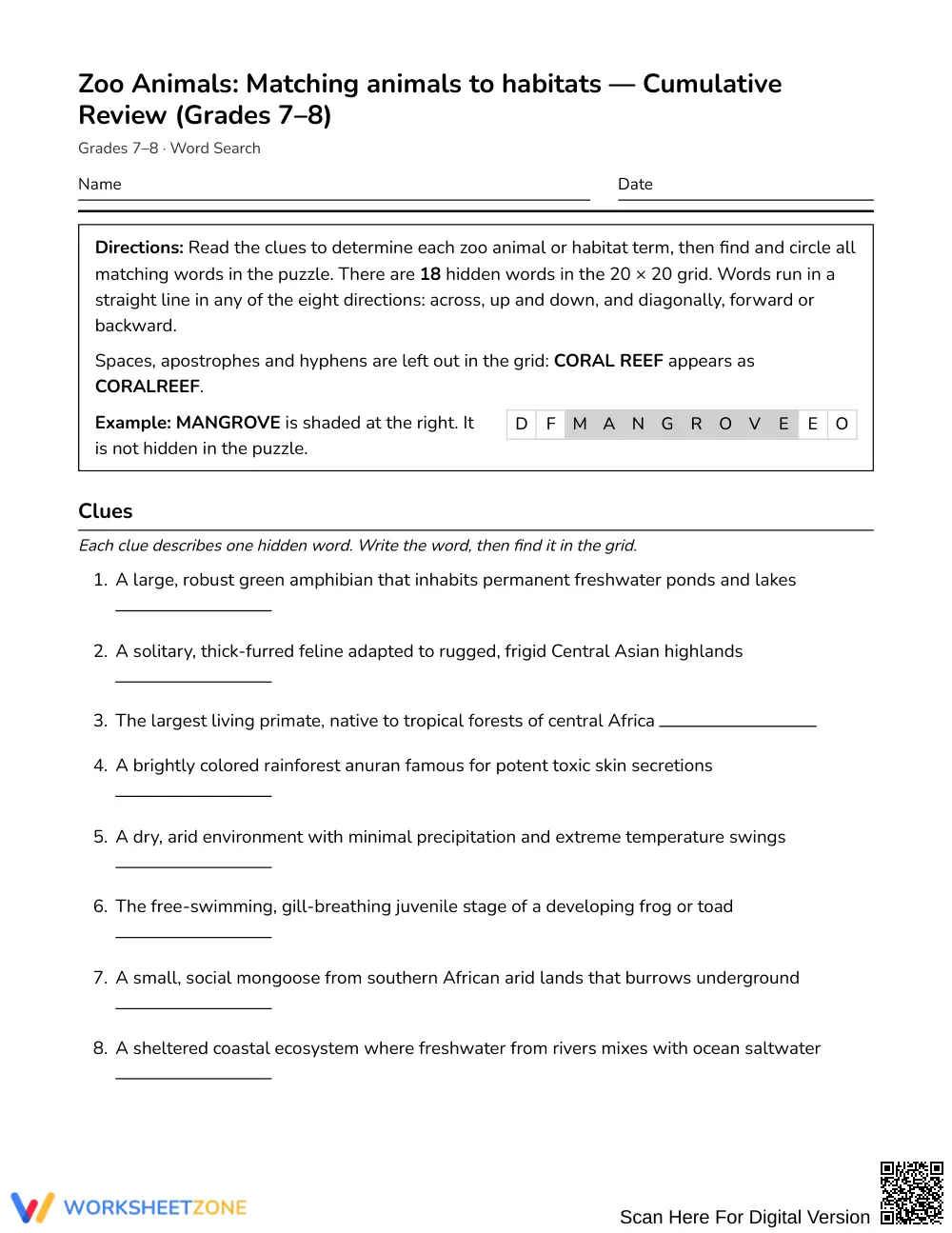
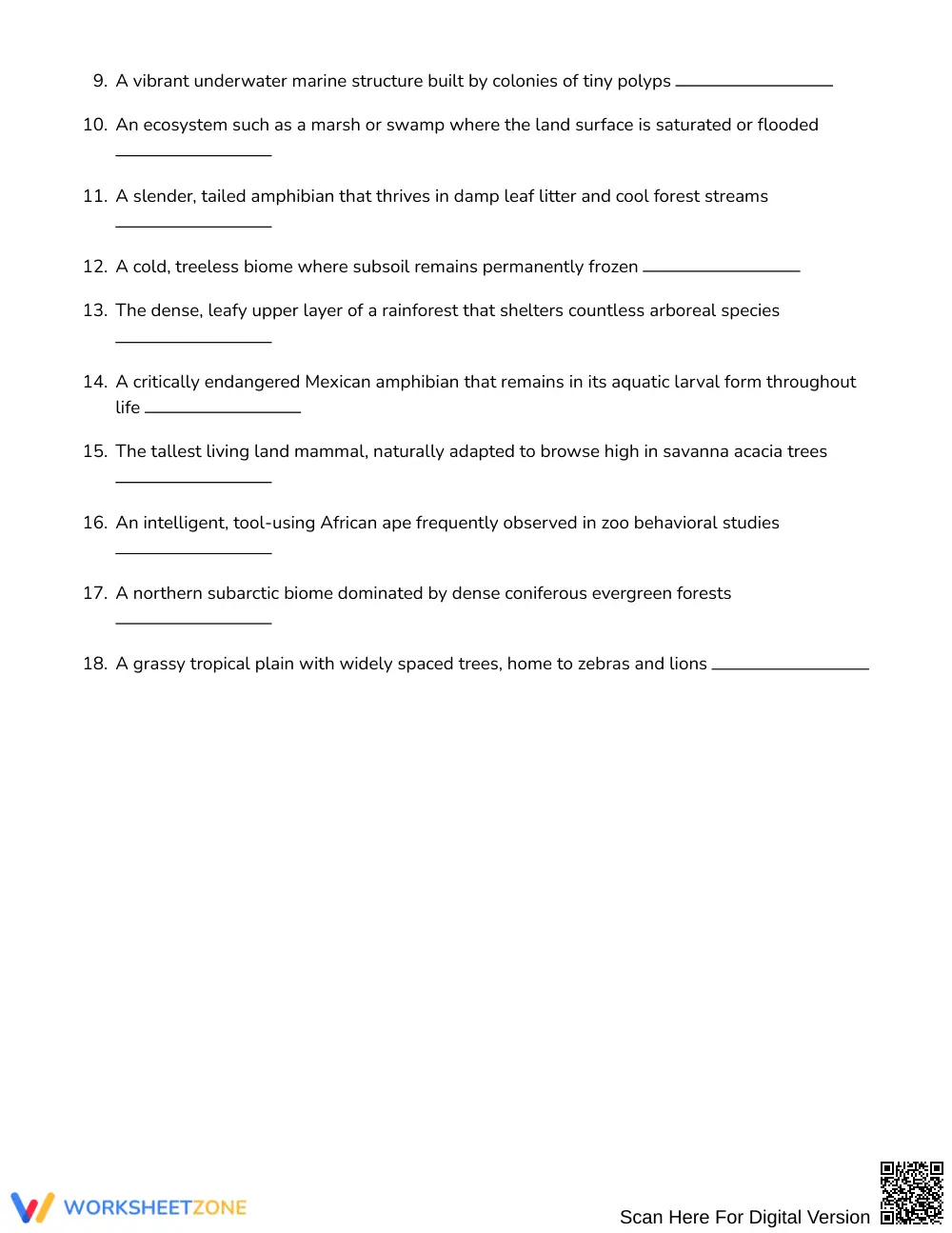
This resource spans 3 student pages accompanied by a comprehensive 4-page answer key. Rather than scanning for an arbitrary list of terms, learners analyze 18 clue-based prompts defining biomes such as savannas, estuaries, taigas, and coral reefs, alongside representative fauna including axolotls, meerkats, and snow leopards. A shuffled word bank provides reference support while requiring learners to read definitions carefully before identifying vocabulary terms within the puzzle grid.
Puzzle Structure and Mechanics
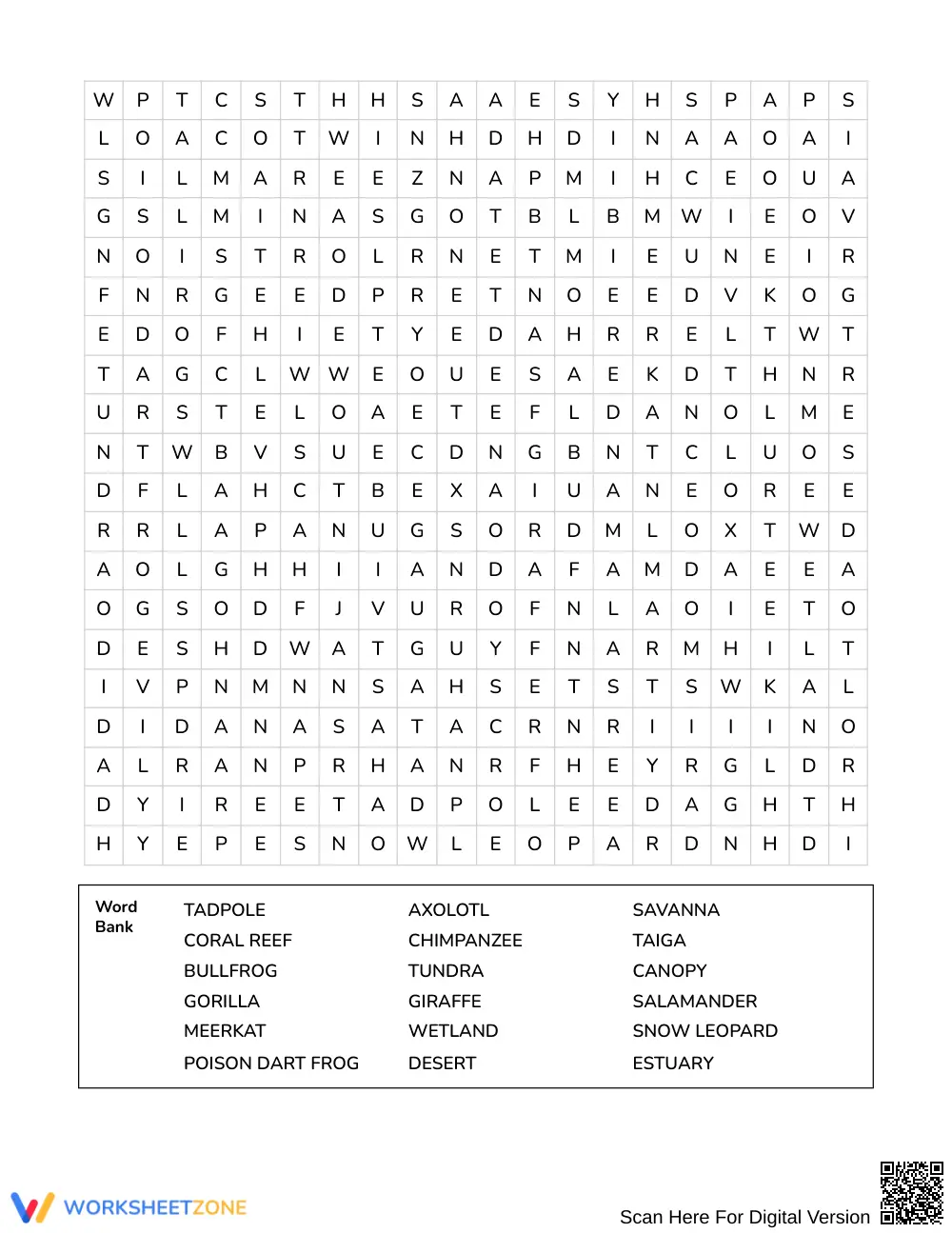
The puzzle is built on a 20 by 20 letter grid designed to engage middle school learners without causing undue visual frustration. Terms are hidden in all eight directions: horizontally, vertically, and diagonally (north, northeast, east, southeast, south, southwest, west, and northwest). Students must connect clue descriptions to corresponding organisms or environments, ensuring active recall rather than passive letter matching.
Standards Alignment
This resource serves as supplemental vocabulary enrichment and is not aligned to a specific state or national content standard. It reinforces general middle school life science terminology by emphasizing organism adaptations, biome structures, and ecological niches across varied ecosystems.
How to Use It
Deploy this word search during cumulative review sessions after completing units on biomes, ecosystems, or animal adaptations. Alternatively, assign it as an independent station during science rotations or as a focused sub plan. During completion, circulate to observe whether students use the descriptive clues to recall terms before referencing the word bank, noting which habitats present conceptual confusion. Expect the activity to take 20 to 30 minutes.
Who It's For
This activity is designed for life science learners in Grades 7–8 who benefit from contextual vocabulary practice. Support emerging bilingual students by highlighting key habitat indicators within each clue, or challenge advanced students to write an adaptation sentence for each animal found. Pair this review with a biomes anchor chart or an interactive food web lesson.
Academic vocabulary acquisition in science requires multiple exposures to domain-specific terminology across varied modalities. According to Fisher & Frey (2014), purposeful word-learning routines that pair conceptual definitions with focused retrieval tasks strengthen long-term schema retention in secondary content classrooms. Rather than isolating terms through rote memorization, contextual clue prompts prompt students to synthesize ecological definitions, biome properties, and animal characteristics simultaneously. This intentional exposure helps learners in Grades 7–8 consolidate critical scientific literacy, reinforcing how organisms interact with specialized environmental niches. When middle school students decipher descriptive clues to identify eighteen ecological concepts, they actively apply structural knowledge, bridging factual recall and semantic comprehension. Integrating structured vocabulary puzzles into life science routines offers an accessible, low-anxiety pathway for deepening content familiarity and sustaining academic engagement across diverse learning environments.


