





























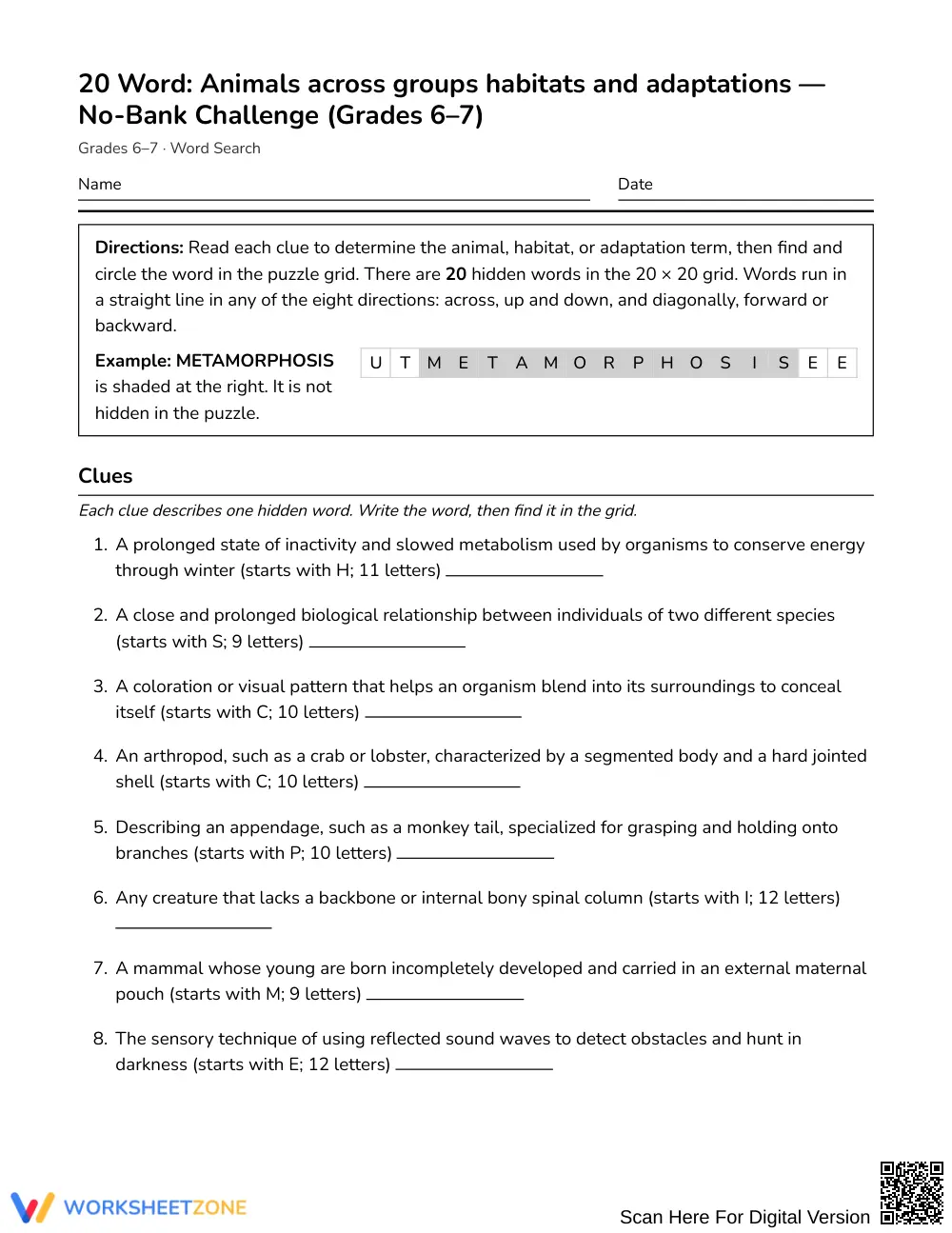


Complete Animal Adaptations Word Search | Grades 6–7 Science

Paste this activity's link or code into your existing LMS (Google Classroom, Canvas, Teams, Schoology, Moodle, etc.).
Students can open and work on the activity right away, with no student login required.
You'll still be able to track student progress and results from your teacher account.
This Grades 6–7 science word search strengthens life science vocabulary by challenging students to identify and locate 20 key terms related to animal groups, habitats, and ecological adaptations. Working from definitions rather than a standard word list, students build active recall and reinforce foundational biology concepts independently.
At a Glance
- Grade: Grades 6–7 · Subject: Science
- Standard: Not standards-assessed — vocabulary enrichment
- Skill Focus: animals across groups habitats and adaptations
- Format: 3 pages · 20 words · Answer key included · PDF
- Best For: Vocabulary review or sub plan
- Time: 25–35 minutes
What's Inside
This 3-page printable activity features a challenging 20-word vocabulary set paired with descriptive biological clues. Rather than relying on a passive word bank, students read accurate scientific descriptions to determine the target vocabulary word before locating it in the puzzle. A complete 4-page answer key provides quick verification of word placement.
Zero-Prep Workflow
The puzzle is built on a dense 20 x 20 letter grid containing hidden vocabulary placed in all eight directions: north, northeast, east, southeast, south, southwest, west, and northwest. Because no word bank is supplied on the student sheet, learners must solve each biological clue first to generate their search terms. Teachers need under 2 minutes of prep to print and distribute the activity, making it exceptionally reliable for guest educators and emergency sub folders.
Standards Alignment
This resource serves as targeted vocabulary enrichment and is not aligned to a specific state or national content standard. It supports foundational scientific literacy across middle school life science units covering ecology, biome diversity, and organism classifications.
How to Use It
Use this puzzle after direct instruction on biomes and animal classifications to consolidate academic vocabulary before a unit assessment. Alternatively, assign it as a high-engagement early finisher task during independent work blocks. During completion, observe whether students can identify vocabulary words directly from the clue descriptions or require reference textbooks to confirm definitions. Expected completion time is 25 to 35 minutes.
Who It's For
This activity is designed for middle school students in Grades 6–7 studying general life science or introductory biology. For differentiated support, pair struggling learners with an illustrated biome anchor chart or textbook glossary to help solve the clue definitions before searching the grid.
Vocabulary acquisition in middle school science requires active retrieval practice to move domain-specific terminology into long-term memory. According to research synthesized by Fisher & Frey (2014), purposeful word-solving routines that require students to connect definitions to conceptual terms significantly deepen content retention compared to passive memorization. This 20-word puzzle strengthens academic language acquisition by requiring students to analyze descriptive biological clues regarding organism classifications, biomes, and physiological traits. By integrating clue deciphering with spatial letter-grid tracking across eight directional pathways, the activity promotes focused cognitive engagement. Teachers can implement this resource as a self-contained reinforcement task that solidifies essential science vocabulary while keeping student engagement high during independent work sessions.


