
































Complete Angle Bisector Worksheet | Grade 10 Geometry

Paste this activity's link or code into your existing LMS (Google Classroom, Canvas, Teams, Schoology, Moodle, etc.).
Students can open and work on the activity right away, with no student login required.
You'll still be able to track student progress and results from your teacher account.
This comprehensive geometry worksheet equips tenth-grade students to master copying angles and constructing angle bisectors using a compass and straightedge. Learners advance from foundational Euclidean procedures to algebraic calculations and formal triangle congruence proofs, developing geometric reasoning and precision required for high school geometry.
At a Glance
- Grade: 10 · Subject: High School Geometry
- Standard:
HSG-CO.D.12— Construct formal angle bisectors and duplicate angles using a compass and straightedge- Skill Focus: Angle bisector and copied angle Euclidean constructions
- Format: 5 pages · 18 problems · Comprehensive answer key included · PDF
- Best For: Compass construction skill practice and formal proof verification
- Time: 45–60 minutes
What's Inside
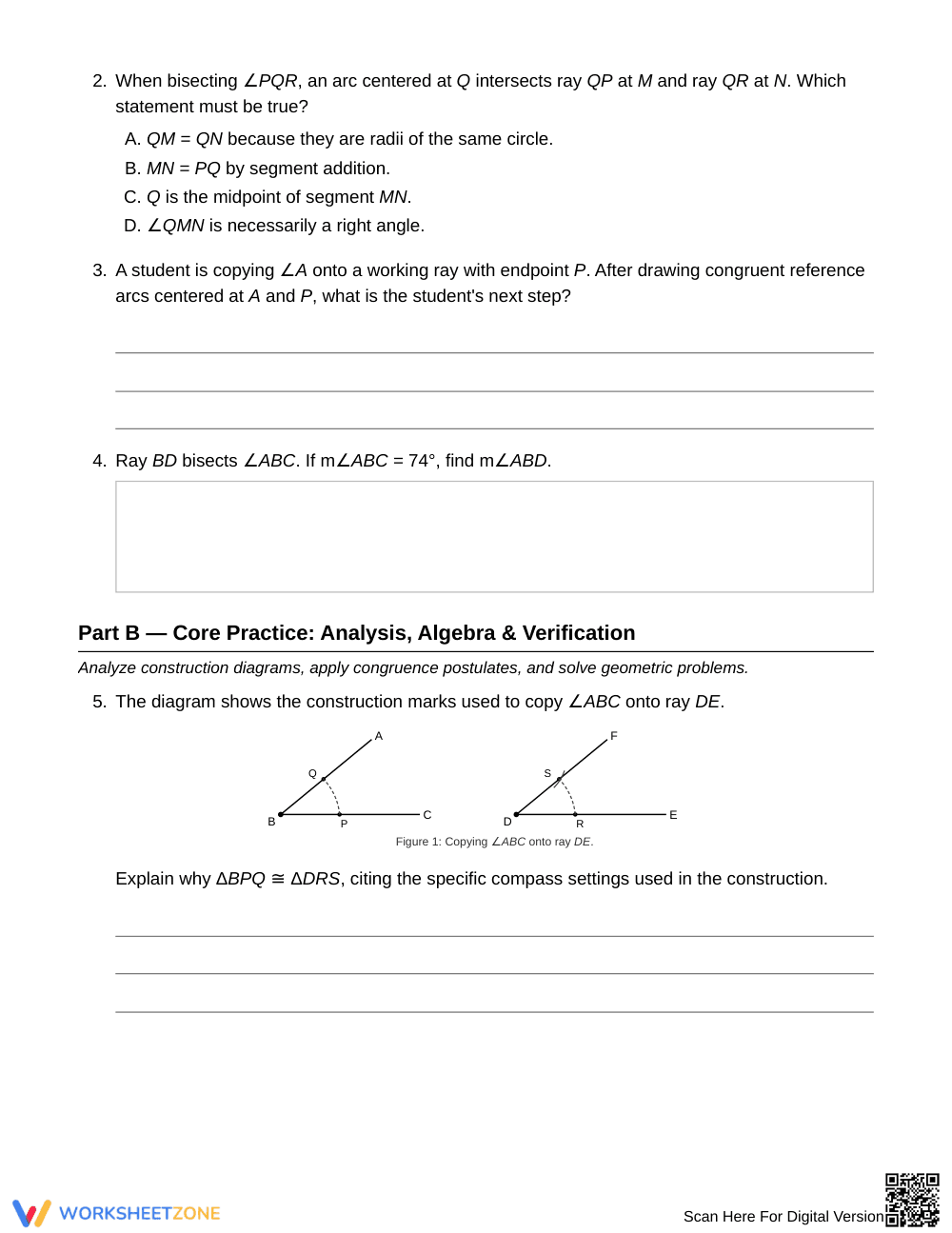
This 5-page printable resource opens with an anchor chart outlining construction steps alongside SSS congruence justifications. The 18 student tasks include multiple-choice conceptual items, compass sequence descriptions, diagram error analysis, algebraic angle equations, coordinate proofs, and a formal triangle congruence proof. A 2-page answer key provides complete solutions, geometric conditions, and full proofs.
Skill Progression
- Guided practice (Part A, 4 tasks): Students identify tool functions, radius properties, and initial steps using an anchor reference table of SSS congruence rationales.
- Supported practice (Part B, 10 tasks): Learners analyze diagrams, identify radius constraints, correct construction errors, and solve algebraic angle equations with moderate scaffolding.
- Independent practice (Part C, 4 tasks): Students work without scaffolds to construct 45-degree angles, calculate angle differences, analyze coordinate bisectors, and write a formal congruence proof.
This sequence mirrors the gradual release model, guiding learners from conceptual recall to independent proof and construction.
Standards Alignment
This worksheet aligns directly with `HSG-CO.D.12`: Make formal geometric constructions with a variety of tools and methods, specifically copying an angle and bisecting an angle. It also supports `HSG-CO.B.8` by requiring students to justify construction validity through SSS triangle congruence. Both standard codes can be copied directly into lesson plans, IEP goals, or district curriculum mapping tools.
How to Use It
Use this resource directly after direct instruction on compass skills for guided classroom practice or assign it across two class periods for reinforcement. As a formative assessment tip, check Part B's error analysis problem to verify whether students recognize that arcs must share equal radii across both rays. Completion takes approximately 45 to 60 minutes.
Who It's For
This resource serves tenth-grade geometry students developing compass construction and proof proficiency. The anchor table supports learners needing step-by-step guidance, while multi-step coordinate problems provide challenge for advanced students. Pair this worksheet with an interactive compass demonstration or an anchor chart displaying SSS congruence proofs.
Aligned to high school geometry standard HSG-CO.D.12, this instructional resource builds student competence in constructing angle bisectors and copying angles using traditional Euclidean compass-and-straightedge methods. Grounded in the instructional frameworks identified by Fisher & Frey (2014), the five-page packet moves learners systematically through a graduated sequence of 18 tasks. Students start by identifying tool functions and arc properties, progress to diagram analysis and algebraic angle calculations, and culminate in autonomous multi-step constructions and formal SSS congruence proofs. Incorporating visual construction diagrams and error-analysis prompts, the materials reinforce CPCTC relationships while requiring rigorous geometric justifications. By bridging physical compass manipulation with formal deductive logic, this curriculum-ready worksheet provides secondary mathematics educators with structured formative practice and verifiable mastery evidence. The included two-page solution key delivers explicit step sequences and algebraic checkpoints, making it an essential resource for standards-aligned geometry instruction.


